
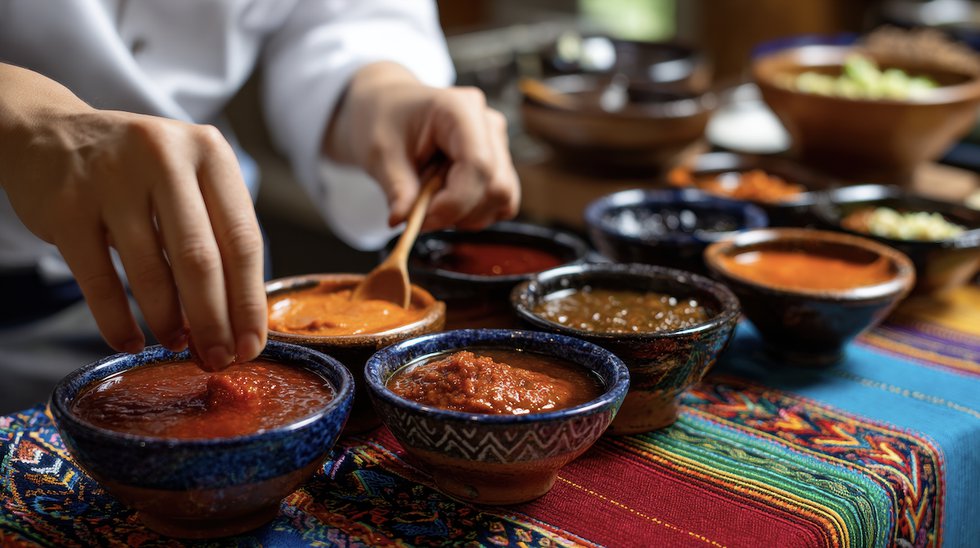
Most Mexican restaurants have basic salsas they serve with the chips they offer — and many don’t veer far from those few recipes. But should they? Are there benefits to experimenting with creative new salsa recipes?
To answer those and other questions, Editor Kathleen Furore reached out to Darryl Holliday, whose recipe for Smoky Oaxacan Charred Cucumber & Jobo Salsa (prepared in the kitchen at Simple Culinary Solutions in Rogers, Arkansas)won first place in el Restaurante’s 2025 Sassiest Salsa Contest sponsored by Sammic.

Darryl Holliday
Here, Holliday shares his thoughts with el Restaurante readers.
Should restaurants move beyond the “standard” salsas? What are the benefits?
They absolutely should. The classic rojo, verde, and pico de gallo are foundational, but when every restaurant serves the same three profiles, salsa becomes background noise rather than a point of distinction or an educational moment about where the chef/owner claims heritage.
Creative salsas allow a restaurant to express its identity. They communicate regional influence, seasonal thinking, and the chef’s philosophy far more directly than almost any other element on the table. From a business perspective, they also:
- Differentiate the brand in a crowded market
- Create a memorable first impression before the entrée ever arrives
- Increase perceived value without major food cost increases
- Encourage repeat visits through novelty and discovery.
Salsa is one of the lowest-risk, highest-impact areas for innovation in Mexican- and Latin- inspired cuisine.
How should a chef begin innovating beyond long-standing recipes?Is there a process?
The best starting point is to stop thinking of salsa as “tomato + onion + chile” and start thinking in terms of structure:
Every great salsa balances these six elements:
- Heat: Fresh, dried, smoked, or fermented chiles
- Salt: Table salt, infused/smoked/salt-cured ingredients, fermented vegetables, or leftover brine
- Acid: Lime, citrus, vinegars, or fermented components
- Sweetness: Fruit, roasted vegetables, honey, piloncillo, etc.
- Body: Nuts, seeds, avocado, legumes, or puréed vegetables
- Aromatics: Herbs, alliums, spices
A practical creative process involves several steps:
- Choose a nontraditional base: roasted carrot, charred pineapple, tamarind, beet, mango, pumpkin seed.
- Select a heat source with a distinct character: guajillo, pasilla, chile de árbol, morita, habanero, etc.
- Layer acid and sweetness intentionally, not automatically.
- Adjust texture to match the dish: chunky, emulsified, creamy, or fluid
- Finish with a defining aromatic note.
- Build in small bench-top batches, taste frequently, and evaluate the salsa, not only alone, but on the protein or dish it’s meant to support.
Are there any ingredients that are popular right now when it comes to salsas? What are some current trends and creative directions that chefs are taking?
Several movements are influencing modern salsa work:
- Smoked and fermented profiles: chipotle, morita, fermented chile pastes
- Fruit-forward heat: pineapple-habanero, mango-serrano, guava-chile
- Seed- and nut-based salsas: pipián, sesame, peanut-chile blends
- Global crossovers: yuzu-lime, tamarind-ginger, miso-chile, gochujang-adobo
- Herb-driven green salsas beyond tomatillo: cilantro, parsley, hoja santa, mint
Chefs like Enrique Olvera (Pujol) and Gabriela Cámara (Contramar), and modern regional taquerías across the United States are treating salsa as a composed sauce, not a condiment — often building multiple house-made salsas for each menu item rather than a single generic table salsa.
How can restaurants that use prepared salsas transform them into a “signature” house product?
Using a prepared base isn’t inherently wrong; the mistake is leaving it unchanged. Restaurants can elevate commercial salsas by:
- Roasting or charring fresh vegetables and blending them in
- Adding fresh citrus, zest, or specialty vinegars
- Incorporating fresh herbs or toasted spices
- Layering in a secondary chile for complexity
- Adjusting texture with puréed roasted peppers, nuts, or seeds
Even small additions, such as a splash of specialty vinegar or mezcal, a touch of smoked chile, a spoon of roasted garlic purée, or fresh lime and cilantro, can transform a standard product into something distinctly house-made, while preserving consistency and labor efficiency. Salsa should taste like it belongs to that restaurant, not to a distributor’s catalog.
However, most Americans have come to expect the standard salsa that hits the table with chips when they first walk in, and restaurants shouldn’t turn a blind eye to this profile. However, offering a second flavor, or better yet, a rotating salsa flight, can boost ticket sales slightly and allow for creativity as well as reduce food waste.
Click here to go to the next article, The Chains are Shrinking: 2026 Mexican Multiunit Report