
Josefina Rodríguez Zamora
By Alfredo Espinola
In the northern Mexican state of Coahuila, desert landscapes, mountains, and open horizons tell stories that began long before humans learned to cultivate grapevines. Today, this extraordinary natural heritage coexists with a winemaking tradition that has found in the region a source of identity and an opportunity to attract travelers interested in discovering more than just a destination.
The experience has a name of its own: Vinos y Dinos, a route that connects two of Coahuila’s greatest treasures: its wines and the paleontological heritage that reveals the lives of the dinosaurs that inhabited this region millions of years ago.
The experience offers a different way to explore the state. Here, a visit to a winery can become the start of a journey through Earth’s history; a glass of wine can spark curiosity about the landscape that made its production possible; and each stop offers a new perspective on the region’s cultural, natural, and productive richness.
It is an invitation to discover Coahuila through its contrasts: the patient work of those who cultivate the vines set against the immensity of geological time; traditions passed down from generation to generation set against the vestiges of a life that existed millions of years ago.
A region where wine has deep roots
The story of Vinos y Dinos begins in a land that holds a special place in the development of Mexican winemaking.
Coahuila has around 40 registered vineyards, 22 of which are open to the public. These vineyards offer visitors the chance to experience different expressions of winemaking, discover contrasting landscapes, and learn about the work behind each bottle.
One of the highlights of this tour is Parras de la Fuente, a town renowned for its winemaking tradition and for being home to Casa Madero, founded in 1597 and considered the oldest winery in the Americas.
But the history of Coahuila’s wine is not limited to its historical roots. In the state, the unique conditions of each region, the microclimates, and the diversity of its landscapes have contributed to the development of a range of offerings that spans from long-established wineries to projects exploring new possibilities for winemaking.
Parras, Arteaga, Saltillo, General Cepeda, and Ramos Arizpe are all part of this wine tourism experience. Each area offers a distinct setting for exploring wine and understanding the relationship between the land and those who work it.
Among the wineries and wine-producing estates that are part of the route are Casa Madero, Viñedos Don Leo, Bodega Rivero González, and BarroViejo, in the Parras region; Bodega Los Cedros and Bodegas del Viento, in Arteaga; Guidova, in the Sierra de Arteaga; Hacienda Florida, in General Cepeda; Vino San Juan de la Vaquería, in Saltillo; as well as Vinícola Rancho El Fortín, Hacienda El Marqués, and Vinícola Parvada.
Each contributes, through its own history and unique offerings, to showcasing the diversity of the state’s winemaking industry.
During a working tour of Coahuila, Josefina Rodríguez Zamora, Mexico’s Secretary of Tourism, accompanied by Cristina Amezcua González, the state’s Secretary of Tourism, visited various sites that reflect the state’s tourism potential, including the Guidova vineyard.
The visit highlighted the value of an offering that integrates wine with other regional attractions. The goal is to expand the reasons to visit Coahuila and offer experiences that bring travelers closer to the state’s nature, cuisine, culture, and communities.
However, what sets this route apart is that the experience doesn’t end when you leave the vineyard.
When Wine Meets Dinosaurs
The idea behind “Wines and Dinos” is as simple as it is fascinating: to capitalize on two heritage elements that, although belonging to radically different eras, share the same setting.
On one hand, there are the vineyards, where knowledge, climate, and human labor combine to transform grapes into wine. On the other, the fossils and paleontological sites, which allow us to reconstruct the history of the species that inhabited the region long before the first wine-growing communities existed.
Approximately 72 million years ago, during the Cretaceous period, parts of what is now Coahuila had environmental conditions very different from those of today. The region was part of a landscape featuring coastal environments and a biodiversity that left its mark on the fossil remains discovered over time.
It is this historical depth that gives meaning to the route.
To connect these two worlds, the project incorporated dinosaur replicas in the participating vineyards, representing species whose remains have been found in Coahuila. The result is an experience that adds an educational and visual component to the wine tourism visit, while sparking the curiosity of audiences of all ages.
The initiative allows visitors to move from contemplating the landscape to exploring its past. The land ceases to be merely the place where vines grow and becomes, instead, a natural archive that preserves traces of other eras.
Much of the appeal of “Wines and Dinos” lies in this convergence. It is not simply a matter of bringing together two eye-catching themes, but of establishing a connection between the region’s current productive identity and the natural heritage that defines it.
For those seeking unique experiences, the route offers an opportunity to discover Coahuila from a perspective that combines tourism, science, gastronomy, and culture.
Saltillo: A Window into Millions of Years of History
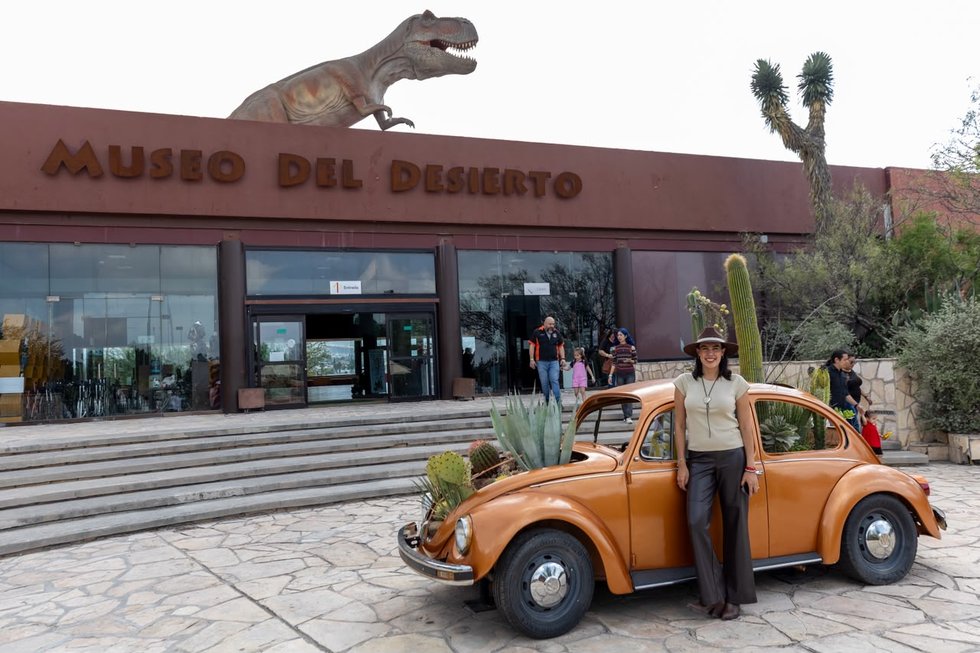
To understand the paleontological dimension of this experience, a must-see stop is the Desert Museum in Saltillo.
This museum offers a closer look at the evolution of life, introduces visitors to the dinosaurs that once inhabited the region, and explores the biodiversity of desert ecosystems. Its exhibits help place paleontological findings within a much broader historical context: that of the geological and biological changes that shaped the region.
More than just a complement to the route, the Desert Museum provides the keys to understanding why Coahuila’s natural past is one of its greatest attractions.
In this way, Wines and Dinos expands on the traditional wine tourism experience. The journey isn’t limited to visiting a winery or tasting its wines—it also invites you to discover the natural context that makes the region unique.
Two Itineraries, Multiple Landscapes
Coahuila’s vast geographical expanse allows the route to encompass a wide variety of settings. The vineyards are scattered across desert areas, valleys, and mountainous regions, where environmental conditions give each landscape its own distinct character.
Broadly speaking, the route can be understood through two major environments: the desert and the mountains.
The desert route features plains, geological formations, fossil remains, and historic wineries. In this part of the region, the landscape invites you to pause and observe how time has shaped the land.
The mountain route, on the other hand, leads to higher-altitude regions, temperate forests, and vineyards surrounded by mountainous landscapes. Arteaga and its surroundings offer a different perspective on Coahuila, where the vegetation, elevation, and climatic conditions add new nuances to the experience.
This diversity is one of the most interesting aspects of Coahuila’s wine tourism. Visitors do not encounter a single wine-growing landscape, but rather a succession of settings that allow them to discover the state’s geographical breadth.
The tour also offers the opportunity to complement visits to wineries with culinary experiences, cultural activities, and encounters with local communities. In this way, wine serves as a common thread that ties together different aspects of regional life.
A glass of wine, millions of years of history
Some destinations are remembered for their landscapes. Others, for their cuisine or the history preserved in their streets. Coahuila offers the chance to combine all these experiences into a single journey.
In its vineyards, visitors discover the work of those who cultivate the vines, craft the wines, and keep alive a tradition that is part of the history of Mexican winemaking. In its museums and paleontological sites, they encounter traces of a distant world that continues to raise questions about the evolution of life and the transformation of the planet.
“Wines and Dinosaurs” invites you to explore this region with a broader perspective—one that recognizes that wine does not exist in isolation but is part of a relationship between the land, the climate, knowledge, and the people who inhabit it.
In Coahuila, the past and the present share the same landscape. Wineries tell stories of tradition, hard work, and evolution; fossils reveal a much older chapter, written millions of years before the first bottle left a winery.
And perhaps that is the greatest virtue of Vinos y Dinos: reminding us that behind every landscape there is a story and that, sometimes, a single glass of wine is all it takes to begin discovering it.