
By Alfredo Espinola
The first impression came not through the palate, but through the aroma.
Before the glasses were raised and the chocolate touched the tongue, the air was already filled with the scent of roasted cocoa, sweet spices, and notes of ripe fruit. Within the walls of MUCHO (the Chocolate Museum)—a space dedicated to preserving the memory and culture of Mexican cacao—an experience was beginning that promised much more than a pairing: a conversation between two of the finest expressions of the Mexican land.
The evening brought together Viñedo San Miguel—recognized as Winery of the Year 2026 by the Mexican Sommeliers Association—and the ancestral world of cacao to explore how wine and chocolate, born of different lands, could find common ground in a shared language of aromas, textures, and emotions.
The soft lighting seemed to invite us to slow down. To observe. To smell before tasting.
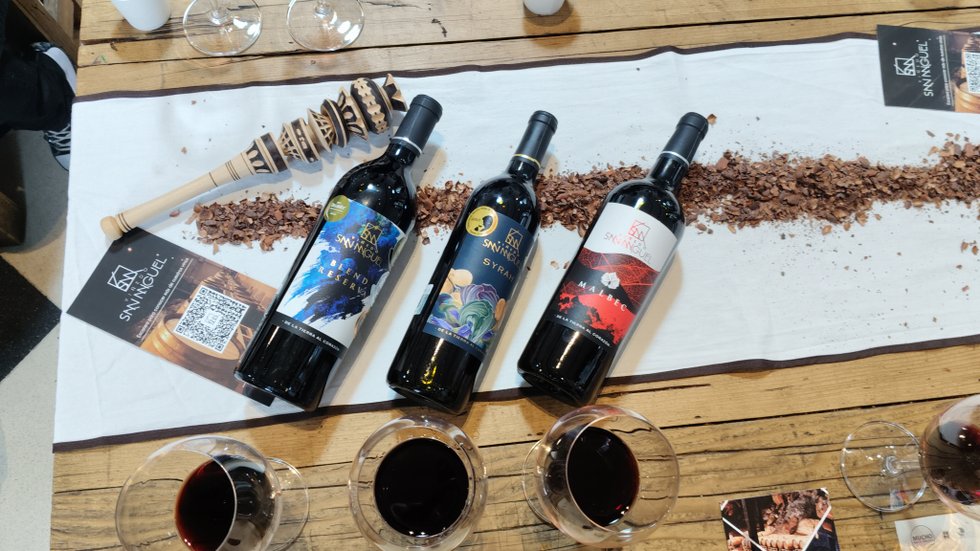
The first glasses revealed the personality of three of the winery’s iconic wines: an elegant Blend Reserva, an expressive 2023 Syrah, and a Malbec with a vibrant character. Opposite them, four artisanal chocolates awaited like landscapes waiting to be discovered.
The journey began in Veracruz.
The Zococolco 70% cacao presented itself with a serene intensity. Its aroma evoked damp wood, freshly cracked seeds, and a subtle hint of nuts. Upon tasting, the chocolate unfolded slowly, leaving a lingering, enveloping sensation. Then came the Blend Reserva. The pairing transformed both profiles: where there had once been isolated notes, new layers of flavor emerged, as if each sip were awakening hidden corners of the cacao.
Next, the journey led to Tabasco, the cacao heart of Mexico, responsible for a large part of the country’s production. There, cacao ceases to be merely a crop and becomes part of the landscape, tradition, and family heritage.
The Cunduacán Mestizo, from the La Chontalpa region, offered a deeper, earthier expression. Its profile evoked the richness of tropical soil after the rain, while the Syrah added freshness and contrast. Each pairing seemed to tell a different story of the same territory.
The experience reached one of its most evocative moments with the Selva Zoque 70% cacao, made with beans from Teapa, Tabasco. It revealed jungle-like nuances, an almost vegetal aromatic intensity, and a sensation that evoked the humidity of the mountains, the shade of the trees, and the very origin of the cacao. The pairing with the Malbec did not seek to dominate those nuances, but rather to accompany them, allowing each element to find its own space.
The evening unfolded amid conversations, discoveries, and brief silences—those moments of quiet that arise when a flavor takes you by surprise and leaves you pausing for a few seconds.
Then came the final creation.
A truffle made with Syrah wine. Small in size, immense in experience.
The velvety smoothness of the chocolate melted with the wine’s fruity and spicy notes until the boundary between the two worlds dissolved. The texture enveloped the palate while the aromas lingered for long moments. It was an elegant finale, yet also an emotional one: a demonstration that great pairings are built not solely on technique, but on affinity.
Beyond the glasses and the tastings, the event revealed something essential: the extraordinary potential of Mexican products when they engage in dialogue with one another. The wine carried with it the expression of its vineyards; the chocolate, the memory of the cacao-growing regions that for centuries have cultivated one of the most iconic ingredients of our history.
When the last truffle was gone and the last glass was empty, no one was talking about pairings, cocoa percentages, or tasting notes anymore. We were talking about territory. About identity. About pride. Because beyond the senses, the true star of the evening was Mexico. A Mexico that expressed itself through cacao, soared through wine, and reminded us that the deepest stories aren’t told with words—they’re tasted.