
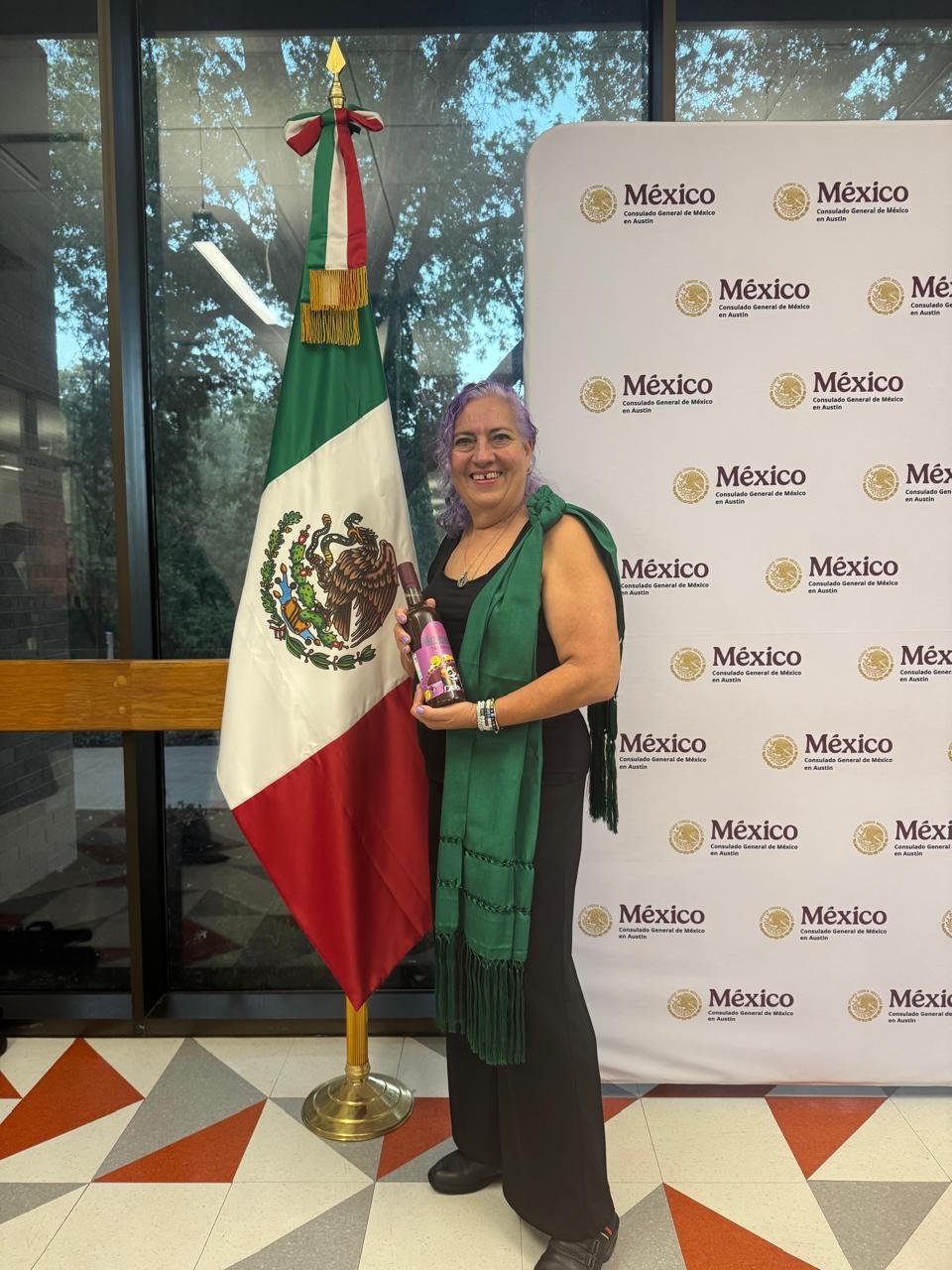
Laura Ibarra
By Alfredo Espinola
In the world of Mexican spirits, where tequila and mezcal have gained international recognition, there is a drink that is beginning to make its mark with a personality all its own: raicilla. Native to Jalisco and with a tradition dating back several centuries, this artisanal spirit is piquing the curiosity of those seeking to discover new flavors and experiences.
Behind Don Mariano, a raicilla brand produced in Mascota, Jalisco, stands Laura Ibarra Borrajo, an entrepreneur who entered this industry almost by chance but who has now turned the project into much more than a business: it is a commitment to a region’s identity, an opportunity for growth, and, above all, a way to keep her family’s legacy alive.
From Discovering Raicilla to a Business Venture
A computer engineer by training, Laura has been involved in the beverage industry for years. Before venturing into raicilla, she developed Fiesta Mexicana, a brand of sangrita and cocktails made with hibiscus, tamarind, and chamoy, available in both alcoholic and non-alcoholic versions.
Her participation in various trade missions, alongside institutions such as the Ministry of Economy, the municipality of Zapopan, and the Mexican consulates in Houston and Austin, allowed her to explore new markets and hear a recurring question: Why not also market a Mexican spirit?
Between tequila and mezcal, Laura found an alternative that piqued her interest: raicilla, a lesser-known product with a very distinctive character.
The opportunity arose during a visit to Mascota, Jalisco, where she and her husband, Manuel Magallanes, attended a festival dedicated to this drink. There, they met the producers, learned about its characteristics, and had the chance to taste it.
The experience was decisive. Both saw raicilla as a product with potential and decided to take a chance on it.
That’s how Don Mariano was born—a brand that’s now in its fourth year and has begun to receive international recognition. Among its accolades are a gold medal won in Chile in 2024, a silver medal at the Brussels Competition in 2025, and, in 2026, a double gold medal and the award for best raicilla at Latin American Wine & Spirits.
For Laura, these awards represent much more than just medals: they are confirmation that their initial bet was well-founded and that they are working with a high-quality product.
What makes raicilla different?
Although it shares certain production processes with tequila and mezcal, raicilla has characteristics that set it apart. Its identity is determined primarily by the agaves used and the geographical conditions of the regions where it is produced.
Its designation of origin, recognized in 2019, encompasses 16 municipalities in Jalisco and Bahía de Banderas, in Nayarit.
One of its distinctive features is that there are two main varieties: coastal raicilla and highland raicilla. Each develops different flavor profiles as a result of the agaves, climate, soils, and natural conditions of its environment.
On the coast, Agave angustifolia and Agave rhodacantha are primarily used, while in the highlands, Agave maximiliana, Agave inaequidens, and Agave valenciana are employed.
This diversity is directly reflected in the taste. Raicillas from the highlands typically feature herbal, citrus, and fruity notes, while those from the coast may offer more saline and mineral profiles.
Don Mariano raicilla is produced in Mascota, Jalisco, under the guidance of Manuel Salcedo, a renowned producer in the region.
Its alcohol content falls within the typical range for this category, between 35 and 45 degrees. The Don Mariano expression is 40 degrees.
Laura emphasizes that one of the greatest appeals of this spirit is the naturalness of its production processes and its connection to its environment. Some of the agaves used can take around ten years to mature, as their propagation from seed requires a longer process.
It is precisely this relationship between the land, time, and the producers’ expertise that gives raicilla its own distinct identity.
A spirit seeking its place in the international market
Despite its history and qualities, raicilla still faces the challenge of gaining recognition. For Laura, the main obstacle isn’t necessarily acceptance of the flavor, but rather getting more consumers to take the plunge and discover a drink that remains unknown to a large part of the market.
Her experience at tastings has been encouraging. Those who try Don Mariano are often surprised by its smoothness and herbal notes, which leave a pleasant sensation on the palate.
However, turning that first impression into a purchase still requires work.
For over two years, the brand has had the necessary paperwork in order to export to Texas and has conducted promotional activities in Houston and Austin. At some tastings, the public’s response has been very positive, although sales haven’t yet reached the pace Laura would like.
For her, every interaction represents an opportunity. She knows that introducing a little-known spirit into a market accustomed to tequila and mezcal requires patience, persistence, and consumer education.
Along this path, mixology can become a great ally.
Raicilla offers interesting versatility when paired with fruits, tropical ingredients, and other flavors. Laura has found that when combined with hibiscus, tamarind, or chamoy, it retains its personality and adds a distinctive character to the drinks.
She also follows with interest the initiatives of other producers who are developing ready-to-drink beverages and canned cocktails made with raicilla.
However, she does not believe its future depends on becoming a mass-market spirit. On the contrary, she believes its value lies precisely in preserving its special character.
She envisions it as a drink for those who enjoy discovering products with a distinct identity, learning about their origins, and appreciating what lies behind each bottle.
The Role of Women in a Traditionally Male-Dominated Industry
Women’s participation in the Mexican spirits industry has gained ground, and raicilla is no exception.
Laura is a member of the Mexican Council for the Protection of Raicilla and the Mezcal Agave Women’s Council, forums where she has met women involved in different stages of the production chain.
There are women agave growers, master raicilla makers, and entrepreneurs who actively participate in the preservation and promotion of this beverage.
Although she acknowledges that this is an industry where men still make up the majority, she also highlights the openness she has encountered within the council and its willingness to include and listen to women’s proposals.
Her inclusion was almost a natural consequence of the recognition she began to receive with Don Mariano. After participating in various competitions, members of the council approached her to invite her to join the organization.
That’s when she discovered a community of producers and people committed to keeping the raicilla tradition alive.
For Laura, being part of this community has been an enriching experience and an opportunity to better understand the cultural and economic value of the drink she decided to market.
The Future: Growing Without Losing the Essence
When Laura imagines what raicilla will be like in ten years, she doesn’t necessarily picture a drink found in every bar around the world. Her vision is different: she envisions it as a spirit with an international presence, recognized for its quality and appreciated by consumers seeking unique experiences.
There are already producers taking their brands to markets as diverse as Thailand, New Zealand, and Europe. For her, this is a promising path: perhaps it’s not about achieving high production volumes, but rather about ensuring that raicilla finds a place in different parts of the world.
She’s also confident that bartenders will eventually discover the possibilities of this spirit.
In fact, Don Mariano is already featured in cocktails at a restaurant in Houston. During several tastings in the United States, Laura has seen how bar professionals experiment with the drink and discover combinations they could hardly achieve with other spirits.
Her message to them is simple: you have to dare to try it.
Raicilla has personality, character, and a story that deserves to be told. It doesn’t need to imitate any other drink to find its place.
Don Mariano: A Bottle That Holds a Love Story
But there’s a reason why this brand holds a meaning that goes far beyond its commercial offering.
Don Mariano is named after Laura’s father-in-law. However, the family story behind the project centers on Manu, her son, who passed away in July 2021.
His passing marked a turning point in Laura’s life and that of her family. From then on, they found in the creation of the Más Bosque Manu Foundation a way to transform their grief into a cause that could help others.
The foundation works with volunteer paramedics who provide support on weekends in the Bosque de La Primavera, in Jalisco, to treat and rescue accident victims.
The project requires resources, organization, and constant commitment. Laura explains that she and her family have covered a large portion of the expenses while they seek different ways to sustain this work.
Among these are her brands: Fiesta Mexicana and Don Mariano.
Laura shares that the revenue generated by her products goes toward supporting the foundation. In this way, every bottle carries a purpose that transcends the act of simply drinking a beverage.
During our conversation, I asked her with whom she would share a glass of raicilla if she could turn back time and sit down at a table with two glasses and her bottle.
Her answer was immediate: with Manu.
She would have loved to share this project with him, talk about what they’ve accomplished, and dream together about everything that might still be to come. She recalls that her son was a visionary and that he actively participated in other family projects, especially in developing the cocktails and at the distillery.
An unexpected sign
Laura recalls an anecdote she cherishes deeply. During her first visit to the raicilla festival in Mascota, a cyclist approached her at the hotel and told her that he had gone for a ride with Manu just a week before his passing.
She was so overcome with emotion that she couldn’t even ask who he was. Later, they discovered he was one of the cyclists who had accompanied her son on a route through Nevado de Colima—a route that Manu had created.
The next day, a woman approached Laura to thank her for sending the cyclists to buy raicilla. She hadn’t sent anyone; someone had simply told them that Manu’s mom wanted them to get to know and buy the product.
A love story that transcends every bottle
Laura acknowledges that entrepreneurship has been a journey of intense emotions. There are days of enthusiasm and strength, but also moments when exhaustion and nostalgia weigh heavier than expected. Throughout this journey, the support of her husband and daughters has been essential.
And perhaps that is where the true essence of Don Mariano lies.
Because behind every bottle lies a story of tradition, hard work, and a family that decided to keep moving forward. There is a woman who is committed to a spirit that is still finding its place in the world, who believes in the producers of her homeland, and who has found in entrepreneurship a way to keep a cause alive.
Raicilla has a long way to go. Perhaps its growth won’t be immediate or spectacular, but, as Laura seems to have learned throughout this experience, some of the most valuable things take time to find their place.
And as Don Mariano begins to win over new palates, it also carries with it something no medal can measure: the love and memory of Manu.