
By Alfredo Espinola
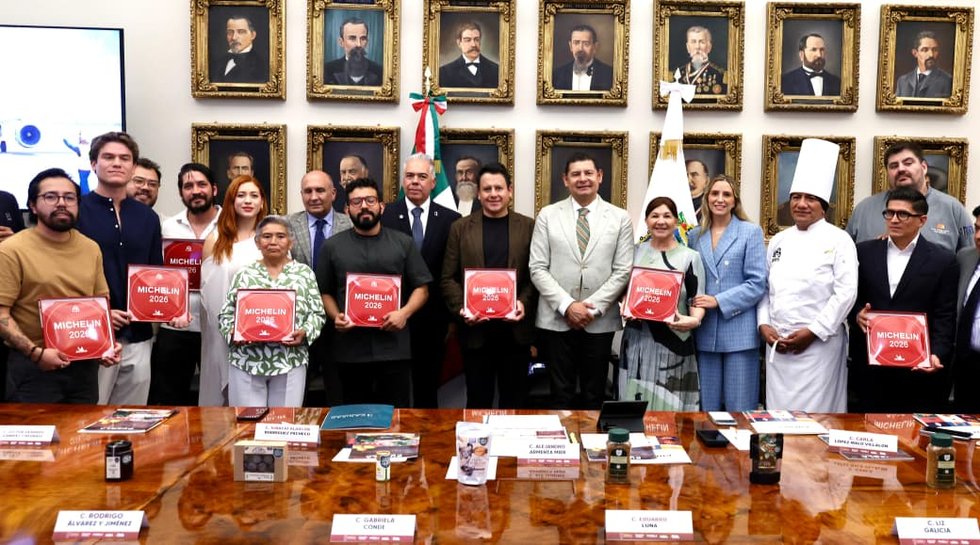
PUEBLA, Puebla, July 22, 2026. Puebla’s cuisine has once again taken a prominent place on the national culinary map. At a ceremony celebrating culinary talent, tradition, and innovation, Governor Alejandro Armenta Mier presented plaques of recognition to the 14 restaurants in the state that were included in the 2026 MICHELIN Guide Mexico, a distinction that confirms Puebla as one of the country’s most prominent culinary destinations.
More than just an acknowledgment of individual establishments, the ceremony was a tribute to a culinary tradition that has spanned generations. Each honored restaurant represents a story of dedication, identity, and respect for the ingredients that have shaped one of Mexico’s most iconic cuisines.
Accompanied by the Secretary of Tourism Development, Carla López-Malo Villalón; the national president of the National Chamber of the Restaurant and Seasoned Foods Industry (CANIRAC), Ignacio Alarcón Rodríguez Pacheco; and the president of CANIRAC Puebla, Juan José Sánchez Martínez, the governor reiterated that gastronomy is one of the strategic pillars for strengthening tourism and showcasing the state’s cultural richness to Mexico and the world.
During his remarks, Alejandro Armenta emphasized that Puebla’s cuisine does more than just nourish: it tells stories, preserves collective memory, and expresses the identity of a people who have successfully transformed their recipes into living heritage. He acknowledged the daily efforts of chefs, traditional cooks, restaurant owners, and producers who have made Puebla a culinary benchmark whose influence transcends borders. He also emphasized that such distinctions drive tourism development, strengthen the local economy, and create opportunities for thousands of families in Puebla.
For his part, Ignacio Alarcón Rodríguez Pacheco stated that the inclusion of 14 restaurants from Puebla in the 2026 MICHELIN Guide Mexico confirms the state’s extraordinary culinary quality. He noted that this achievement is the result of the talent, discipline, and passion of those who elevate the prestige of Puebla’s cuisine every day, as well as the joint efforts of government authorities and the private sector to establish Puebla as a leading national culinary destination.
Similarly, the Secretary of Tourism Development, Carla López-Malo Villalón, emphasized that the inclusion of these restaurants in the MICHELIN Guide represents much more than international recognition. It is a celebration of the work of cooks, chefs, restaurateurs, and producers who preserve recipes, ingredients, and techniques that are part of the state’s cultural identity, while strengthening one of Puebla’s most important tourism sectors.
The distinguished establishments reflect the diversity and richness of Puebla’s culinary scene. In the Bib Gourmand category, which recognizes establishments offering excellent quality at affordable prices, the following were recognized: Cultivo, Moyuelo, Casareyna, Jacinto y Yo, El Güero Marinero, Vica, Los Camellos, and Semitas Beto. Meanwhile, Augurio, Casa Baccuza, Mural de los Poblanos, La Noria, Salón Mezcalli, and Valiente were included in the selection of restaurants recommended by the 2026 MICHELIN Guide Mexico.
Each of these establishments represents a distinct way of telling Puebla’s story through flavors: from traditional cuisine that preserves the legacy of generations to contemporary offerings that reinterpret the culinary heritage without losing its essence. Together, they showcase the gastronomic dynamism that sets the state apart today and continues to spark the interest of domestic and international travelers.
In line with the national tourism promotion strategy spearheaded by the Government of Mexico, the State Government, through the Secretariat of Tourism Development, reiterated its commitment to continue strengthening culinary tourism, promoting the talent of Puebla’s restaurateurs, and establishing Puebla, The Heartbeat of Mexico as a destination internationally recognized for the excellence of its cuisine, the richness of its traditions, and the authenticity of its cultural identity.