
By Alfredo Espinola
When you enjoy a glass of good wine, you probably know that there’s a difference between a white wine glass and a red wine glass, and if you’re a sophisticated drinker, you know much more. But not long ago the relationship between a quality wine glass and the drinking experience was not as well known. And in Mexico, which has enjoyed a growing reputation for world-class wine, that knowledge came even later.
Pablo Behar, the founder of Kristalov, is largely responsible for that new understanding.
Years of observation, experience, and a rare sensitivity for spotting opportunities where others saw only everyday objects drove Behar to found Kristalov in 2000. He didn’t create the company merely to sell glasses; he wanted to transform the way Mexican wine was experienced, served, and appreciated.
But that story began much earlier.
From childhood, Pablo Behar grew up surrounded by glass. His father ran a company specializing in flat glass, where mirrors, table tops, and windows were part of the everyday landscape.
In 1985, Behar joined the family business and took charge of the crystal trophy division—it was there that he began to develop the skill that would define his entire career: seeing what the market was not yet able to see.
Selling trophies took him to schools, companies, and trade shows. There he discovered that Mexico lacked a formal industry dedicated to this segment and realized there was ample room for innovation. Promotional product exhibitions became an unexpected showcase where distributors began requesting decorative pieces made of crystal.
It was then that a concern arose that would change the course of his career.
Major international wine and spirits brands—Hennessy, Buchanan’s, and many others—were investing enormous resources in building prestige around their labels. However, that effort was often accompanied by glasses and decanters whose quality did not match the value of the product they contained. The contradiction was evident. The vessel did not live up to the contents.
Behar decided to investigate.
A trip to Spain in 1998 marked a turning point. While visiting his trophy distributor in Spain, he discovered a world virtually unknown to the Mexican market. Before him were not mere glasses; they were pieces designed to interact with the wine, enhance its aromas, and transform the experience of whoever held them in their hands.
That visit changed his perspective.
He realized there was a profound difference between conventional glass and fine glassware. It wasn’t just a matter of transparency or elegance. It was technology, precision, and knowledge applied to an object whose importance had been underestimated for decades.
His connections with European distributors allowed him to import the first collections to Mexico. Very soon, wine and spirits companies discovered the value of pairing their bottles with engraved glasses that elevated the consumer experience and reinforced their brand identities.
Meanwhile, something equally important was beginning to take place within the country.
In the late 1990s, Mexican wine began a quiet transformation. Wineries invested in better vineyards, adopted technology, professionalized their processes, and began competing with international labels. Sommeliers, winemakers, and consumers spoke with increasing enthusiasm about the quality achieved by domestic wines.
However, there was a paradox. This evolution came to a halt the moment the wine was served. Carefully crafted bottles reached tables where they were tasted in glasses designed for another era, for other markets, or simply to serve a utilitarian purpose. The experience remained incomplete.
Pablo Behar realized then something that seems obvious today, but that very few people could perceive 25 years ago: Wine never ends in the bottle.
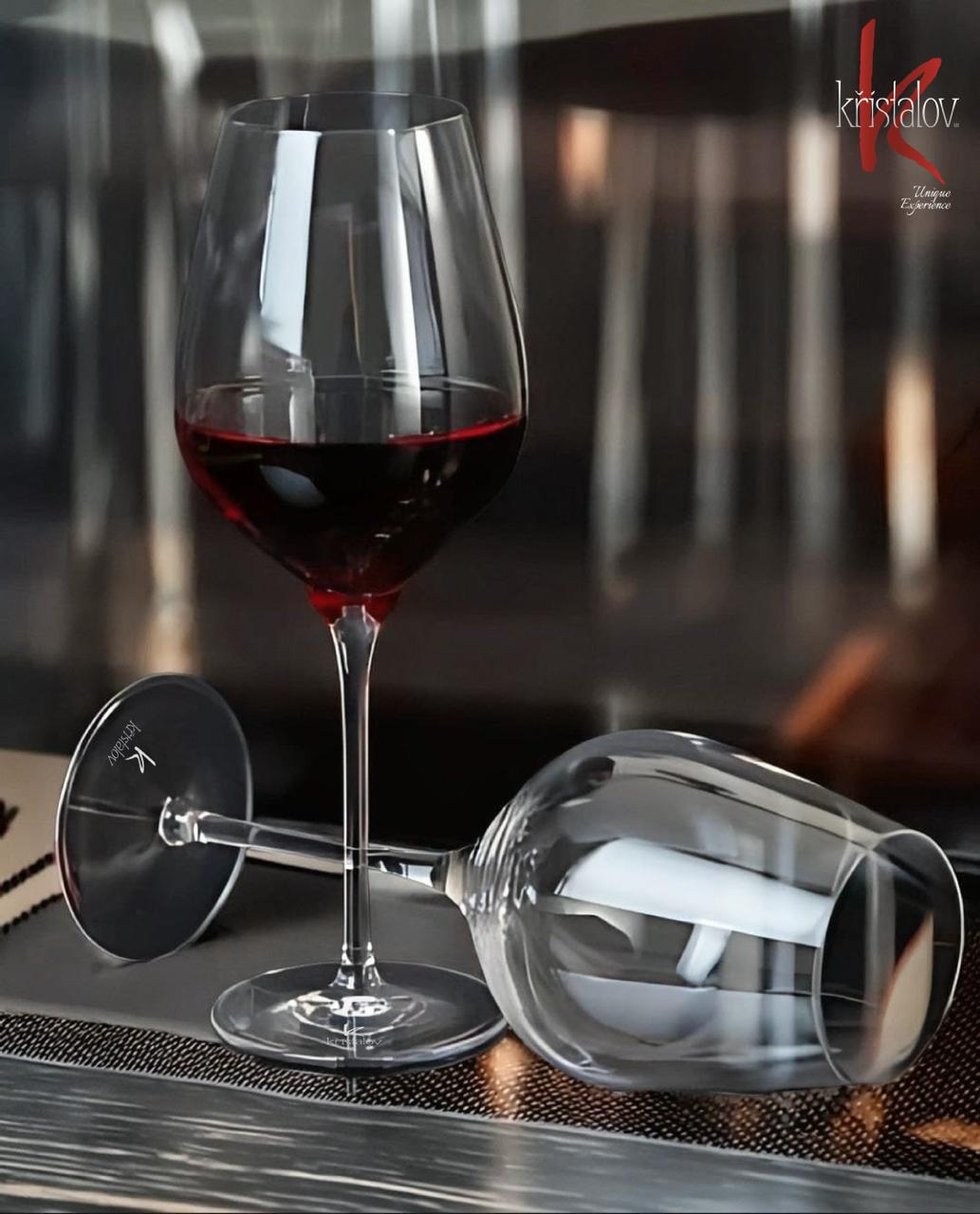
It continues in the crystal that concentrates the aromas, in the shape of the bowl that directs the liquid toward the palate, in the balance of the stem that supports the glass, and in that delicate architecture capable of revealing nuances that would otherwise remain hidden.
The glass ceased to be an accessory; it became an essential part of the experience, and from that conviction, Kristalov was born.
The Glass as a Language
When Kristalov opened its doors in 2000, the market offered a simple path: compete on price. Many companies viewed glassware as a high-volume product—a vessel intended solely to fulfill its function.
Pablo Behar chose a different path. While others sold glasses, he decided to craft experiences; the difference seemed subtle, but it would ultimately redefine the company’s place within the industry.
Each design had to answer a specific question. How do aromas travel? How does the opening of the bowl influence aeration? What happens when the rim alters the wine’s first contact with the palate? Beauty was important, yes, but never enough. Aesthetics had to serve the experience.
Thus, the glass ceased to be a decorative object and became a sensory tool.
Anyone who has served the same wine in different glasses immediately understands that the glass is not a passive bystander. Its geometry alters the concentration of aromas, directs the liquid toward different areas of the mouth, and changes the way the brain interprets flavors, textures, and aromas. What many consider a design detail is, in reality, the final link in a process that begins years earlier, in the vineyard.
Behar understood that behind every great wine lay a chain of knowledge that deserved to reach the consumer intact; that is why Kristalov never worked in isolation.
The company began engaging with sommeliers, winemakers, chefs, and specialists who offered a different perspective on the act of serving. Each conversation opened up new possibilities. It wasn’t just about crafting more elegant pieces, but about translating decades of research into an everyday object that anyone could hold in their hands.
The questions multiplied.
How does the diameter of a glass influence the aromatic expression of a Cabernet Sauvignon? What happens when a spirit strikes the perfect balance between oxygenation and concentration? To what extent can a few millimeters alter the perception of a wine?
Little by little, Kristalov began to develop its own philosophy: to first listen to those who understood the beverage before considering the vessel that would hold it.
In an industry where tradition often takes precedence over innovation, the company decided to invest in technologies capable of raising quality standards. It incorporated lead-free crystal with titanium, a material that combined strength, lightness, and exceptional transparency without sacrificing elegance.
It was no small decision. It meant investing before the market demanded it and committing to a long-term vision when many continued to prioritize immediate solutions.
Over time, that decision confirmed something Behar had understood from the very beginning: excellence is rarely the result of chance. It is the outcome of hundreds of unseen decisions.
The crystal began to speak for itself.
Its lightness was surprising. Its brilliance remained intact after countless uses. Its durability defied the notion that delicacy always implies fragility.
New wineries were beginning to write the history of regions that had until then remained off the wine map. Winemakers returned from Europe with knowledge that revitalized traditional practices. The nation’s gastronomy found new ways to engage with domestically produced wines, while specialty restaurants, sommelier schools, and food festivals solidified a culture that just a few decades earlier had seemed distant.
Kristalov accompanied this movement without seeking the limelight.
Every glass placed on a table represented a silent statement of confidence in Mexican talent. It was a way of saying that wines produced in the country deserved to be enjoyed according to the same standards as the great international labels.
The company not only observed the industry’s growth—it grew alongside it—and, in many ways, also helped drive it forward.
A Legacy Not Measured in Glasses
For more than two decades, the company has faced the challenges inherent to any organization committed to growth: technological transformations, economic crises, changes in consumer habits, and increasingly global competition. However, if one thing sets Pablo Behar’s journey apart, it is the conviction that solid companies are not built by responding to the urgency of the present, but by anticipating the future.
Every single conversation with experts, every process refined, and every innovation incorporated added up to small, almost imperceptible victories. Viewed in isolation, they seemed like minor details; taken as a whole, they ultimately built a brand capable of competing on the international stage.
Recognition came as a natural consequence.
Becoming the official glass of the Brussels World Competition in 2024 was recognition from an industry accustomed to valuing even the smallest detail, where precision allows for no compromises and quality becomes a universal language.
It was not merely a badge of honor for Kristalov; it was a sign of maturity for a Mexican company demonstrating that innovation can also emerge far from the major European capitals traditionally associated with wine culture.
Today, Mexican wine is experiencing one of the most exciting chapters in its history; new wineries are emerging in regions that, just a few decades ago, seemed unlikely candidates. Consumers are showing growing curiosity about the origins of wine labels, understanding grape varieties, and discovering the work behind each vintage. Mexican cuisine, recognized worldwide for its richness and creativity, finds in domestic wines a natural ally in continuing to build its identity.
In this context, glassware ceases to be merely an accessory and becomes part of the story.
Contemporary hospitality understands that a memorable experience never depends on a single element. The lighting, the service, the tableware, the wine’s temperature, and the glass all participate in the same conversation. Everything communicates, and when every detail harmonizes, the memory lingers long after the final toast.
Kristalov has successfully interpreted this evolution.
But perhaps its greatest contribution lies in helping to shape a different kind of consumer.
One who is better informed, more curious, and more willing to discover that behind a glass lies design, science, and knowledge—because a glass seems like a simple object… until someone explains why it has that particular shape.
And Kristalov, in turn, quietly changed the way thousands of people understand wine, because a great wine can move you from the very first sip, and when paired with a great glass, it is able to tell its entire story.