
By Alfredo Espinola
At times, Jorge Solís speaks as a CEO. At others, he speaks as a passionate lover of the countryside, a champion of Mexican wine, and, above all, as a man deeply aware that great accolades never belong to just one person.
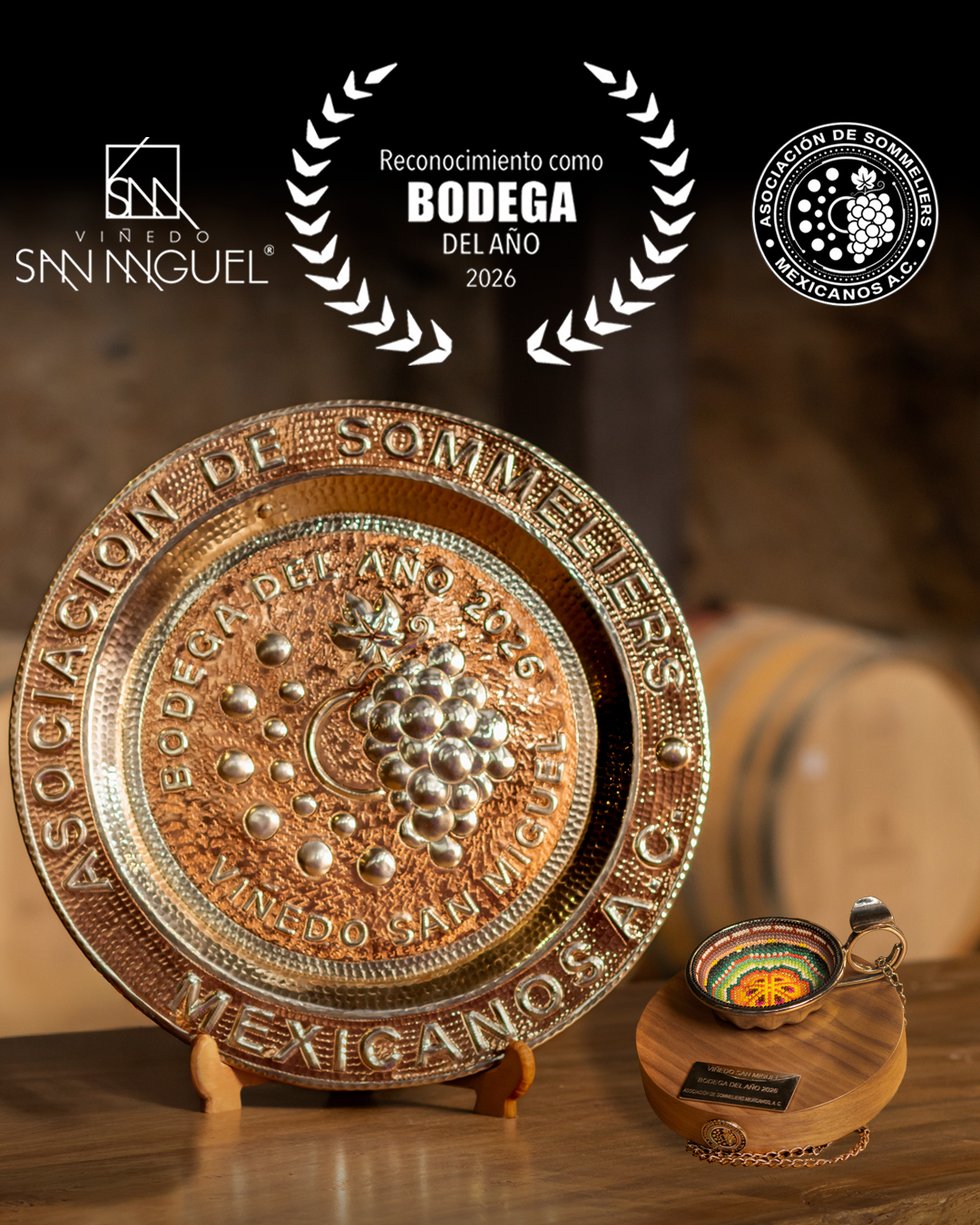
The news arrived just as the accolades that truly matter do: after years of quiet work, difficult decisions, memorable harvests and others not so much, early mornings in the vineyard, and long days in the winery. On June 3, Viñedo San Miguel was named Winery of the Year by the Mexican Sommeliers Association—an honor that goes beyond the quality of its wines to become a recognition of a work philosophy, a shared vision, and a project that has established itself as one of the most important leaders in the nation’s wine industry.
For Jorge Solís, CEO of Viñedo San Miguel, the recognition has a very clear meaning.
“It’s not a matter of arrogance or conceit,” he states calmly. “It’s recognition of many years of effort, hard work, and, above all, our people.”
And that is precisely where the story of this Guanajuato winery begins.
The Human Factor Behind a Great Winery
In an industry accustomed to celebrating labels, medals, and scores, Solís insists on looking elsewhere: toward the people. The more than 90 employees who make up Viñedo San Miguel represent, in his view, the true heart of the project.
From those who work the land to those who welcome visitors during wine-tasting tours; from the winemaking team to the culinary offerings that now set the winery apart, everyone is part of the same value chain.
“There are no results without a team,” he asserts with conviction.
The comparison he uses is revealing. Just as no great sports star succeeds without the support of a solid team, neither can a winery achieve excellence solely through a great label or a great winemaker. Excellence, he explains, is built collectively.
And that philosophy has paid off.
In addition to its recent recognition as Winery of the Year, Viñedo San Miguel has earned significant international and national accolades, including awards for its wine tourism offerings and multiple medals in some of the world’s most prestigious competitions.
Mexican Wine on the World Stage
For Solís, one of the greatest challenges facing Mexican wine lies not within the country, but outside it.
“The competition isn’t among us,” he notes, referring to domestic wineries. “The competition lies with the major international producers who come to Mexico with centuries of history behind them.”
His vision breaks with the traditional logic of competition among local producers. He believes that the Mexican wine industry must strengthen itself through collaboration, understanding that collective growth will benefit everyone.
Mexico, he acknowledges, remains an emerging region compared to historic wine powerhouses. However, he observes a significant shift: Mexican consumers have begun to look at their own wines with growing interest and pride.
Quality, he asserts, is no longer the exception but the norm.
“We must break the paradigm that Mexican wine was inconsistent or of low quality. Today, consumers are discovering that there is enormous talent behind our bottles.”
That is why he insists on an idea that seems to be becoming a statement of principle: “The Mexican industry must grow stronger by standing united.” And the results seem to prove him right.
The medals won by Viñedo San Miguel in international competitions such as the Brussels World Wine Competition or Decanter are not merely individual triumphs. They are also signs that Mexican wine has begun to carve out a place in the global conversation with ever-greater legitimacy.
Guanajuato: An Identity of Its Own
To speak of Viñedo San Miguel is also to speak of Guanajuato.
Located 1,850 meters above sea level, its vineyards have helped establish an increasingly recognizable winemaking identity: wines with high natural acidity, depth, structure, and a gastronomic profile.
For Solís, the Bajío region offers exceptional conditions for producing complex, balanced wines with great aging potential.
“They are deep, food-friendly, well-rounded wines with plenty of fruit,” he describes.
But if he had to sum up Viñedo San Miguel’s identity in a single characteristic, he doesn’t hesitate:
“We are very honest about the wine’s identity.”
That honesty translates into varietal wines that clearly express their origin and personality, without seeking to imitate international styles or follow fleeting trends.
The New Generation of Mexican Wine
One of the most significant developments in the winery’s recent evolution has been the addition of winemaker Alejandra Cordero, a native of Chihuahua who trained in Spain and represents a new generation of Mexican talent.
With international experience and a solid scientific background, Cordero brings a combination that Solís considers essential: technical rigor and creative sensitivity.
“She’s a great Mexican talent,” he says. “And we are deeply proud that it is a woman who is helping to build the future of our wines.”
Her arrival also reflects a broader transformation within the industry: the growing participation of women in a sector historically dominated by men.
The Future: Consolidating a Vision
Twelve years after planting its first vineyards, Viñedo San Miguel is entering a new stage of maturity.
The 2026 vintage is shaping up to be one of the most promising in the winery’s history. At the same time, the project is making progress in the international consolidation of its labels, the strengthening of its wine tourism offerings, and the expansion of its brand positioning.
Recent results seem to confirm the progress made so far: a Grand Gold at the Brussels World Wine Competition, multiple international medals, and, now, recognition as Winery of the Year by the Mexican Sommeliers Association.
However, for Jorge Solís, the real challenge is just beginning.
“We’re not looking to compete with other Mexican wineries,” he says. “We want to represent Guanajuato with dignity and demonstrate that Mexican wine can measure up to any great wine region in the world.”