
Jose Manuel Alarcon
David Quevedo Olvera
By Alfredo Espinola
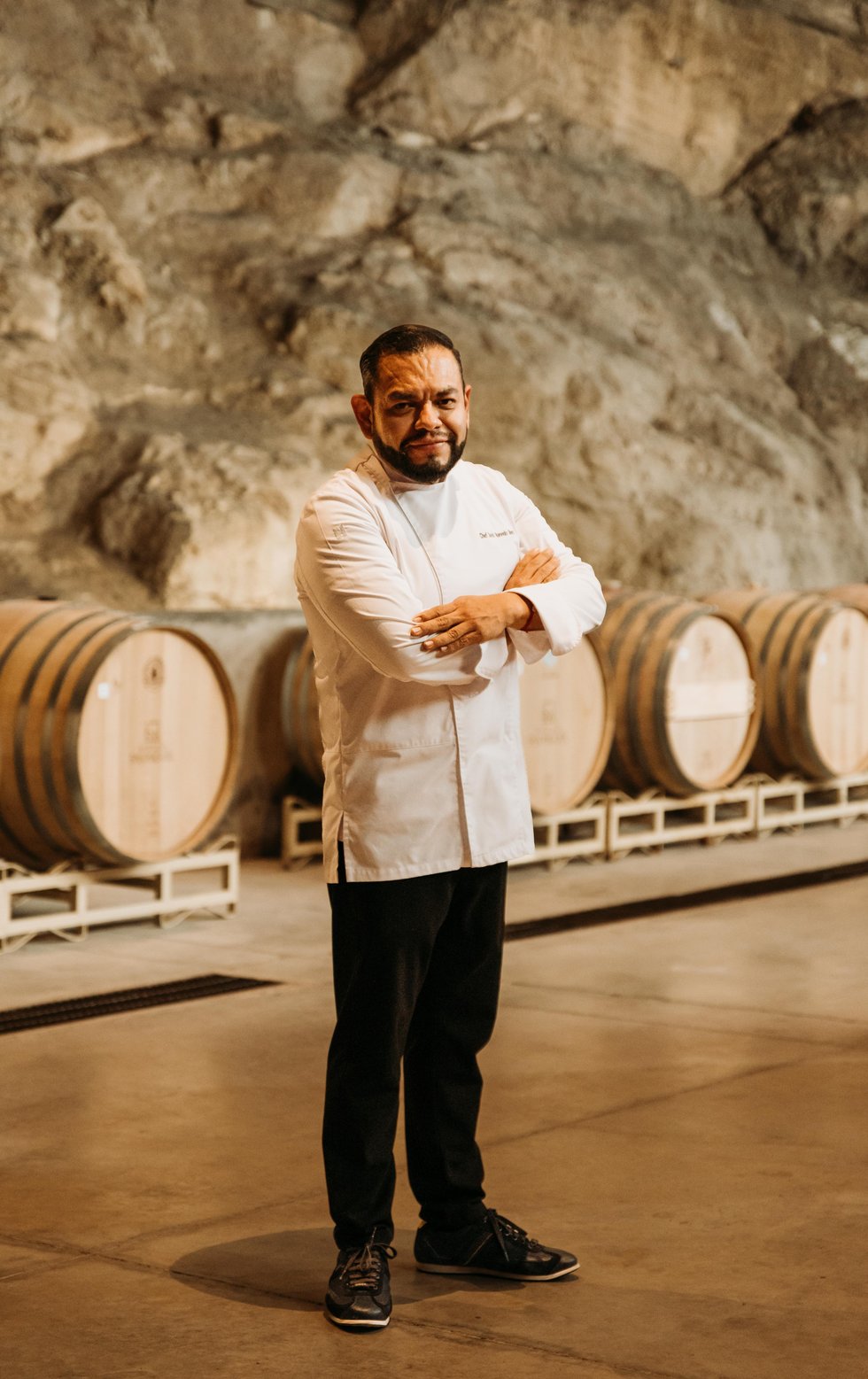
In a vineyard kitchen, time is measured differently. Not by the clock, but by the patience of the fire, the aging of the wine, and the memory of flavors. There, amid vineyards and long silences, Chef David Quevedo Olvera, current executive chef at Viñedo San Miguel in San Miguel de Allende in Mexico, crafts a culinary experience that isn’t just cooked—it’s remembered.
The moment when a calling changed course
“I’ve loved gastronomy for as long as I can remember,” he says matter-of-factly, as if that certainty had always been there, waiting for its moment. Before dedicating himself to cooking, he studied dentistry in León, Guanajuato. Two full years. A seemingly secure path.
But his passion persisted. It was during that time that a course, almost by accident, ended up defining everything. “That’s when I discovered that my passion wasn’t dentistry; it was gastronomy.”
The change wasn’t easy. Back then, studying cooking didn’t have the recognition it does today. For his family, it was a sudden turn, hard to understand. For him, however, it was a decision he has never regretted.
Over the years, he even found a curious connection between the two disciplines.
“Later, when I studied in Spain, I realized I had studied two very similar fields. One works with the mouth, with the senses, with the taste buds… the other does too. It all goes through there.”
The First School: Home Cooking
Before any university, there was the family table. His parents were teachers, not cooks, but cooking was part of the daily ritual. Weekends held special significance: the time to gather around home-cooked meals.
“Watching my mother cook, seeing that joy in making food for the family, was what shaped me. I would imitate her, make things for my siblings… without realizing it, that’s where it all began.”
From that domestic memory arose a conviction that today defines his cuisine: Gastronomy is not just technique; it is culture, history, and affection.
Spain, Mexico, and Learning the Trade
After studying gastronomy, his training continued in Spain in 2011, where he completed a specialization that broadened his perspective on the craft. He worked in Aranjuez, at Chef Rodrigo de la Calle’s restaurant, and later returned to Mexico to continue his journey in various kitchens. Mexico City, Guanajuato, León, and finally the vineyards.
For six years he worked at Caminos de Vinos, a vineyard in Guanajuato. Working there introduced him to the world of wine and to cuisine rooted in the land. In 2021 came the opportunity to join Viñedo San Miguel in San Miguel de Allende, a place where culinary excellence is part of its identity.
“San Miguel is a challenge. It’s a gourmet city, a city of haute cuisine. Coming here meant starting something new, but also proving what I can do.”
Trasiego; tradition transformed into signature cuisine
At the Trasiego restaurant, the chef’s concept stems from a clear idea: traditional Guanajuato cuisine as the starting point.
For more than 17 years, he has traveled through communities, learned from traditional cooks, and studied techniques born of necessity, not luxury.
“Guanajuato cuisine is a cuisine of survival. It was born in times of war, when people had to eat without being seen, using whatever was at hand. It is a cuisine of the countryside, of insects, of ancient techniques… but full of history.”
That tradition isn’t replicated exactly as it is. It transforms.
“I respect the origin, I respect the ingredient, but my job as a chef is to turn it into an experience. So that the diner doesn’t just eat, but remembers what they tasted.”
That’s why he defines Trasiego’s cuisine as signature cuisine with traditional roots: dishes that preserve the essence but are presented with a contemporary flair.
The taco that conquered the world
One of the defining moments of his career came in 2021, when he won the International Tapas Championship in Europe, after having taken first place in Mexico.
The dish he competed with was, on the surface, simple: a ceremonial taco filled with confit rabbit.
But there was history behind it. The chef brought together two traditions of Guanajuato: Otomí and Chichimeca cuisine. From the Otomí people, he took the ceremonial tortilla, stamped with wooden seals passed down through generations. From the Chichimeca, the technique of cooking underground, used to avoid smoke during times of war. The result was a bite that encapsulated culture, resilience, and memory.
“I wanted the judges to taste Mexico in two bites.”
The taco was presented atop a figure of La Catrina, a symbol chosen to explain to Europeans the Mexican relationship with death.
“It’s not a taboo. It’s tradition. We eat with our dead; we live alongside them. That, too, is Mexico.”
The jury, composed of Michelin-starred chefs, awarded first place.
Raising the flag on that stage, he recalls, was one of the most intense moments of his life.
Cooking Mexico for the World
Throughout his career, he has represented Mexican cuisine in Germany, Spain, Japan, Ecuador, the United States, and at various international events. On every occasion, he follows one rule: bring Mexican ingredients whenever possible.
“The chili peppers that arrive in Europe don’t taste the same. I prefer to bring our own, even if it’s more complicated.”
He also adjusts the heat, cleaning the chili peppers to reduce the intensity while preserving the flavor.
The intention is clear: “I want people to taste authentic Mexican cuisine, not Tex-Mex. I want them to understand that our cuisine is culture, history, and identity.”
Cooking in a vineyard; the challenge of pairing
Working within a vineyard changes the way you think about cooking.
Here, every dish must converse with the wine. “Wine reveals flavors that aren’t noticeable on their own. That’s why I first study the wine, taste it, understand it… and then create the dish.”
The biggest challenge, he acknowledges, is achieving balance.
“Being in a vineyard is like being in the cathedral of wine pairing. Everything has to work together.”
The future; taking Trasiego further
After a career that includes competitions, travels, and accolades, his goal is not to stop.
He wants to take Trasiego’s cuisine abroad. To show that Guanajuato’s tradition can speak the same language as any haute cuisine in the world. Because, in the end, his approach always comes back to the same place: memory, origin, the story that can be told on a plate.
“Traditional cuisine has magic. My job is to respect it… and to help people experience it.”