
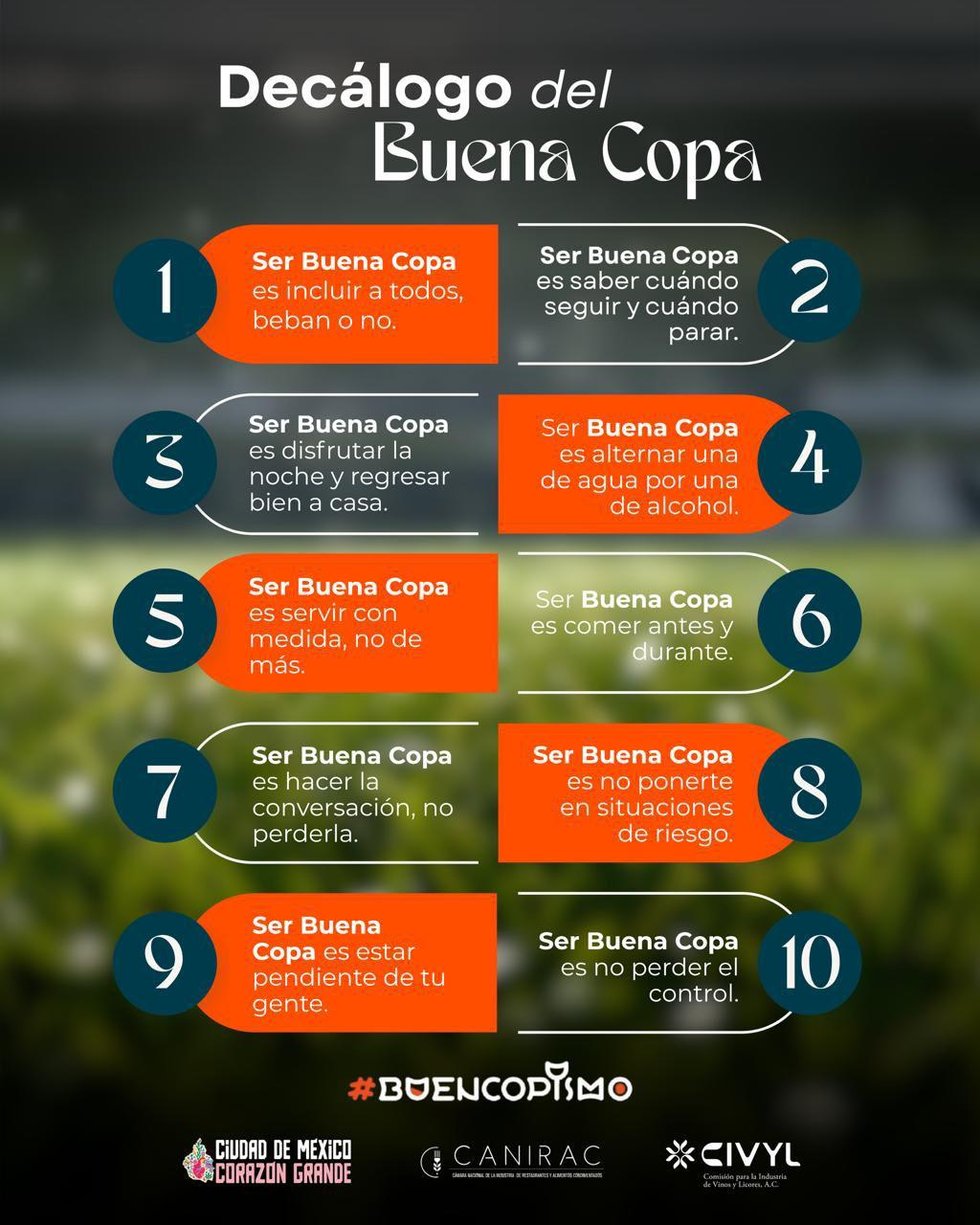
Mexico's 10 Commandments of Drinking
By Alfredo Espinola
In a country where sharing a drink is often an act of hospitality, celebration, and cultural belonging, talking about responsible drinking remains an uncomfortable conversation. Mexico toasts, celebrates, and socializes around alcohol, but rarely pauses to reflect on how to do so better.
For Panambí Garcés, director of the Commission for the Wine and Spirits Industry (CIVYL), that cultural silence is precisely the starting point for the Decalogue of the Good Drinker, an initiative spearheaded by the country’s eleven leading alcoholic beverage companies, whose goal is not to discourage consumption but to promote a new culture based on responsibility, respect, and social harmony.
“Our business is selling alcoholic beverages,” she acknowledges with absolute clarity. “But our responsibility is to create tools that enable people to make better decisions.”
The initiative arose from a seemingly simple question: How do Mexicans consume alcohol, and what behaviors have we normalized that, in reality, keep us from healthy social interaction?
The answer led to ten practical principles, designed to be remembered and applied in everyday life. The project brings together the expertise of companies such as Bacardi, Brown-Forman, Campari, Casa Cuervo, Diageo, Pernod Ricard, Suntory Global Spirits, Pedro Domecq, and other key industry players, all of whom share a common goal: to foster a public conversation about responsible drinking.
Breaking the Stigma
For Garcés, one of the campaign’s main achievements has been to dispel the notion that talking about alcohol necessarily implies moral condemnation.
“In Mexico, there’s a constant contradiction: we consume alcohol, but we avoid talking openly about it,” he explains. “The first step is to understand that the conversation shouldn’t focus on prohibition, but on learning to coexist better.”
The response from consumers, restaurant owners, hoteliers, and even government agencies has been positive. The campaign, he says, has resonated because it offers practical tools, free from moralizing rhetoric.
What Should Never Be Normalized
Although the Decalogue of Responsible Drinking is aimed at adult consumers, Garcés emphasizes two non-negotiable principles: no alcohol consumption by minors and total abstinence during pregnancy and breastfeeding.
“Current scientific evidence is clear: there is no safe level of alcohol consumption during pregnancy,” he points out.
He also questions a deeply rooted cultural practice: allowing teenagers to try alcohol under family supervision with the idea that this will teach them to drink responsibly.
“It’s not a good practice. The adolescent brain is still developing, and alcohol directly affects decision-making processes.”
Learning to Drink
The first official principle of the Decalogue addresses a common behavior in Mexican culture: social pressure to drink.
“Respecting those who choose not to drink alcohol is essential,” says Garcés. “No one should feel pressured to drink just to fit in or socialize.”
From there, the decalogue offers recommendations that are seemingly simple but backed by scientific evidence and social experience: alternate each alcoholic drink with a glass of water, eat food before and while drinking, know your own limits, and avoid risky situations.
Among the most specific recommendations, the campaign suggests not exceeding four drinks per occasion for men and three for women, in addition to reminding people that the body requires approximately one hour to metabolize each standard drink.
“The problem begins when we normalize behaviors such as downing multiple shots in a few minutes or completely losing track of what happened during a night out,” she explains.
For the director of CIVYL, the goal is not to take away the enjoyment, but to preserve the social experience without compromising safety or personal dignity.
A Decalogue Designed to Last
Although the initiative has gained visibility during the current World Cup season, Garcés clarifies that the project began long before that and is conceived as a long-term strategy.
“Education on responsible drinking cannot be limited to a temporary campaign,” she maintains.
Mexico City recently adopted the “Decalogue of the Good Drink” as part of its strategies for promoting harmonious coexistence during large-scale events, and other institutions have begun to replicate the model to address various forms of public behavior.
The campaign has also been active in Guadalajara, in collaboration with the National Chamber of the Tequila Industry, through informational materials distributed in restaurants and bars.
The Future of Alcohol Consumption in Mexico
When asked how he envisions the future of alcohol consumption in the country, Garcés is optimistic.
“We’re dealing with increasingly informed and demanding consumers,” he says. “People want to know what they’re drinking, how it’s produced, and where the products come from.”
This evolution, he believes, will benefit both major international brands and the growing range of beverages with a distinct Mexican regional identity: tequila, mezcal, sotol, raicilla, bacanora, charanda, and, of course, Mexican wine, whose production currently spans eighteen states across the country.
“Virtually every region in Mexico has a natural aptitude for producing a beverage with its own unique identity,” he reflects. “If we manage to combine economic development with education and responsibility, the future will be extraordinary.”
The Ten Commandments of Good Drinking
1. Include everyone, whether they drink or not.
2. Know when to keep going and when to stop.
3. Enjoy the night and get home safely.
4. Alternate an alcoholic drink with a glass of water.
5. Serve in moderation.
6. Eat before and while drinking.
7. Keep the conversation going; don’t let it die.
8. Avoid risky situations.
9. Look out for those with us.
10. Don’t lose control.
In a country where toasting is a universal language, perhaps the real challenge isn’t to stop celebrating, but to learn how to do it better.