
By Alfredo Espinola
The question posed by Taco Tasting Room—the exclusive gastronomic bar from Central Hoteles, located in the heart of Mexico City’s Historic Center—seems simple, but it holds a profound reflection on contemporary Mexican cuisine: What happens when the taco—the most democratic and emotionally resonant dish in our culinary tradition—is placed in a space designed to appreciate every ingredient, every technique, and every story behind its creation?
The answer is an experience where haute cuisine does not seek to reinvent the taco, but rather to reveal its extraordinary complexity.
With just fourteen seats arranged around a bar conceived as a stage, a laboratory, and a meeting place, Taco Tasting Room—listed among Mexico’s 250 best restaurants by the Michelin Guide—offers an experience radically different from any preconceived notion of a taquería.
Created by Chef Pepe Salinas, the concept is based on a premise that is as ambitious as it is respectful: to explore the infinite narrative possibilities of the taco without betraying its essence. Each dish is the result of research, technique, and sensitivity—a gastronomic journey that honors the roots of Mexican cuisine while engaging with the contemporary language of haute cuisine.
The Ceremony of Unlearning
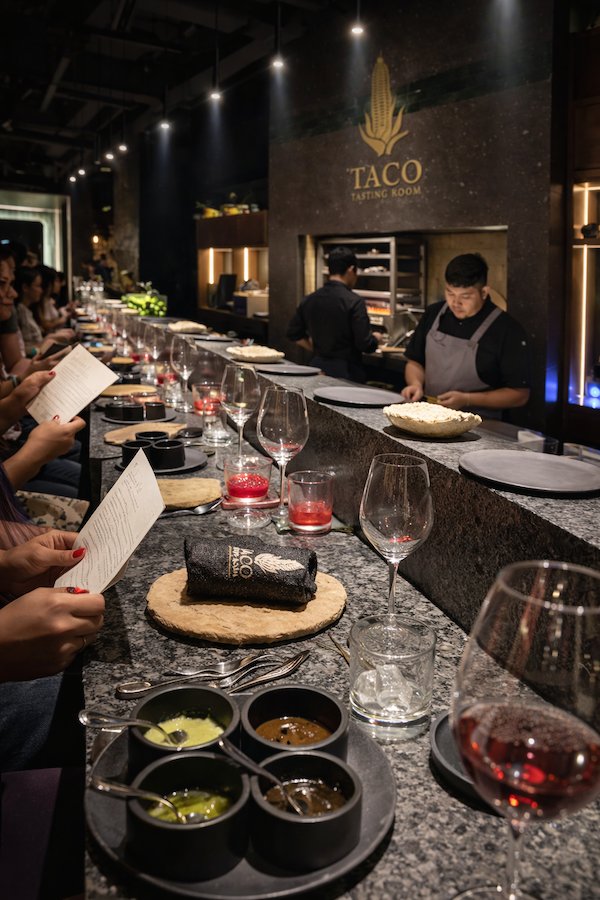
Taco Tasting Room in Mexico City reveals the potential complexity of the taco.
I recently had the privilege of enjoying a meal at Taco Tasting Room. The evening began with an instruction: “Please take the taco directly from the paper.” That phrase became the first sign that the evening would be, above all, an exercise in unlearning.
The bar then revealed itself as a stage. There are no tablecloths or rigid protocols; there are recycled cardboard boxes turned into plates, pieces of paper that will eventually be transformed into improvised origami figures, and a constant invitation to actively participate in the contemporary ritual of the taco.
The first drink we received was a Canelo, a sour cocktail made with carrot cordial and a delicate hint of cinnamon. Aromatic, elegant, and precise, the drink fulfilled the role that every great opener must: to pique curiosity.
A red aguachile slush, enriched with strawberry, watermelon, and ginger, then appeared to refresh the palate and stimulate the appetite.
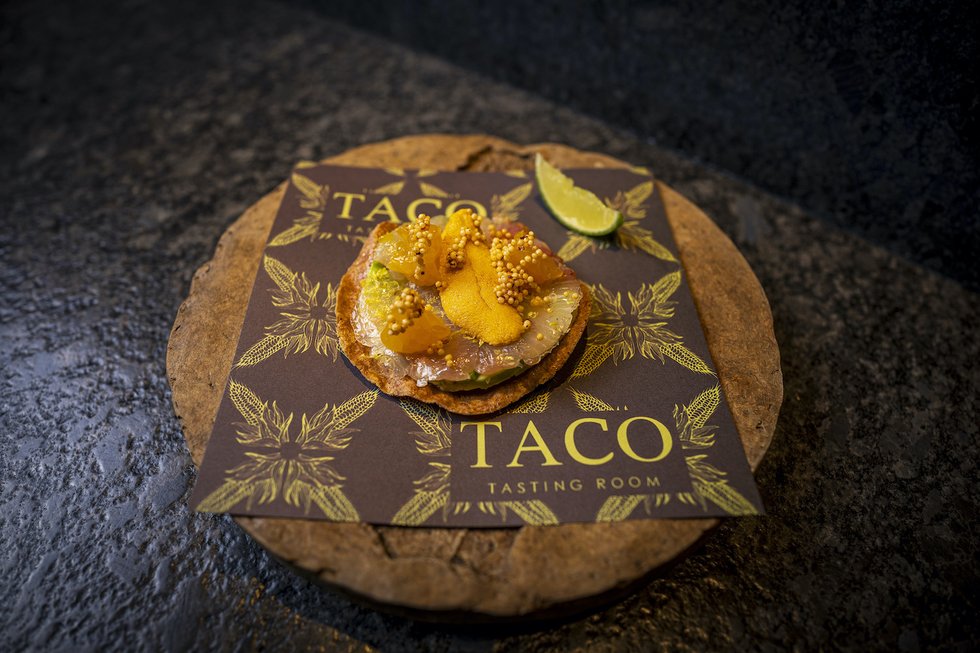
The first major revelation came with a delicate tostada of farmed horse mackerel accompanied by ikura, spicy puffed rice, and citrus notes of mandarin. The dish’s technical precision found a perfect counterpoint in a Portuguese wine with pronounced minerality, demonstrating that, at Taco Tasting Room, pairing is an essential part of the narrative.
Memory as an Ingredient
One of the most moving moments of our dinner was, without a doubt, the mole de novia. Based on the historic recipe created by Chef Alicia Gironella as a wedding gift for her daughter, the dish preserves the original spirit while incorporating a contemporary sensibility. Almonds, peanuts, amaranth, and pumpkin seeds come together in a delicate and complex preparation, and the original white chocolate has been replaced by pear. The unexpected star is the candied sunflower heart, whose texture is reminiscent of both artichoke and mushrooms, offering one of the most refined expressions of contemporary Mexican plant-based cuisine.
The journey continued toward the sea with a quesadilla featuring butter-candied lobster, accompanied by aged cheese from Guanajuato, lychee, and pico de gallo. Beyond its impeccable technical execution, the dish incorporates a contemporary reflection on sustainability and marine conservation, reaffirming that 21st-century gastronomic luxury also entails responsibility.
The Luxury of Authenticity
The journey paid homage to Mexico City with esquites enriched with bone marrow fat, ribeye, and grasshopper mayonnaise. Intense, deeply urban, and surprisingly elegant, they found an unexpected ally in a Portuguese rosé of great freshness and minerality.
Next came the carnitas made from a whole suckling pig, whose richness was masterfully balanced by a Sauvignon Blanc from the Guadalupe Valley. The wine provided structure, depth, and evocative notes of freshly baked bread.
The experience unfolded amid natural wines, Mexican sparkling wines, and conversations about art, worldview, and popular culture. Little by little, it became clear that the taco can be many things at once: food, territory, memory, identity, and narrative.
The Return to the Roots
And then came the finale. A dessert served on a slate, the deliberate absence of cutlery, and one final instruction delivered with absolute naturalness: “We’re a taquería; here, desserts are also eaten with the tongue.” The phrase provoked laughter, surprise, and, finally, understanding. Because after several hours sitting at this bar, one comes to understand that true sophistication does not lie in distancing oneself from one’s roots, but in finding new ways to return to them.
This philosophy—honoring one’s origins through a contemporary lens—is, perhaps, what defines not only Taco Tasting Room but also the hospitality vision of Central Hoteles, the project to which this unique gastronomic bar belongs. Located across from the Metropolitan Cathedral, in one of the country’s most iconic urban settings, the group has created a concept where heritage, design, culture, and gastronomy coexist organically.
In this context, Taco Tasting Room transcends the category of a signature restaurant or omakase bar. It becomes a space for gastronomic reflection, a narrative experience, and, above all, a reminder that the taco—that everyday, popular, and deeply Mexican gesture—remains one of the most powerful cultural vehicles we have for telling the story of who we are.