
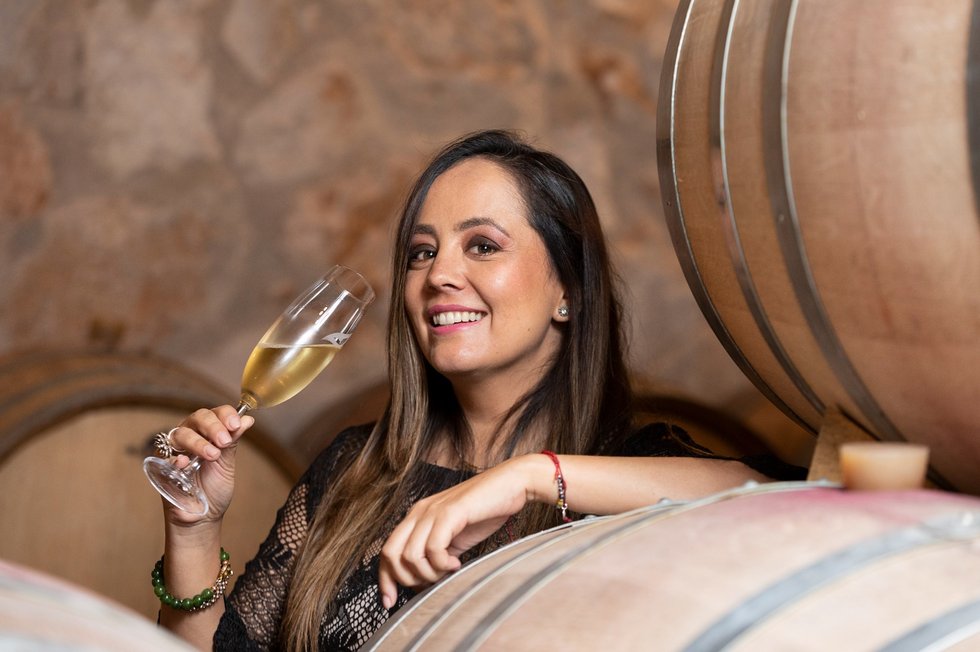
Paz Austin
By Alfredo Espinola
For generations, Mexicans learned to look to Europe when they thought of wine. France represented tradition. Italy evoked the family dinner table. Spain spoke of history. Meanwhile, Mexico remained on the sidelines of that conversation, as if its wine were an exception rather than the result of a long agricultural tradition, hundreds of producers, and a territory capable of offering extraordinary diversity.
That reaction inadvertently became a guiding compass for Paz Austin.
It wasn’t just about promoting an industry. It was about changing a perception. Because she understood something that rarely appears in market studies: people don’t choose based solely on quality. They also choose the stories with which they decide to identify.
That discovery ended up guiding her entire career. Although today her name is linked to Mexican wine, the story began long before a single bottle.
The Girl Who Learned to See
Paz was born on April 25, 1982, in the city of Guadalajara. Long before she set out on the path that would define her professional life, her story began amid the streets and traditions of this land of Guadalajara. Over the years, life took her to Mexico City, a vibrant city full of challenges that not only became her home but also the setting where she has built much of her career, her learning, and the experiences that have shaped her worldview.
“I’ve learned that one’s place of origin is merely the starting point; it’s the experiences, the decisions, and the people we meet along the way that ultimately shape our identity. Between my Guadalajara roots and the inexhaustible rhythm of Mexico City, I’ve developed a way of seeing the world based on contrast, adaptability, and a constant quest for growth and transformation,” says Paz.
While other children waited to reach their destination, she enjoyed the journey. The highways taught her that the country changed from one state to another while remaining the same. The landscape transformed, as did the accents, the colors of the markets, the seasonal fruits, the ingredients, and the cuisines.
There was something deeply revealing about discovering that the same recipe took on a different character depending on where it was prepared.
Without realizing it, she was learning the first lesson that would shape her entire professional life: Gastronomy doesn’t begin in the kitchen—it begins with the land, the climate, the people, and the history of those who have tended a crop for generations.
At home, food was never just a custom; it was a way to talk about Mexico.
Meal-time conversations would stretch on, filled with family anecdotes, travel memories, and discussions that inevitably turned to the origins of the ingredients, the producers, or regional traditions.
Her great-grandmother would often open a bottle of tequila to accompany those gatherings. Over time, Paz would come to understand that they weren’t really talking about a drink—they were talking about identity.
Those scenes lay dormant for years; she never imagined that one day they would resurface to give meaning to her entire career.
The Journey That Changed Her Course
At the age of 25, during a family visit to Guadalajara, an aunt invited her to an event in Tequila, Jalisco. She accepted, thinking she’d get to know a small town; she ended up discovering a whole universe.
Charros, mariachis, horses, producers, and entire families brought to life a tradition that permeated every corner. That’s when she understood that tequila wasn’t just a spirit: it was agriculture, landscape, economy, tourism, and heritage. It was a way of telling Mexico’s story.
And a question arose that would never leave her: If a drink could hold so many stories, why was almost no one telling them?
That curiosity shaped her destiny. She decided to build bridges between gastronomy, culture, and communication—even if the path didn’t yet exist. So she forged her own.
That decision would lead her, years later, to the Tequila Regulatory Council, to the founding of Tequila Melier, and to the discovery of an idea that would transform her career and the conversation about Mexican wine.
Because before becoming one of the most influential voices in the wine industry, Paz Austin understood a truth that continues to guide her work: Beverages aren’t just products; they’re a country’s liquid memory.
Learning That Beverages Also Tell a Country’s Story
The early years of her career began in 2010 with a venture called Dulce Corazón, a shop dedicated to traditional Mexican sweets. Before long she moved on to the spirits industry, where people spoke of their work with infectious enthusiasm, describing the land, the climate, the harvests, and the generations that had cultivated the same soil.
However, when that story made its way into advertising or institutional campaigns, almost all of it disappeared—all that remained were the awards, the alcohol percentages, the production processes, and the tasting notes, as if the most valuable part of a drink could be reduced to a technical spec sheet.
Paz sensed that there was a huge void there, because people rarely remember a technical spec sheet—they remember a story. That intuition gave rise to Tequila Melier, a consulting firm specializing in communications for beverages and gastronomy.
The project was born from a simple idea—and, at the same time, one that was unusual for its time: it wasn’t about selling a bottle; it was about explaining the world behind it. Instead of repeating that a tequila was exceptional, they preferred to show the sunrise over the agave fields, the hands of the jimador, the families who had been working the same land for decades—the small details that rarely appeared in advertising.
It wasn’t an aesthetic strategy; it was a different way of understanding communication. Because a drink never travels alone—it’s accompanied by the culture that made it possible.
The Country Told Through the Table
Those years coincided with a growing international interest in Mexican cuisine.
Chefs, traditional cooks, producers, and artisans were beginning to take an increasingly visible place in the global conversation.
Paz found there a natural terrain on which to develop her work; she understood that a meal could become a form of diplomacy, that a spirit could spark conversations about history, biodiversity, and heritage, and that a well-crafted dinner was capable of explaining a country better than many speeches—each project reinforced this same conviction.
When a person discovers the flavors of a place, they also begin to take an interest in the people who live there.
Craft Beer and the Value of Community
The next challenge came from a completely different world: Mexican craft beer was experiencing a boom. Across various states, small brewers were emerging who experimented with local ingredients, revived traditional styles, and committed to independent brewing.
There was creativity, there was talent, there was enthusiasm—but there was also a shared sense of isolation.
Each brewery was fighting its own battle for survival. While some held their ground with ingenuity and others barely managed to stay afloat, the Mexican craft beer industry was searching for a voice capable of uniting efforts and blazing new trails. It was in this context, in 2015, that Paz received an invitation to take on the role of Executive Director of the Mexican Craft Brewers Association (Asociación de Cerveceros Artesanales e Independientes de México [ACERMEX]).
She accepted the challenge with the same conviction that had guided every step of her career: listening, building community, and turning challenges into opportunities. What many saw as a crisis, she viewed as the ideal moment to demonstrate that true growth begins when people work together.
She heard concerns that were repeated time and again: limited market access, complex regulations, and a lack of institutional representation. It didn’t take her long to discover that the real problem wasn’t the beer—it was the lack of a collective voice.
For five years, she fostered spaces for dialogue, training programs, and partnerships with government agencies, universities, and business organizations. But above all, she helped hundreds of brewers begin to recognize themselves as part of the same community.
Years later, she often sums up that period with a phrase that seems simple: Industries don’t change when a single company succeeds. They change when they learn to work together.
An Unexpected Call
In 2019, Paz Austin concluded her tenure as executive director of ACERMEX. During those years, she gained insights that would shape the rest of her career. She discovered the complexity of trade association leadership, the value of negotiation, and the importance of building institutions capable of outlasting the people who lead them.
With that chapter closed, she believed it was time to return to her independent projects. She felt she had contributed what she needed to and that it was time to embark on new paths with the freedom to create.
But life had a new opportunity in store for her.
One day, the phone rang. On the other end of the line, an unexpected invitation awaited her—a proposal that brought together everything she had learned up to that point and that, once again, would change the course of her story.
When the Mexican Wine Council (Consejo Mexicano Vitivinícola [CMV]) began its search for a new Executive Director, she accepted the meeting without suspecting that she was about to face the greatest challenge of her professional career. What seemed like just another conversation would ultimately mark the beginning of a chapter that would change not only the course of her career but also the history of the institution.
With determination, vision, and the conviction to blaze new trails, she took the helm of the Mexican Wine Council, becoming the first woman to serve as its Executive Director. This appointment marked a turning point, demonstrating that great changes begin when someone dares to imagine a different future.
The Woman Who Changed the Conversation About Mexican Wine
When Paz Austin arrived at the Mexican Wine Council, she found an industry that was already producing high-quality wines. Wineries were evolving, winemakers were beginning to make their mark, and new regions were appearing on the map.
The problem wasn’t the wine.
Outside of specialized circles, Mexican wine remained largely unknown. The biggest challenge wasn’t conquering other markets, but convincing Mexicans themselves.
For years, many continued to believe that good wine could only come from France, Spain, or Italy. That idea wasn’t going to change with advertising. The conversation had to change.
Listen Before You Speak
Her first impulse wasn’t to create a campaign. It was to listen.
She toured vineyards, spoke with families, winemakers, and small producers. She discovered that each winery told a different story, but they all spoke of the same country.
There wasn’t just one Mexican wine. There were many Mexicos expressing themselves through wine.
That’s when she realized the mistake: marketing it as a uniform product, when its greatest strength was its diversity.
She also understood that the language had to change. The challenge wasn’t to convince those who already loved wine, but to bring it closer to those who felt it was out of reach.
She proposed talking less about technicalities and more about people, landscapes, and culture. She wanted a bottle to stop being seen as a luxury and instead become the expression of a region.
Because wine doesn’t begin when the cork is pulled. It begins in the soil, in the hands that tend the vines, and in the families who, for decades, have been committed to it.
A Deeply Mexican Table
There was one question that kept coming up again and again: Why do we keep imagining wine only alongside European recipes?
One need only look at any Mexican table to discover that there was another way: moles, cabrito, cochinita pibil, fish, seafood, chiles en nogada, or barbacoa. One of the world’s great cuisines doesn’t need to import its own way of enjoying wine.
Changing that perception involved much more than a campaign. It meant bringing wine back to the Mexican table—not as a symbol of sophistication, but as a natural part of its culinary culture.
That’s how a different conversation began. It was no longer just about talking about wine. It was about talking about Mexico.
Building Something That Would Endure
There’s a difference between managing an institution and transforming it. Managing means keeping it running; transforming it means building something that will continue to exist long after you’re gone.
Over the years, that idea began to take up more and more space in Paz Austin’s thinking. As she worked to modernize the Mexican Wine Council’s communications, bring wine to new audiences, and promote a narrative more closely tied to the region and Mexican cuisine, she realized that the real challenge wasn’t just to communicate better, but to change the way people related to wine.
Her arrival at the Council coincided with a pivotal moment. Hans Backhoff had just assumed the presidency with a youthful, dynamic vision and a firm belief that the industry needed to reinvent itself to connect with a new generation of consumers. Paz found there the ideal setting to bring a fresh perspective.
She came from the world of digital communications and was convinced that wine needed to shed the solemnity that had surrounded it for years. It was time to leave behind the idea that it was a drink reserved for special occasions and transform it into an everyday staple, capable of complementing a plate of tacos, a music festival, or a rock concert. Wine culture had to feel approachable, simple, and authentic.
That vision created an immediate connection with Backhoff. Both shared the desire to build a modern, accessible Mexican Wine Council capable of speaking the language of the younger generations without compromising the identity of Mexican wine.
However, just a few months later, the situation changed completely.
Paz joined the Council in late 2019. In October and November, she was embarking on a new professional chapter; by March 2020, the entire world was facing the pandemic. The lockdown forced a halt to in-person activities and accelerated a transformation that would otherwise have taken years.
Overnight, everything had to go digital. Meetings, events, campaigns, and the way organizations engaged with consumers all migrated to the virtual realm. What had long been a source of resistance for many organizations in Mexico became an urgent necessity.
For Paz, that crisis ultimately confirmed that they were on the right path. Digital communication ceased to be an innovation and became the bridge that would keep the conversation alive between Mexican wine and its consumers. Rather than an obstacle, the pandemic accelerated the cultural shift that the Council had already begun to drive and demonstrated that an institution capable of adapting was also an institution prepared to transform itself.
After modernizing the Mexican Wine Council’s communications, bringing wine to new audiences, and promoting a narrative more closely tied to the region and Mexican cuisine, she began to ask herself a different question.
What will remain when all this is over?
She was looking for something that would outlast administrations, boards of directors, and those who would eventually take her place.
Then an opportunity arose that, until that moment, had seemed as obvious as it was nonexistent.
Mexico did not have a National Wine Day.
This absence was surprising: a country with more than four centuries of winemaking tradition lacked an official date to celebrate an activity deeply rooted in its agricultural, gastronomic, and cultural history.
Bringing it to fruition proved much more complex; for years there were discreet meetings, conversations with legislators, historical arguments, working groups with producers, and legal reviews—it was not an initiative for one person, but a project for an entire industry.
When, on January 10, 2023, the Official Gazette of the Federation finally decreed October 7 as National Mexican Wine Day, the news was received with enthusiasm.
For many, it was a celebration; for Paz, it represented something different—it was proof that industries also need symbols, because symbols create memory, and memory, over time, eventually becomes identity.
Perhaps that was the greatest change she drove during her tenure—not convincing Mexicans to buy one more bottle, but inviting them to view Mexican wine as part of their own history; and once a society changes the way it tells its story, it is very difficult for it to see that story through the same eyes again.
Paving the Way for Others
Over the years, Paz Austin came to understand that leadership rarely takes center stage. It happens when someone decides to step aside so that others can move forward.
That’s why, when talking about the projects that excite her most, she almost never starts with her own. She prefers to talk about people, networks, and communities.
After working in the tequila, beer, and wine industries, she came to a realization: no industry grows solely because of the quality of its products, but rather when those within it understand that they are part of something bigger.
That conviction took shape in Mujeres Intaninos. While others focused on visibility, Paz spoke of structure, processes, and governance. She knew that good ideas only endure when they have a foundation capable of sustaining them.
She helped consolidate an organization where female winemakers, sommeliers, researchers, communicators, and entrepreneurs could find a space to share knowledge and open up opportunities for other women.
Today, the network continues to grow because it addresses a real need. And when the conversation centers on the role of women in the industry, Paz avoids empty rhetoric. She prefers to talk about concrete changes: more women occupying spaces that were previously closed to them and a transformation that is just beginning.
DrinkSend: Back to the Roots
In 2023, Paz Austin closed one of the most significant chapters of her professional life at the CMV. After years of spearheading projects through business organizations and building bridges between the industry, the government, and producers, she realized it was time to return to the place where she had always found her greatest freedom: creation.
It wasn’t a change of course, but rather the natural consequence of a path built on dialogue, strategy, and experience. Every project, every negotiation, and every shared story reaffirmed a conviction that has guided her since the start of her career: brands and territories only take on true meaning when they manage to inspire and forge lasting connections with people.
From that conviction, DrinkSend was born—the beverage division of FoodSend, a company with more than fifteen years of experience in food marketing. From there, she oversees the curation of wines, spirits, and premium waters, bringing together producers, distributors, and consumers within a single ecosystem.
But DrinkSend transcends the traditional concept of a communications agency. It is a space where wine, gastronomy, tourism, culture, and public diplomacy converge; a creative laboratory where strategies are born from sensitivity, experiences forge connections, and stories reveal a region’s identity through its people, its products, and the memories that sustain them.
This vision has transformed his work into a form of cultural diplomacy. Over the past few years, it has spearheaded projects that use gastronomy and wine as tools to strengthen identity, foster dialogue, and showcase Mexico on the international stage.
Among these, New Generation of Traditional Women Cooks stands out—an initiative developed by Marianne México in collaboration with the French Embassy in Mexico to recognize, preserve, and highlight the legacy of the women who safeguard traditional Mexican cuisine.
As a consultant in gastrodiplomacy, Austin has advised governments, organizations, and the private sector on designing strategies that link gastronomy, wine, tourism, and regional identity. Projects such as Vinos Camino de la Plata and the ¡Qué Gusto! Festival, held in France, reflect a vision that views gastronomy as a language capable of connecting cultures and opening new opportunities for international collaboration.
Her voice is also part of the public conversation. As a columnist for Opinión 51 and México Está de Moda, she writes about wine, gastronomy, culture, and regional development from a perspective that combines analysis, sensitivity, and experience.
The consistency of her work has led her to be repeatedly named among Mexico’s most influential women in publications such as Forbes, Líderes Mexicanos, Expansión, and Bloomberg. These accolades recognize not only a solid professional track record but also a unique ability to transform wine, gastronomy, and culture into tools for dialogue, identity, and international visibility.
However, the most significant recognition of her career came when she least expected it.
April 25, 2023, was her birthday when she received a call from Europe. At first, she thought it was an invitation to participate in an academic project. The news, however, was something else.
The International Organization of Vine and Wine (OIV) informed her that she had been awarded the OIV Award of Merit, one of the most important honors the institution bestows upon those who have contributed to the development and dissemination of wine culture on the international stage.
The award was presented to her during the 44th World Congress of Vine and Wine, held June 5–9, 2023, in Jerez de la Frontera and Cádiz, Spain.
At just 40 years old, Paz Austin became the first Mexican woman and the youngest person to receive this award. This recognition went beyond individual merit: it was confirmation of a career dedicated to building bridges between producers, institutions, cultures, and regions, driven by her conviction that behind every wine lies a story capable of bringing people together.
The True Recognition: “Daring”
For a few seconds, she remained silent—not because she was thinking about the award, but because she was reflecting on the journey. She recalled that visit to Tequila when she was just beginning her professional life; she remembered the roads traveled with her family, the meetings with small-scale producers, the long negotiations to drive regulatory changes, the trips, and the projects that seemed impossible. She realized that this recognition did not honor a single moment.
I ask her, “To whom did you dedicate that award?”
She doesn’t hesitate to answer.
She speaks of her mother, she speaks of her grandmother—both are named Paz.
Both taught her that courage isn’t always loud; that often, it simply means daring to do something.
When she returned from Europe, her grandmother hugged her and said something she still cherishes as one of the greatest gifts of her life.
“I’m proud of you because you dared.”
She didn’t say she was proud of the recognition, or the prestige, or the ceremony; she spoke of daring—and perhaps no other word better sums up this entire story.
Because, looking back, Paz Austin’s career has never been about accumulating titles; it has been about daring—to challenge the status quo, to imagine new conversations, to sit at tables where few women had sat before, to champion industries still seeking recognition, and, above all, to believe that Mexico could tell its own story without borrowing anyone else’s words.