
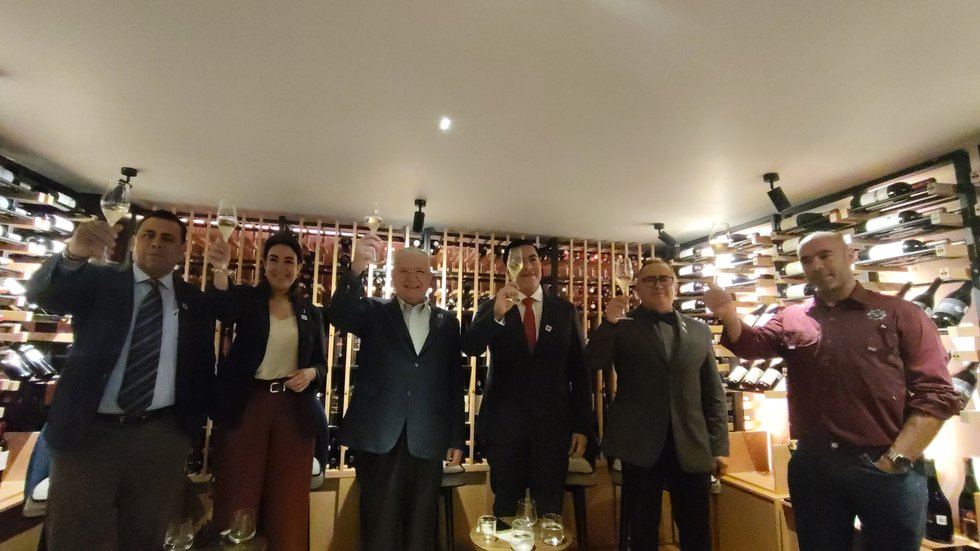
At the press conference about Mexican Wine Day: From left to right: Raúl Perea Jasso, B.A., director of meeting development, representing the Ministry of Tourism; Claudia Ramírez, executive president of Canirac; Salomón Abedrop, president of the Mexican Wine Council; Ricardo Espíndola, sommelier and ambassador for Mexican wine; Javier Casillas, producer and contributor to the Mexican Wine Council
By Alfredo Espinola
With more than 550 wine-making projects in 17 states and 39 out of every 100 bottles consumed in Mexico being domestically produced, the industry arrives at Mexican Wine Day with a history that goes far beyond the glass.
There’s something special about opening a bottle of wine.
First comes the pop of the cork. Then, the wine slowly pours into the glass. The color, the aroma, the first sip.
But before reaching that moment, there was a harvest, the land, people who worked in the fields, and a winery that transformed grapes into something meant to accompany a meal—and, often, to become part of an experience.
That story is becoming increasingly Mexican.
On October 7, Mexico will celebrate Mexican Wine Day, a date that recognizes an industry with more than five centuries of history and one that today occupies an increasingly prominent place in the country’s agriculture, gastronomy, tourism, and dining tables.
The figures help illustrate the scale of this growth.
Currently, 39 out of every 100 bottles of wine consumed in Mexico are domestically produced. There are more than 550 wine-making projects in 17 wine-producing states, while 9,477 hectares are dedicated to the production of wine grapes.
The production chain also generates more than 500,000 workdays, making the wine sector the second-largest source of employment in the agricultural sector, according to data from the Mexican Wine Council (CMV).
But perhaps the most interesting figure isn’t found in a statistic.
It lies in what happens when a bottle of Mexican wine reaches the table.
An Industry That Pairs with Food
For years, talking about Mexican wine meant talking mainly about wine-producing regions and wineries. Today, the conversation is much broader.
Wine is part of an ecosystem that includes restaurants, sommeliers, chefs, hotels, distributors, producers, and tourist destinations.
For a restaurant, a bottle can be much more than just a drink. It can become a waiter’s recommendation, the perfect pairing for a dish, a gateway to discovering a region, or the reason a diner decides to return.
That connection between wine and gastronomy is precisely one of the industry’s driving forces.
“Restaurants are an important part of the Mexican wine value chain: we are the place where a wine is discovered, recommended, and turned into an experience,” said Claudia Ramírez, executive president of CANIRAC.
The industry is also building that bridge through tourism.
Mexico currently has eight established wine tourism routes, connecting vineyards and wineries with restaurants, hotels, local producers, and other experiences.
In Baja California, around 850,000 visitors arrive each year drawn by wine tourism, generating an economic impact of 3.6 billion pesos associated with this activity.
In Querétaro, the Art, Cheese, and Wine Route welcomes approximately 1.2 million visitors annually and generates an estimated economic impact of 4 billion pesos.
Thus, wine ends up doing something few products achieve: taking the consumer to the very place where it was born.
From Mexico to the World
This evolution is not limited to the domestic market either.
Mexican wines have gained prominence in international competitions and, in 2025, won more than 1,000 medals—25% more than the previous year—according to data from the CMV.
“We have more wine-producing regions, more projects, more labels, and consumers who are increasingly interested in learning what Mexico is doing,” said Salomón Abedrop, president of the Mexican Wine Council.
The industry now faces an exciting opportunity: turning that curiosity into a more everyday relationship between consumers and Mexican wine.
And that’s where restaurants play a key role.
Because it’s on a wine list that many people encounter a label for the first time. It’s while dining that they discover a Mexican wine can pair well with Mexican cuisine. And it’s in a conversation with a sommelier or a server that an unfamiliar bottle can become a new favorite.
October: A Month for Discovery
Mexican Wine Day will not be limited to October 7.
From September 30 to October 16, restaurants, wine bars, wineries, and institutions will participate in a program featuring pairing dinners, tastings, mixology experiences, promotions, and special events.
With the support of CANIRAC, restaurants across the country will offer promotions designed to introduce more consumers to domestic wines.
There will also be special corkage fees, ranging from 0 to 100 pesos per bottle, as well as wine-by-the-glass options.
For those working in the industry, the program will include training and business opportunities.
On October 6, the masterclass “The Current State of Mexican Wine” will bring together sommeliers and professionals from the HORECA sector.
On October 6 and 7, the Business Factory, developed in partnership with GS1 Mexico, will seek to connect domestic wineries with major buyers and distributors.
On October 7, the official celebration of Mexican Wine Day will take place.
The agenda will continue with activities such as a special tasting with the MUCHO Chocolate Museum, the conference “The Science Behind Wine” at the UNAM Institute of Chemistry, and, on October 16, the Mexican Wine Fair, featuring guided tastings and a trade exhibition of wines from various wine-producing states.
A Bottle Tells a Story
The Mexican wine industry now has more regions, more projects, and more labels to offer.
It also has a new generation of consumers who want to know what they’re drinking, where it comes from, and who made it.
“Choosing Mexican wine means supporting ‘Made in Mexico,’” said Abedrop. “It means supporting job creation for thousands of professionals who work passionately, from the vineyard to the table.”
Perhaps that is the true story behind Mexican Wine Day.
It’s not just about celebrating a drink.
It’s about recognizing everything that happens before the wine reaches the glass: the land, the labor, the investment, the expertise, the regions, and the people who make every bottle possible.
And for restaurants, it also represents an opportunity: to take a fresh look at their wine lists, discover producers, share their stories, and offer diners one more reason to explore Mexico through what’s in their glass.
This October 7, the invitation is simple.
Open a bottle. Pour it. Taste it. And discover, perhaps, a part of Mexico we didn’t know yet.
Mexican Wine Day 2026 Schedule
September 30 MUCHO Museum Night
October 4–11 Wine2Bar, wine-pairing dinners, and CANIRAC promotions
October 4–11 Digital campaigns #ChooseMexicanWine
October 6 Masterclass: “The Current State of Mexican Wine”
October 6–7 Business Factory
October 7 Mexican Wine Day / Official Celebration
October 9 Special Tasting with the MUCHO Chocolate Museum
October 14 “The Science Behind Wine,” UNAM Institute of Chemistry
October 16 Mexican Wine Fair