
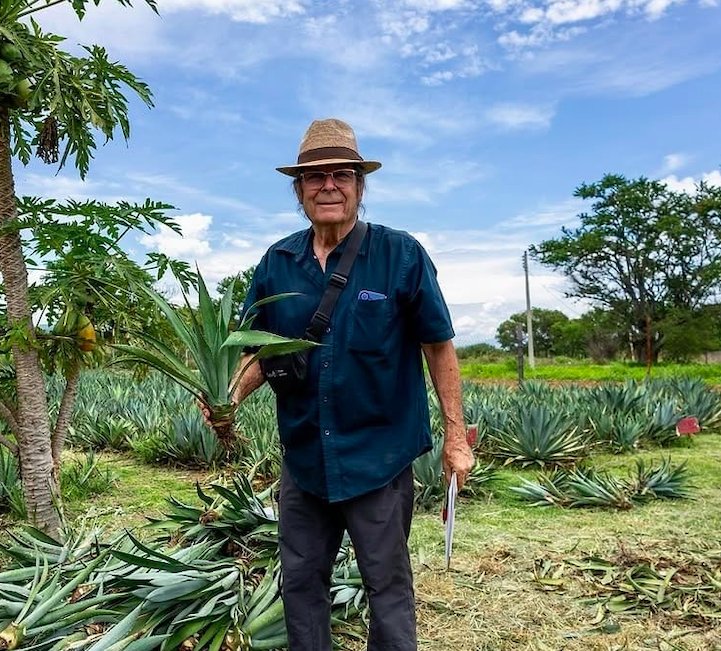
Douglas French
By Alfredo Espinola
In the heart of Oaxaca—a land of rugged mountains and skies that turn purple at dusk—unfolds a story that weaves together tradition, science, biodiversity, and social vision. It is the story of Douglas French, owner of Scorpion Mezcal S.A. de C.V., who has dedicated more than three decades to transforming maguey cultivation into a conservation project and creating a distillery where women take center stage.
From Textiles to Mezcal
French was born in New York but moved to Mexico with his mother when he was a child. She launched a textile company in Oaxaca with the idea of giving employment to women. As the economy evolved, that company switched to mezcal production, leading to the foundation of Scorpion in 1996.
On the company’s two-hectare ranch, French began planting maguey, convinced that each plant carried a unique flavor. He discovered that each variety of agave—tobalá, espadín, mexicano, and barril—has its own character, a nuance that deserves to be recognized.
To honor that diversity, he adopted a process inspired by tequila tradition: steam cooking in stainless-steel autoclaves, milling in mill trains, fermentation of the juice, and distillation in pot stills. This cleaner, more controlled method allows the agave’s flavors to express themselves clearly, without relying exclusively on the smoke or bagasse that characterize other traditional palenques.
The decision was no accident: it was an act of respect for Oaxaca’s natural wealth and an attempt to show the world that mezcal could be as diverse as the landscapes that gave it birth.
Seeds Against Extinction
The Scorpion Mezcal project soon went beyond production. French discovered that many agave varieties were at risk of disappearing: they were harvested without anyone replanting them, and farmers relied on wild plants found in the mountains.
Thus began his crusade for biodiversity. He traveled through the mountains collecting seeds from mature agaves and created a gene bank. With patience and experimentation, he established nurseries capable of propagating endangered varieties. The process is slow and requires perseverance: a maguey can take between 5 and 14 years to mature, and it takes five to seven generations to stabilize a species.
After more than 30 years of work, Scorpion has succeeded in establishing five wild varieties, integrating them into the agricultural supply chain and offering the market flavors that would otherwise have been lost. Each bottle is, in a way, an act of resistance against extinction.
The Invisible Guardians
In the history of mezcal, there is a key figure who rarely appears on bottle labels. He receives no international recognition. He wins no awards. He is not mentioned in advertising campaigns. He works only at night. He is the bat.
While much of the industry cuts the quiote to concentrate all the sugars in the piña destined for mezcal, Douglas French realized that this practice also eliminated the main food source for nectar-feeding bats. Without flowers, they disappear. And without them, much of the agave’s natural pollination is also lost.
The equation was simple:
- Fewer flowers meant fewer bats.
- Fewer bats meant less genetic diversity.
- Less genetic diversity meant a more fragile future for mezcal.
That’s why he made a decision that’s unusual for a producer: he let part of his plantations bloom. He deliberately chose not to harvest some agaves to allow them to complete their biological cycle. The flowers once again provided food for the bats. The bats carried pollen between different varieties. Nature resumed a process that had been interrupted for years by purely commercial logic.
The result was a different landscape: fields where some plants were set aside for production and others were allowed to bloom as an offering to biodiversity. There, amid the twilight and the rustling of wings, a silent pact was taking shape. Mezcal ceased to be merely an agricultural product and became a shared ecosystem.
French describes it as a balancing act: “When you want to save an endangered variety, you have to let the quiotes bloom. It’s a buffet for the bats, and they, in turn, ensure the species’ survival.”
Thus, the invisible guardians of mezcal—the bats—once again found their place in the chain of life. And Scorpion Mezcal became one of the few companies to understand that true wealth lies not only in the bottle, but in the nocturnal flight of those who ensure the agave’s continued existence.
The Laboratory Is in the Mountains
Over time, something unexpected happened. Some seeds began to produce plants different from their parents. The natural exchange of pollen carried out by the bats gave rise to new genetic combinations. It was nature experimenting on its own.
Douglas and his team observed how specimens with different characteristics could emerge from a single parent plant. Not all of them survived. Not all of them managed to adapt. But some did. And those new varieties represented an extraordinary opportunity to expand the biological heritage of Mexican agave.
“We don’t yet know which ones will remain,” he acknowledges. Nature, like time, never offers immediate answers. What he does know is that today there are varieties that were on the verge of disappearing thirty years ago and are now thriving once again thanks to that quiet work.
They are not just plants. They are living fragments of Mexico’s agricultural history.
Women at the Helm of the Distillery
If biodiversity is the soul of the project, female leadership is its heart. When the company shifted from textiles to mezcal, many of the female workers remained with the project. They learned to break down 50-kilo agave heads into manageable pieces, to wield machetes and axes with skill, and to maintain impeccable cleanliness in the distillery—which they call “the kitchen.”
Today, 85 percent of the company’s employees are women. The discipline, strength, and sensitivity of these women have transformed the distillery into a unique space: a place where tradition blends with modernity and where women’s labor challenges stereotypes in an industry historically dominated by men.
Identity and the International Market
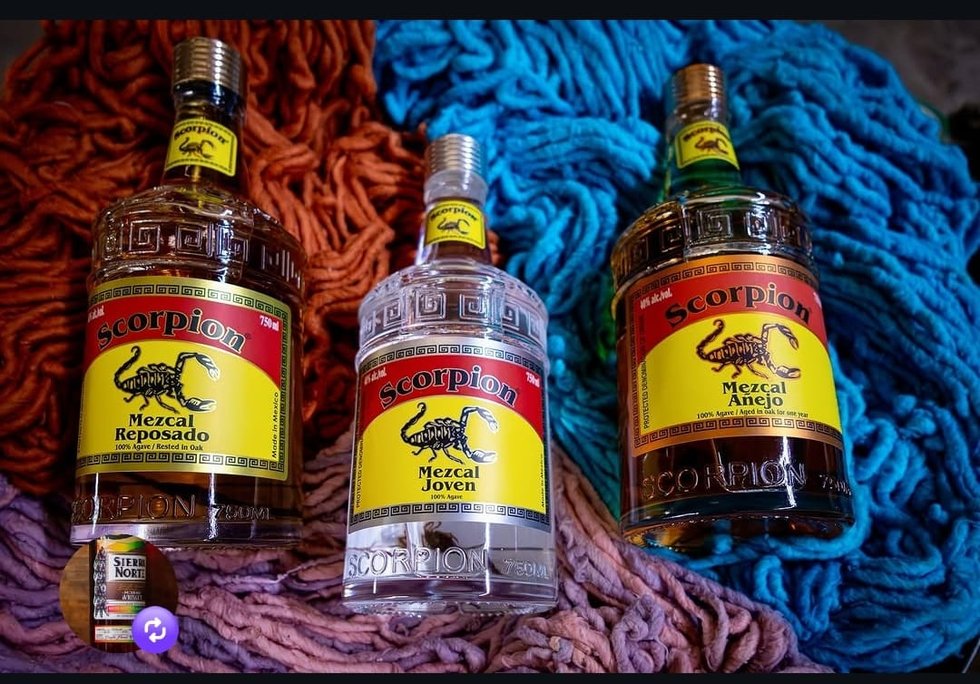
In the United States, Scorpion has faced the challenge of educating consumers unfamiliar with the diversity of agaves. While espadín dominates the market, accounting for more than 90 percent of production, the company offers tobalá, quiche, barril, and mexicano, championing authenticity over uniformity.
French acknowledges that competing against industry giants is difficult. Companies like Diageo and Southern Wine and Spirits control much of the distribution, leaving little room for small producers. However, he is confident that the story behind each bottle—biodiversity, female leadership, and tradition—appeals to those seeking more than just a drink: they are looking for a narrative.
In a saturated market, telling the story becomes both a strategy and an act of resistance.
The Mezcal Ritual: A Flight of Flavors
Beyond production, French invites consumers to experience mezcal as a ritual. He suggests tasting a flight of four different varieties, comparing aromas and flavors in successive glasses. The exercise reveals the richness of the agave: each variety offers a distinct nuance, a surprise that unfolds on the palate.
“It’s like a revelation,” he says. “I’ve served flights to thousands of people at exhibitions, and they’re always impressed to discover how many flavors agave can offer.”
Mezcal, then, ceases to be just a drink: it becomes an experience, a discovery, a bridge between cultures.
A Vision for the Future
In times of economic crisis, the priority is survival. French knows this: he has weathered three severe recessions and has seen even major brands like Jack Daniels close distilleries. However, his vision is long-term.
Scorpion Mezcal plants thousands of maguey plants to ensure a future supply of raw materials and shares plants with other producers, strengthening a network dedicated to saving endangered species. The hope is that mezcal will become a category as broad and widely recognized as tequila, and that future generations will find in Oaxaca not just a product, but a legacy.
“I hope my company lasts three or four generations,” says French, convinced that mezcal still has much to offer the world.
Mezcal as a Legacy
The story of Scorpion Mezcal is the story of a man who decided to sow the seeds of the future in the land of Oaxaca. It is the story of women who transformed the distillery into a space of strength and dignity. It is the story of bats that, in the darkness of the night, ensure the survival of a species. Every bottle is a testament to resilience: against extinction, against market homogenization, against the invisibility of women’s labor.
But it is also a promise. A promise that mezcal can be more than just a drink: it can be memory, it can be territory, it can be community. Every sip carries with it the patience of the years, the fragility of the seeds, the nocturnal flight of the bats, and the strength of the hands that produce it.