
By Alfredo Espinola
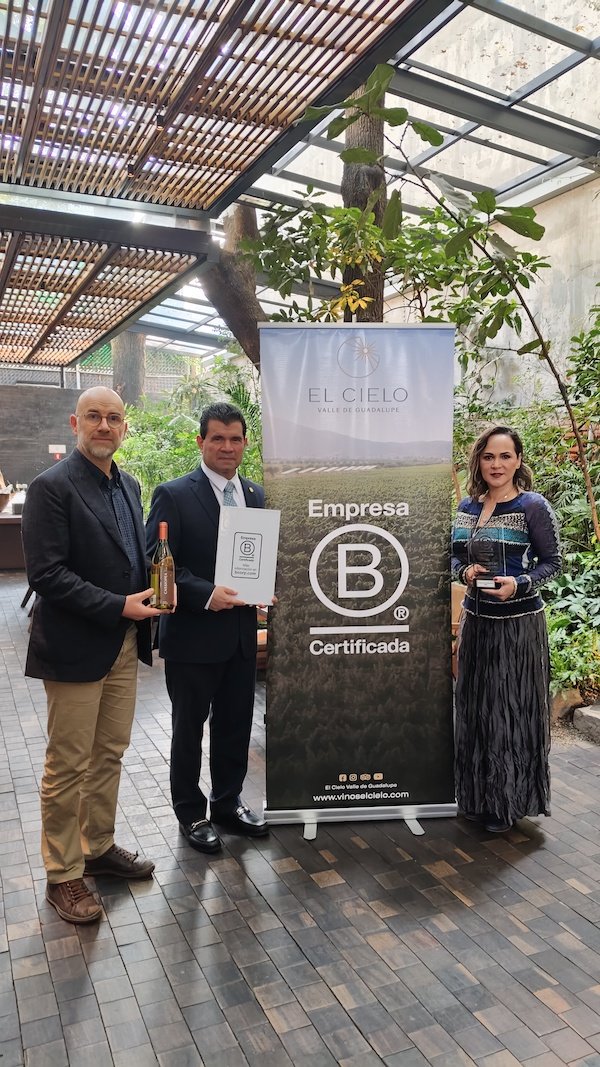
Celebrating El Cielo's achievement of B Corporation certification. Left to right: Javier Herrero, Gustavo Ortega and Georgina Estrada
El Cielo, a winery in Mexico's Valle de Guadalupe, has earned B Corporation certification, which recognizes a way of doing business in which product quality is inseparable from responsibility toward people, the community, and the environment.
The announcement was made at an event held at Pujol restaurant, also a certified B Corporation. The choice of venue was significant: two Mexican hospitality projects brought together by a shared conviction—that excellence and responsible management can go hand in hand.
The certification, obtained on September 16, 2026, following an independent evaluation and verification process, covers El Cielo’s operations across its vineyards, winery, and El Cielo Research. The certification evaluates how a company makes decisions and its performance in areas such as governance, employees, community, environment, customers, and suppliers. More than just an isolated distinction, it represents membership in an international community of companies seeking to use business as a force for good.
For Gustavo Ortega Joaquín, founding partner and CEO of El Cielo, the recognition builds on a vision that began long before the certification process started. From the project’s inception, he explained, the intention was to build a sustainable company—both in vineyard operations and in its relationships with employees and the surrounding community.
That conviction is also reflected in the evolution of its agricultural practices. Ortega noted that the transition toward organic and regenerative viticulture has required time, investment, and difficult decisions. In one of the original vineyards, the winery undertook a profound renewal: reworking the soil, incorporating cover crops and compost, and restoring soil health. The goal is for all of its vineyards to be organically certified by 2030.
The environmental effort extends far beyond the rows of vines. In a region where water is a particularly valuable resource, El Cielo uses drip irrigation systems and monitoring tools to calculate the water needs of its crops. At its facilities, it has installed energy-efficient devices, treatment plants, and systems to reuse treated wastewater in gardens, ornamental areas, and olive groves.
Energy efficiency is another part of this strategy. The company has installed solar panels at the winery and at various facilities throughout its operations; approximately 98 percent of its lighting is LED, and more than a quarter of its energy consumption comes from renewable sources. It has also opted for lighter bottles—weighing approximately 20 percent less—and natural corks, decisions that help reduce the environmental impact associated with production and transportation, while also supporting the conservation of cork oak forests.
But responsibility, as became clear during the meeting, does not end with environmental practices. El Cielo has focused on training, inclusion, equity, and respect for human rights. According to information shared during the presentation, its entire team has received training on the company’s code of ethics. The company also collaborates with social organizations and educational institutions, participates in initiatives to strengthen the regional economy, and strives to prioritize local suppliers.
In explaining the meaning of the certification, Javier Herrero, Country Manager for Mexico at Sistema B, emphasized that a company must be understood as a network of relationships and responsibilities. It is not enough to look at its financial results: it also matters how it treats its employees, how it engages with its community, what impact it has on the environment, and what practices it upholds throughout its value chain.
Herrero noted that the B movement was founded in 2006 with the aim of fostering companies capable of addressing social and environmental challenges through their core business activities. The certification requires measuring the organization’s performance, verifying results, and making formal commitments that extend corporate responsibility beyond shareholders. In this sense, he pointed out, obtaining the certification does not mean reaching a final goal, but rather embarking on a path of continuous improvement.
The Sistema B representative also recognized El Cielo as a pioneering winery in Mexico within this movement. By 2026, he explained, the global B Corporation community will include more than 11,000 companies of various sectors and sizes. Their diversity demonstrates that responsibility can be integrated into very different business models and, at the same time, become a pathway to innovation and enhanced competitiveness.
For Georgina Estrada, deputy general manager and brand ambassador at El Cielo, receiving the certification is a source of pride, but above all, it entails a responsibility moving forward. “Making great wines isn’t enough,” she said, sharing the philosophy that guides the project. It also matters how they are made, who is involved in that work, and what impact is left on the place where they originate.
Estrada, president of the ASM and a sommelier, emphasized that wine is an expression of the land, the culture, and the efforts of many people. For this reason, caring for the vineyards, respecting the environment, and ensuring the well-being of employees and the community are not separate actions but part of a single identity. True legacy, she said, is also measured by the positive impact a company leaves on future generations.
From the industry’s perspective, Salomón Abedrop, president of the Mexican Wine Council, celebrated the recognition as the result of sustained effort. He noted that a certification of this nature is not achieved through a single, isolated action, but rather through consistent practices over many years. Wineries, he noted, are part of rural communities and have a responsibility that extends not only to the countryside and production but also to marketing and the development of the people living in those regions.
Abedrop expressed his hope that other Mexican wineries would learn about the process and find this experience a model to follow. He mentioned that in states such as Baja California, Guanajuato, Querétaro, and Coahuila, there are projects involving sustainable practices and community work that could strengthen their efforts and move toward more responsible management models.
Finally, Gustavo Ortega emphasized that the certification does not represent a point of arrival, but rather the beginning of a phase of continuous improvement. More than just recognition, he considers it a tool that allows the company to assess its progress, identify new opportunities, and constantly raise its standards. As part of this journey, El Cielo remains committed to strengthening working conditions, expanding training programs, and deepening its efforts in the areas of inclusion and accessibility—through initiatives such as teaching sign language and adapting signage for people with visual impairments.
Since its inception, El Cielo has viewed its presence in the Guadalupe Valley as a project that goes beyond winemaking and is committed to building a legacy in the region. B Corporation certification recognizes the progress made so far, but it also reaffirms the commitment to continue evolving, with the conviction that excellence is built day by day and that its true value lies in the impact it has on the land, on people, and on the community.
Ultimately, the true value of a winery is not measured solely by the quality of the wines that end up in the glass, but also by the care taken of the land that makes them possible, the well-being of those involved in their production, and the positive impact it has on the community. Because building a legacy in the world of wine means, above all, taking on the responsibility of preserving what will allow future generations to continue telling their own story.
.