
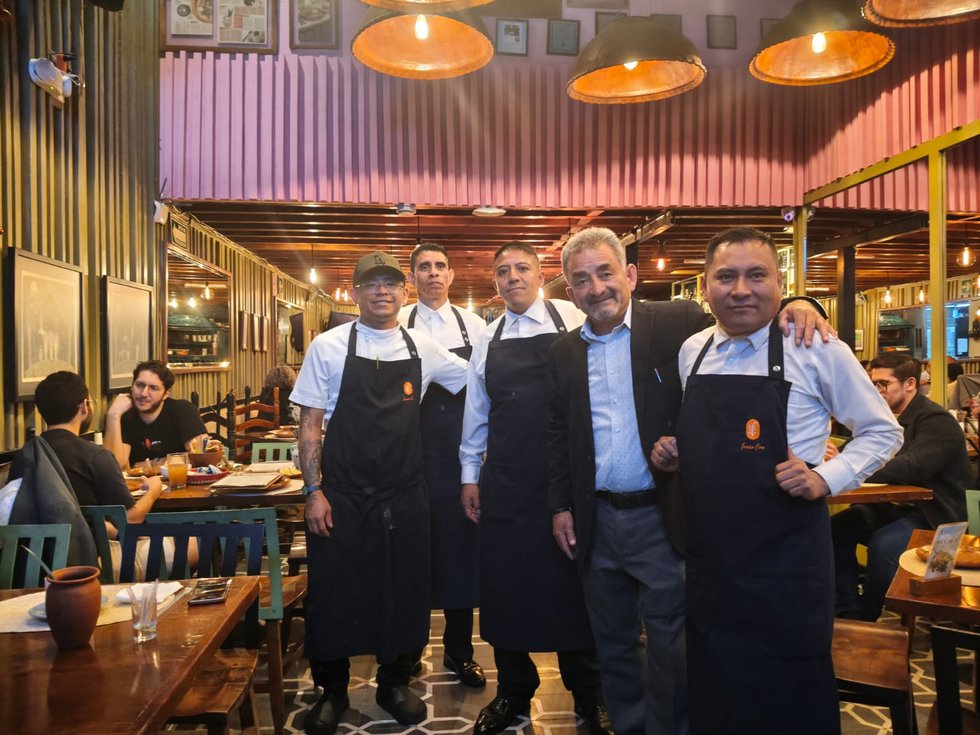
Chef Max Juárez, left (wearing a cap), with some of the Fonda Fina's waitstaff.
By Alfredo Espinola
Mexico City’s Roma Norte neighborhood wakes up early; before the tables fill with conversation and toasts, the sidewalks welcome passersby, office workers, and neighbors strolling through a neighborhood where art galleries, specialty coffee shops, bookstores, and some of the country’s most influential restaurants coexist. Amid this mosaic of offerings, behind an unassuming facade, Fonda Fina has, for over a decade, found its own way to endure. It has never tried to compete to be the flashiest or the most sophisticated place, but rather to remind us that Mexican cuisine finds its greatest greatness when it knows how to embrace.
The idea took shape when Ramón Orraca and Chef Juan Cabrera—joined in the early days by Jorge Vallejo—visited numerous local eateries throughout the city. They weren’t looking to replicate recipes to the letter; they wanted to understand why those places lingered in the memories of those who visited them. They discovered that the true ingredient had never been just the seasoning. It was the sense of belonging.
That’s How Fonda Fina was Born
A restaurant where fideo seco shares the spotlight with tlacoyos, peneques with pipián, braised chamorro, or churros with hot chocolate that evoke family afternoons. Everyday dishes elevated through contemporary techniques, yet always recognizable, always familiar.
Over the years, this project ceased to be a novelty and became a classic in the Roma neighborhood. Not by following trends, but precisely by ignoring them when necessary. While the culinary world went through passing fads, Fonda Fina remained true to one conviction: to cook so that people would return not just for a dish, but for the experience of feeling welcome.
The Chef Who Grew Up With the Restaurant
When Max Juárez, now the restaurant's head chef, arrived at Fonda Fina, the restaurant was just beginning to write its story.
It had been open for only a few months. He was in his early twenties, with some prior kitchen experience and an enormous willingness to learn. What seemed like just a job at the time ended up becoming the place where he would spend virtually his entire professional life.
Today, as he moves through the kitchen with the ease of someone who knows every corner, it’s hard to imagine the restaurant without him.
His path, however, was not a straight one.
He studied gastronomy, but family circumstances changed his plans. His father’s death forced him to leave school before completing his studies and dive headfirst into the trade. Many would have seen that interruption as a setback. He turned it into an opportunity to learn from the place where, he insists, a chef is truly forged: the kitchen itself.
He doesn’t dismiss academic training. Over time, he has come to understand that theory and practice do not compete with each other; they complement one another.
Knowing the history of an ingredient, understanding the origin of a technique, or studying the evolution of a recipe provides tools that enrich daily work. But no school can replace the hours spent in front of a stove, the rhythm of service, or the decisions that must be made when a full dining room is waiting for the next course.
“Limitations only exist in the mind,” he says, with a conviction born of experience rather than mere rhetoric. For him, the best chefs are those who never stop learning, no matter where their training began.
Cooking to Bring People Together
Over time, Max discovered that what he’s most passionate about in gastronomy isn’t just the ingredients or the techniques, it’s food’s ability to bring people together.
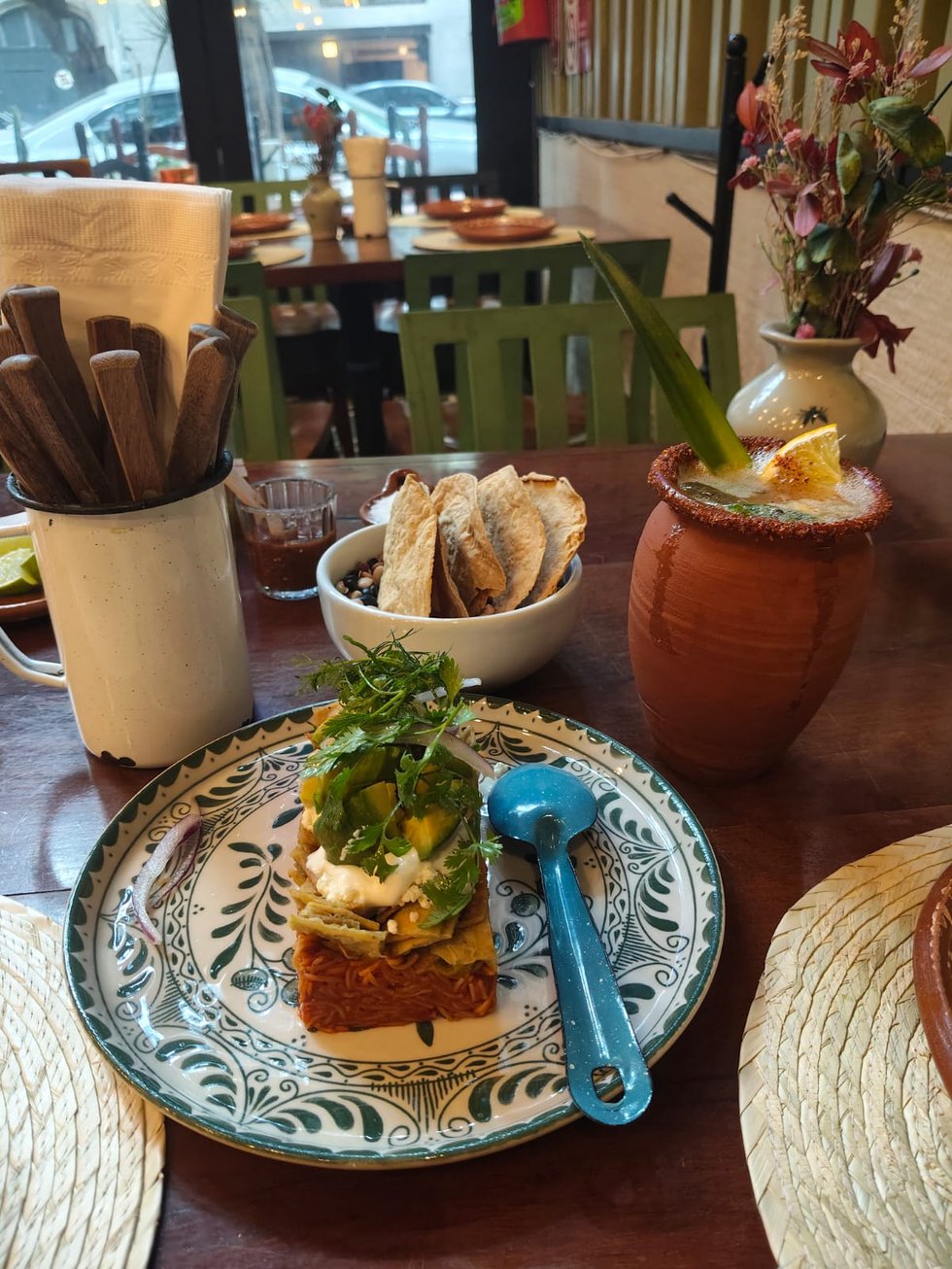
A table can become the setting for a reconciliation, a birthday, a first date, or a long-awaited celebration. Around a dish, conversations unfold that would never have happened anywhere else.
That understanding also transformed the way he cooks.
Each service ceased to be a succession of orders and became a collection of stories. Perhaps that’s why, when asked what the true concept of Fonda Fina is, his answer avoids words like “avant-garde,” “innovation,” or “signature cuisine.”
He prefers to talk about something much simpler: eating well, eating with pleasure, and leaving with the feeling of having been cared for.
Because the famous “apapacho”—the special treatment everyone talks about at the restaurant—doesn’t happen only when the dish arrives at the table. It begins the moment the customer walks through the door, continues throughout the service, extends into the conversation, and lingers long after the meal is over.
This principle aligns perfectly with the vision of Juan Cabrera, who defines the fonda as the place where the working class finds a reward at the end of the day: a comforting meal that reminds them of their mother’s or grandmother’s cooking—and to which diners return time and again out of emotional loyalty rather than habit.
Where Tradition Learns New Ways to Speak
Talking about Mexican cuisine often leads to a world full of nostalgia. Every family has a recipe it considers unbeatable; every neighborhood boasts the best fonda; every diner cherishes a dish in their memory that no other kitchen has managed to match. At Fonda Fina, far from fighting those memories, they celebrate them.
Max smiles when he recalls one of the most common comments they hear in the dining room.
“My mom’s noodles taste better.”
The response is never defensive. On the contrary, for him, that comparison is a compliment. Because it means a dish was able to evoke a memory.
“Home cooking will always have an unbeatable advantage: it’s made from memory,” the kitchen’s philosophy seems to say. And precisely for that reason, the goal has never been to compete with family recipes, but rather to offer a respectful interpretation, crafted with technique, patience, and a deep understanding of the ingredients.
Therein lies the difference between copying a recipe and understanding it.
A traditional restaurant might prepare an extraordinary dish of dried noodles because someone learned how to make it from their mother. At Fonda Fina, that same dish retains its home-cooked essence, but behind it lies a meticulous study of temperatures, textures, and cooking times that diners rarely notice. And that is precisely the intention: for the technique to fade into the background so that only the pleasure of eating remains.
The Classics That Tell a Story
Some restaurants change their menus every season. Others keep certain dishes on the menu out of tradition. At Fonda Fina, there are recipes that remain because the customers simply wouldn’t let them disappear.
Dry noodles with chilaquiles are one such example.
On the surface, it’s a humble dish; however, it captures the essence of the restaurant: familiar flavors executed with precision, balance, and a generous dose of nostalgia.
The pork belly sopes represent another facet of Fonda Fina.
The pork belly is first placed in a long brine to season the meat evenly. This is followed by slow cooking, inspired by Michoacán-style carnitas, and finally a process that dries the skin to achieve an intensely crispy crust with a tamarind glaze. The result is served on a bed of slow-cooked beans, cheese, sour cream, and fresh pico de gallo that balances the richness of the pork. It doesn’t seek to surprise with extravagance; it wins you over with its harmony.
The menu also features peneques with pipián, birria tlacoyos, and braised chamorro with oregano, soy sauce, and recado negro. These are dishes that engage with different regions of the country and, without abandoning their roots, find a new expression within Fonda Fina’s culinary language.
Even the desserts participate in this interplay between memory and innovation—for example, a nogada ice cream and another inspired by a “Gansito.”
These aren’t gimmicks designed for social media. They are exercises in gustatory memory: deeply familiar flavors reinterpreted with contemporary techniques, always in the service of pleasure and never of spectacle.
A Kitchen Without a Single Star
In an era when many restaurants revolve around the figure of a star chef, Fonda Fina has forged a different identity.
Max talks about the team just as often as others talk about themselves.
Each new dish is born from shared conversations, tastings, and trials. Creativity isn’t concentrated in a single person; it circulates among chefs, station managers, and staff who contribute ideas drawn from their own experiences. Some work right away; others require adjustments; a few never make it onto the menu. But they’re all part of the same learning process.
Perhaps that’s why he feels a special sense of pride when he talks about those who started out with him a decade ago. Many now run their own kitchens; others lead teams at prominent restaurants.
He doesn’t speak of this with nostalgia, but with satisfaction—like someone who understands that a kitchen can also be a school, and that a chef’s true legacy isn’t always measured by the recipes he leaves behind, but by the people he helped shape.
The Day the Tables Went Empty
If Fonda Fina’s early years were marked by the enthusiasm of building an identity, 2020 put something much deeper to the test: the conviction to keep going when the kitchen could no longer hear the murmur of diners.
As happened with thousands of restaurants around the world, the COVID-19 pandemic completely transformed the daily routine.
The tables stood empty, the order bells stopped ringing, and the frenetic pace of service gave way to a silent wait.
Max recalls those months with an honesty that needs no dramatization. “It was horrible,” he says.
There’s no better way to describe that moment.
There were days when the kitchen prepared barely a serving of dried noodles, a flan, or a couple of cakes to go. Those who were used to serving dozens of tables watched the hours go by without knowing if the restaurant would manage to open the next day.
But then something happened that no business strategy could have anticipated. Customers began to look out for the restaurant with the same affection with which the restaurant had looked out for them for years.
One woman would arrive with her own containers to save the staff from spending money on disposable packaging. Others placed orders even when they could have cooked at home. Some simply called to ask how everyone was doing. It was those everyday acts that ultimately built a support network far stronger than any advertising campaign.
When restrictions began to be lifted, many of those same customers returned.
Today, they celebrate birthdays, housewarming parties, and anniversaries there. The staff knows their names, remembers which table they prefer, and knows which dish they’ll order even before they open the menu.
“They’re already part of our story,” says Max.
A Classic Without Even Trying
The culinary world often measures success through lists, awards, and accolades. Fonda Fina has received them as well.
Its cuisine has caught the attention of national and international media. It has been recommended by specialized publications and has appeared among the must-visit spots in Mexico City. Figures such as Enrique Olvera, Massimo Bottura, and Rick Bayless have dined at its tables, joining a long list of chefs, travelers, and food enthusiasts who have found here an authentic interpretation of contemporary Mexican cuisine.
However, when you talk to the people who make up the restaurant, those accolades seem almost like an afterthought.
They are not the goal; they are a consequence.
What’s truly important happens every day: when a family returns for the same dish they ordered five years ago; when a neighbor walks in without even glancing at the menu; when a tourist recommends the place because they found something they didn’t expect—cuisine capable of moving people without artifice.
Juan Cabrera often says that Fonda Fina can now be considered a classic of the Roma neighborhood. Not because it has been around for a decade, but because it has remained true to its identity while the surrounding area changed at breakneck speed. That consistency—so difficult to achieve in a city where culinary trends rise and fall rapidly—is perhaps its greatest achievement.
The Future is Simple
When asked where he sees himself in ten years, Max doesn’t talk about awards, new restaurants, or fame. He envisions a simple life: a family, perhaps children, and time to enjoy life away from the restaurant. In that answer lies the essence of Fonda Fina: cooking has never been a race to be first, but rather a way of living, caring, sharing, and enduring over time.
While the culinary world constantly chases the next innovation, Fonda Fina has chosen a different path: perfecting simplicity. Remembering that a freshly made tortilla can be just as moving as the most elaborate dish, that a simple noodle dish can evoke childhood memories, and that technique reaches its greatest virtue when it stops drawing attention to itself and allows the flavor to speak for itself.
After more than a decade, Fonda Fina is much more than just a restaurant in the Roma neighborhood. It’s a place where memories find a table, where family recipes engage with contemporary cuisine, and where every meal confirms that true luxury lies not in the complexity of a dish, but in making someone feel at home.
Perhaps that is its greatest legacy: not having reinvented Mexican cuisine, but reminding us that the best food is the kind that, in addition to nourishing, knows how to accompany.
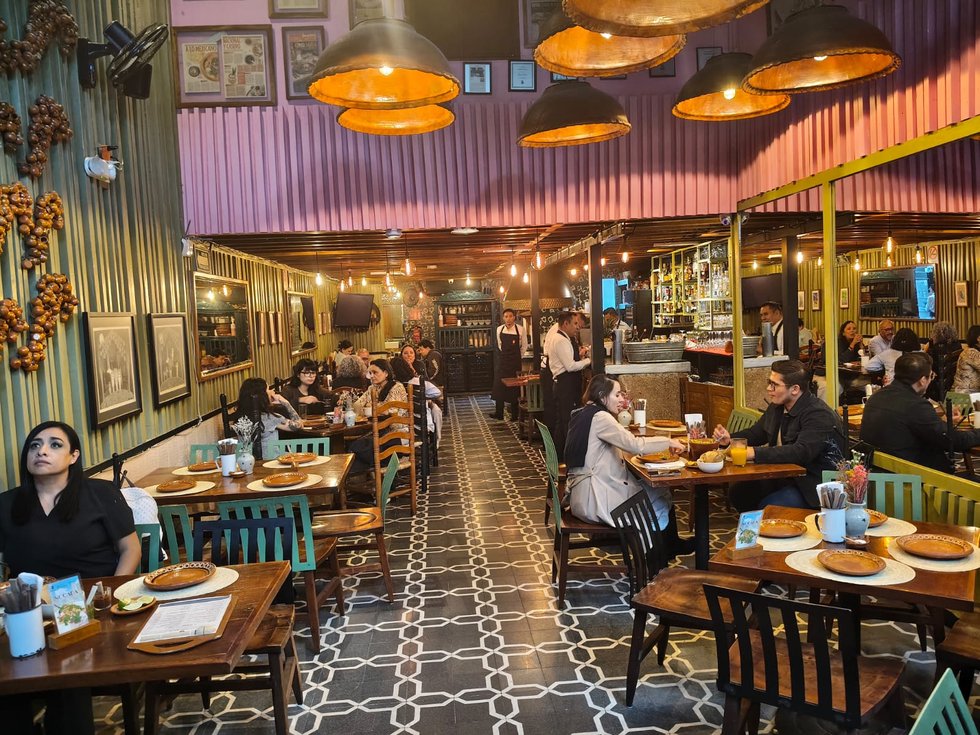
Fonda Fina