
By Alfredo Espinola
Apple Photos Clean Up
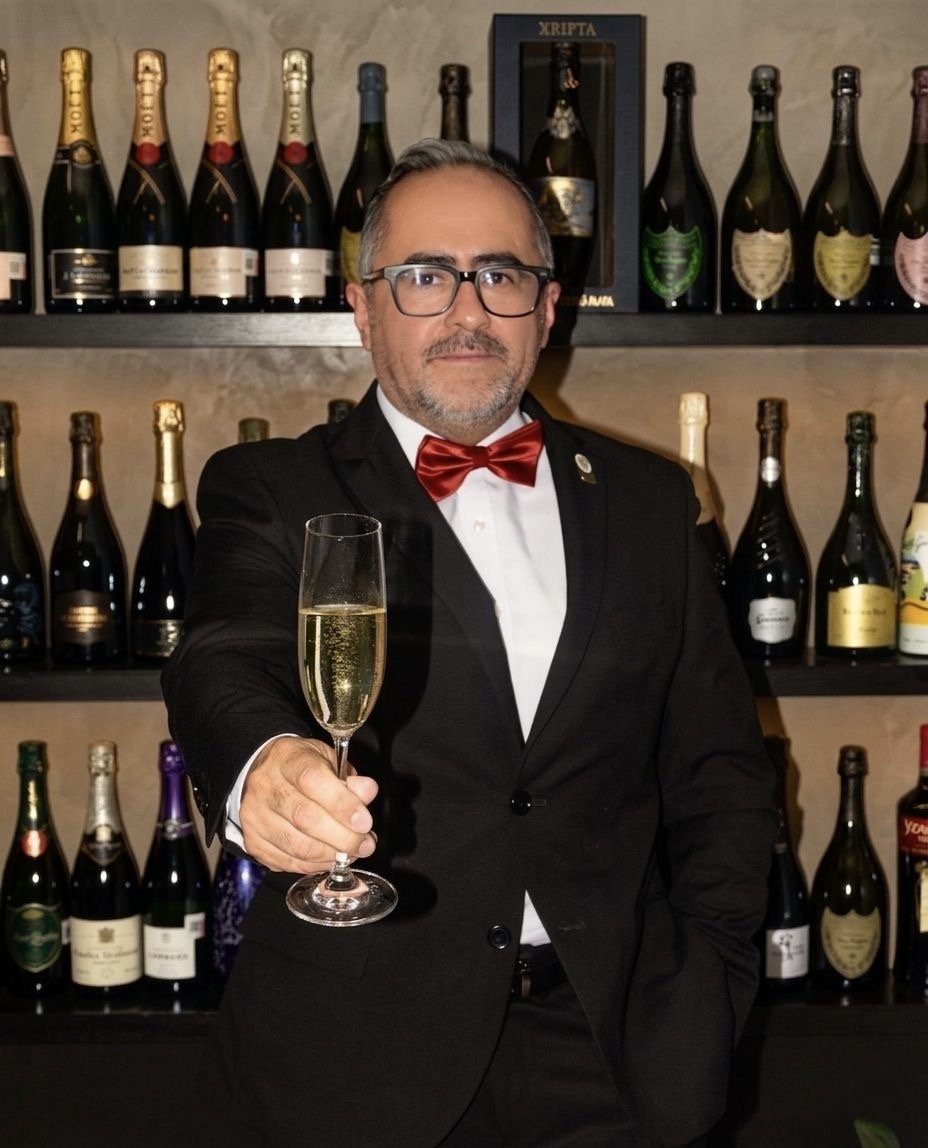
Ricardo Espíndola
In an era when knowledge is often measured by the number of diplomas earned or the number of wines tasted, Ricardo Espíndola effortlessly defies that logic. At 52 years old, with three decades dedicated to the world of sommelier culture, he stands as a rare exception.
Espíndola, founder of the Mexican School of Sommeliers in Mexico City, speaks with the serenity of someone who has traveled through vineyards on different continents, shared meals and knowledge with internationally renowned producers, and trained hundreds of sommeliers. In his discourse there is no room for vanity or for turning experience into a trophy.
Far from assuming the role of an unquestionable authority, Espíndola prefers curiosity over absolute certainty. He understands that wine, like life, is best discovered through questions rather than definitive answers. Perhaps that is why, rather than teaching students to memorize regions, grape varieties, or vintages, he has dedicated 30 years to fostering a different way of seeing: one that recognizes that behind every glass lies a story, a territory, and, above all, people.
When asked how much he knows about wine, he smiles before replying, “The more I study, the more aware I am of what I still don’t know.”
An Unexpected Calling
Nothing in his youth suggested he would devote his life to wine. He studied tourism, drawn to the hospitality industry: hotels, restaurants, and different cultures. Wine was just one more element.
That is, until he discovered how certain bottles transformed the atmosphere at a table: they changed the rhythm of the conversation, compelled people to pause, and invited them to raise a toast. In this way, he sensed that behind every glass there was a story.
His encounter 27 years ago with Pedro Poncelis—a pioneer of the sommelier profession in Mexico—marked a turning point in Espíndola’s life. Studying sommeleria at that time was little short of an eccentricity, and knowledge of wine was just beginning to gain a foothold in the country. Nevertheless, Espíndola accepted the challenge with a mix of curiosity and conviction.
In 2001, he joined Freixenet in Querétaro. There he discovered that wine is never born in the glass. It begins much earlier, in the hands of the viticulturist who gazes at the sky with hope set on the next harvest; it continues in the patience of the winery, where time does its silent work; and it finds its true meaning when it reaches a shared table. He realized a bottle is not simply a product: it is the final link in a chain of trust built by people who, in most cases, will never meet, but who remain united by the same commitment to quality, respect for the land, and the pleasure of sharing.
The School No One Expected
When he recalls the founding of the Mexican School of Sommeliers, Espíndola doesn’t speak of business plans, but rather of a void. In France, Spain, Chile, and Argentina, he discovered that wine was culture: schools, research, and ongoing education. In Mexico, despite the growing quality of its wines, there was no academic institution.
Everyone agreed on the diagnosis: a school was needed. But few were willing to take the risk. Consumption remained low, the profession was barely in its infancy, and wine was associated with a distant luxury.
Espíndola decided to give it a try, because he was convinced that knowledge could transform the way Mexico understood wine. In April 2011, he opened the doors of the Mexican School of Sommeliers in Mexico City.
From day one, he defined the philosophy that would give the institution its identity. The school would not train experts to show off what they know, but rather professionals capable of sharing it. He understood that wine was too vast to be told by a single voice and that each region deserved to be narrated by those who had lived it. With that idea in mind, he brought together winemakers, producers, researchers, and sommeliers from different countries. He wasn’t after celebrities or prestigious names; he sought people with the ability to convey experience, passion, and truth.
For Espíndola, a sommelier is not distinguished by the number of labels he memorizes, but by the sensitivity with which he is able to tell the story behind each bottle. It is the voice of the farmer who waited for the rain at just the right moment, of the winemaker who made crucial decisions during the harvest, and of the family that staked their lives on a piece of land and a tradition. When that story is shared, wine ceases to be a product and becomes an experience that connects people, regions, and memories.
Fifteen years later, that idea has become one of the country’s most influential training institutions. What began with the conviction that wine culture deserved a serious, professional, and passionate space is now a benchmark for those who have decided to make this discipline their life’s calling.
The Mexican School of Sommeliers has woven its history through six strategically located campuses in Mexico City, Tijuana, Mérida, Metépec, Aguascalientes and Querétaro. At each location, the founding philosophy remains intact: to train professionals capable of understanding that the true value of wine transcends the bottle. It lies in the stories behind each label, in the knowledge associated with each vintage, and, above all, in the people who make it possible for a glass of wine to become an experience.
Its academic program has been designed to open the world of wine to all kinds of audiences. It is tailored both for those who aspire to become specialists and pursue a professional career in the world of sommellerie, as well as for those who simply wish to discover, understand, and enjoy the fascinating universe of wine on a deeper level.
From the Professional Diploma in Wine Tasting and Sommelier Training—considered the cornerstone of its educational program—to specialized courses such as Wine for Executives and Fine Grapes I and II, the school offers a teaching model that combines technical rigor with a deep appreciation of wine culture.
The experience is further enriched by wine-tasting afternoons, master classes, and meetings with prominent national and international producers, who share not only their expertise but also the passion that drives one of the world’s most fascinating industries.
Today, 50 classes of sommeliers uphold this legacy. Its students hold key positions at some of the sector’s most prestigious wineries, vinificators, and importers, bringing with them an education that goes beyond technique: a way of understanding wine as a bridge between knowledge, culture, and people.
The Humility of a Glass
The first lesson taught has nothing to do with wine, but rather with the ego. He covers the label with a black sleeve and pours the wine without saying a word. The class begins in silence with the question, “What do you taste?”
Without brands or appellations, the students taste without prejudice. They discover that often their favorite wine is the most modest one and that famous labels can go unnoticed. Espíndola relishes that moment—not because someone gets it wrong, but because the invisible barrier of prestige is broken.
For decades, the language of wine alienated many consumers. Wine lists written for specialists and tastings turned into memory contests; then came the silent customers, those who always ordered the same bottle for fear of mispronouncing a name.
Espíndola answers the inevitable question: “How do I know what a good wine is?” “There is no such thing as the best wine. There is the right wine for each person, for each meal, and for each moment.”
The Year Silence Filled the Glasses
March 2020: restaurants closed, hotels shut down, tastings canceled. For the first time since the school’s founding, Espíndola faced an unfamiliar scenario: how to teach a culture that exists to be shared, when sharing was a risk?
The solution was to invent a method. Each bottle was divided into identical samples sent to the students; everyone received the same wine, the same glasses, and the same instructions. The logistics were enormous, but he didn’t hesitate: he wasn’t just sending wine—he was preserving an experience.
He discovered something unexpected: the screens brought together faces that had never before crossed paths. Students from different cities shared the same class; the school survived, but, above all, it continued to fulfill its mission.
Years later, he would sum up his decision with one sentence: “We never compromise on quality to make things easier.”
Restaurants Will Lead the Way in Wine
Why, with increasingly better vineyards, do Mexicans still feel that wine belongs to only a select few? Espíndola’s answer points to the table.
In Mexico, wine remains a special guest: “Mexicans put chili, lime, salsa, and soda on the table before any other drink”; however, in Spain, Italy, or France, wine accompanies meals from childhood onward.
“Change will happen in restaurants: accessible wine lists, decent glasses—even if the bottle isn’t expensive—and waitstaff who recommend before they sell. Small gestures capable of spreading culture.”
He has seen regions grow that barely appeared on maps 20 years ago. He has worked alongside winemakers who today produce internationally recognized wines. He knows that each new region broadens the conversation—and that this conversation is just beginning.
His great passion remains sparkling wines. Not because they’re a luxury, but because they represent patience and time. A perfect metaphor for life: the best bubbles never appear right away.
The Glass He Never Shared
Interestingly, Ricardo grew up in a family where no one drank. He was the first to open that door. Over the years, he inspired his sister, a nephew, and the younger generation.
But there’s one story he recalls with nostalgia: his mother never fully understood his profession. Every time he tried to explain it, she would respond tenderly, “So they pay you to drink?
On every visit, as he was saying goodbye, his mother would repeat the same ritual: she’d hug him, give him her blessing, and before watching him leave, she’d say with the unmistakable tenderness of Mexican mothers: “Son… but please don’t drink anymore.”
He’d smile, and over time he realized there was no need to explain any further. There are those who understand a profession, and those who simply understand the ones they love.
That’s why, every time he pours the first glass at a tasting and falls silent, he seems to set aside a place for the student he never managed to convince: his mother.
Contact
Want to know more or become a sommelier? Visit the social media sites of the Mexican School of Sommeliers: @SummillersDeMex, www.sommeliersdemexico.com, informes@sommeliersdemexico.com, Facebook: Escuela Mexican de Sommeliers, Instagram: sommeliersdemex.