
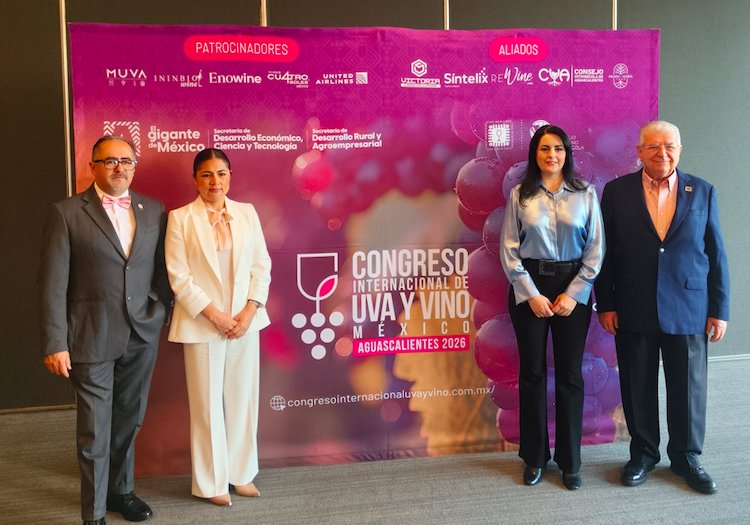
Ricardo Espíndola, Elizabeth Rojas, Nelly Hurtado and Salomón Abedrop
By Alfredo Espinola
In a country where culinary tradition is deeply rooted in gathering, conversation, and celebration, Mexican wine is beginning to establish itself not only as a quality product but also as a cultural, economic, and tourism-driven force with its own distinct identity. Under this premise, the Congreso Internacional de la Uva y el Vino México 2026 (International Mexican Grape and Wine Congress 2026) will occur May 27 to 30. The initiative, which is promoted by Consejo Mexicano Vitivinícola (CMV), seeks to strengthen the sector and project it toward new national and international horizons.
The event, to be held in Aguascalientes, will bring together producers, researchers, academics, business leaders, sommeliers, authorities, and consumers around an industry that is experiencing one of its most dynamic periods.
During the press conference preceding the event, Salomón Abedrop, president of CMV, provided a broad overview of the growth of the national wine industry and its evolution over the past decades.
“The wine industry has a unique characteristic: we are farmers, agribusinesses, and also distributors,” he explained. This integration from vine to glass has allowed Mexican wineries to generate employment, boost regional economies, and also become drivers of tourism.
Today, wine routes are transforming traditionally industrial cities into weekend destinations. Guanajuato, Querétaro, Coahuila, San Luis Potosí, and Aguascalientes are experiencing a new dynamic thanks to wine tourism: full hotels, bustling restaurants, and a growing wine culture.
“We have practically become the fourth-largest source of tourism revenue in Mexico,” noted Abedrop.
But growth is not only evident in tourism; it is also evident in consumption. According to figures shared by the Council, Mexican wine is already the national consumer’s favorite: 39 out of every 100 bottles opened in the country are Mexican.
This data becomes even more significant when considering that historically, Spanish wine dominated the Mexican market. Since 2017, domestic wine has managed to surpass that preference and today maintains its leadership.
The perception that Mexican wine is unaffordable is also beginning to fade. Nearly 30% of domestic bottles are sold for under 300 pesos (about $15 US), while almost half are priced between 300 and 500 pesos. The premium segment accounts for just one-fifth of the market.
“The myth that Mexican wine is expensive no longer corresponds to reality,” he stated.
Added to this is another compelling indicator: although Mexico accounts for just 0.4% of global wine production, it wins around 10% of the medals in international competitions. This recognition has strengthened the perception of Mexican wine’s quality both within and outside the country.
However, the greatest challenge remains cultural.
Currently, average annual consumption in Mexico is 1.5 liters per adult, a figure still far below that of major wine-producing countries. For Ricardo Espíndola, coordinator of the Mexican Wine Fair and representative of the Mexican School of Sommeliers, the challenge is not limited to price or taxes.
“We are dealing with a complex gastronomic culture when it comes to wine,” he reflected. “On the Mexican table, there are chiles, lemons, sauces, soft drinks… elements that naturally do not pair well with wine, as they do in other cultures.”
Even so, he believes progress has been remarkable. He recalled that 25 years ago, championing Mexican wine was a difficult task. Today, domestic labels compete with technical expertise, personality, and quality.
The Congreso Internacional de la Uva y el Vino México will serve as a showcase and meeting point for producers and consumers. “We want everyone to be there: large, medium, and small producers,” said Espíndola.
More than just a tasting, the event aims to become an exercise in collective identity: an open conversation where wine ceases to feel distant and begins to be embraced as part of the country’s contemporary culture.
Innovation and Sustainability for the Future of Mexican Wine
Elizabeth Rojas, director of CMV, explained that the congress will address key topics such as sustainability, climate change, efficient use of resources, intellectual property, consumer trends, and market strategies. Researchers from Spain, Chile, and the United States will share perspectives on the global challenges facing the wine industry.
In addition, there will be sessions dedicated to machinery, technological innovation, supply chain management, logistics, and traceability—sectors that are fundamental to strengthening the competitiveness of the Mexican industry.
“Wine is connected to more than 20% of the country’s economic activities,” emphasized Rojas. “That is why this conference aims to foster partnerships, knowledge exchange, and a vision for the future.”
Aguascalientes: Land of the Future
The choice of Aguascalientes as the host city is no coincidence. The state is experiencing a wine industry revival with over 1,350 hectares planted, 20 vineyards, 24 wineries, and more than 200 labels. “The wine route attracts more than 200,000 visitors a year,” Nelly Hurtado, an advisor to the State Government’s Social Policy Unit, noted that the industry’s growth has also boosted tourism, the regional economy, and international recognition of its wines.
The presence of states such as Baja California, Coahuila, Querétaro, San Luis Potosí, Hidalgo, Jalisco, and, of course, Aguascalientes, will allow for a comprehensive snapshot of the current state of the national wine industry.
Working on the Tax Situation
In parallel with production growth, the sector also seeks to advance public policies that facilitate Mexican consumers’ access to wine. One of the central issues is the current tax structure, particularly the Special Tax on Production and Services (IEPS), which directly impacts the final price of bottles.
The Mexican Wine Council is currently working on proposals to modify the tax scheme and align it with international models where the tax is calculated based on alcohol content rather than the product’s commercial value.
Meanwhile, the industry continues to do what it does best: sowing patience, building identity, and defending, glass by glass, a narrative that today no longer needs external validation.
Mexican wine is no longer an emerging promise. It has finally become a serious conversation about territory, quality, and culture.