
By Natalia Otero
The story of Mejía Barbacoa began long before Omar and Alondra Mejía arrived in California in 1997. Its origins date back to 1932, when Miguel Mejía Téllez, Omar’s grandfather, began preparing and selling barbacoa in Tulancingo, Hidalgo. Since then, making this dish has become a family tradition passed down from grandparents to children, uncles, cousins, and nephews.
For Omar Mejía, continuing the legacy of his grandfather and father is his main motivation. For Alondra Mejía, the venture has also been a source of pride and joy, while teaching her how to manage a family business, organize a team, and share her recipes with people from different cultures.
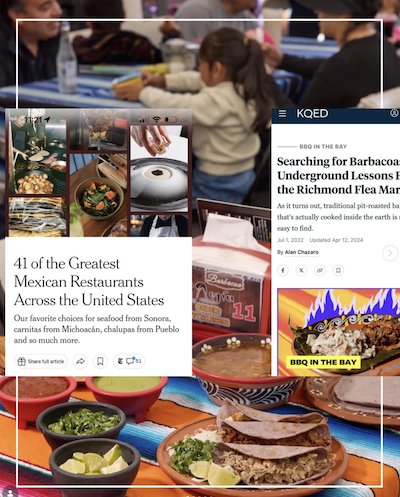
This year, they were recognized by The New York Times as one of the top 41 Mexican restaurants in the United States. It’s an achievement they celebrate with great pride, since—even without a permanent location—they’ve managed to transcend borders and make it onto a list that includes Michelin-starred restaurants.
A Century of Family Tradition, a Story of Craftsmanship
Grandmother Mejía ran a small restaurant in Tulancingo, Hidalgo. It was there that Grandfather Mejía began making barbacoa. Nearly a century later, that story continues in Richmond, California, where Omar and Alondra Mejía keep the culinary heritage of several generations alive through Mejía Barbacoa.
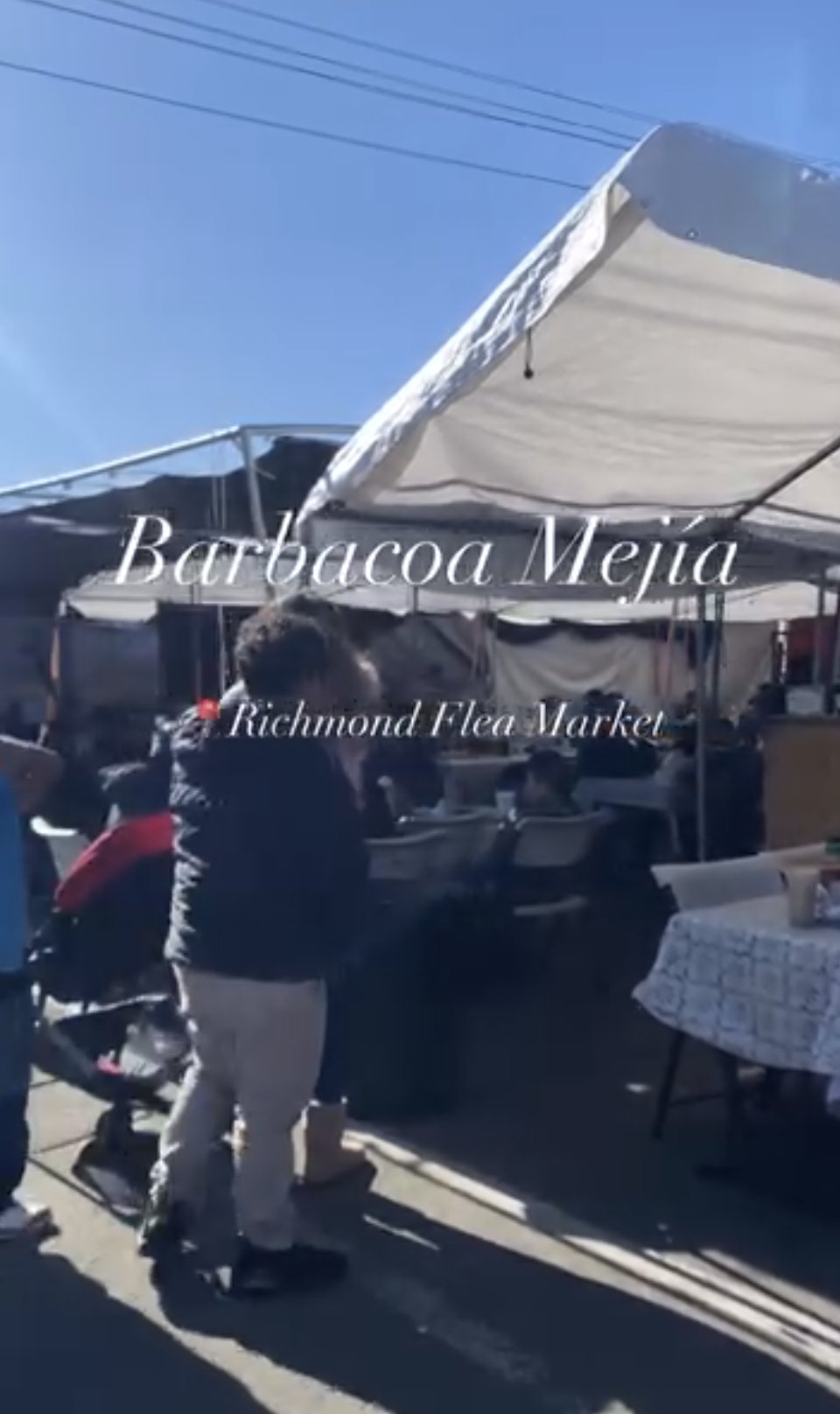
The business operates within the Richmond Flea Market and is not a conventional restaurant: it’s a family-run stand that opens its doors on weekends to those looking to try Hidalgo-style lamb barbacoa, as well as other traditional dishes such as barbacoa chicken, mixiotes, and tlacoyos.
For the Mejías, the main motivation has never been simply to sell food. It’s about preserving a technique, sharing the flavors of their homeland, and continuing the work begun by their ancestors, who trace their roots to the Aztecs.
“For me, what motivates me is the legacy my grandfather left in Tulancingo, Hidalgo—the legacy for which our family is known. Bringing that legacy to the United States, continuing my grandfather’s legacy, and honoring our culture is my greatest motivation,” explains Omar Mejía.
From Gatherings with Friends to a Family Business
Although Omar’s family had been making barbacoa in Mexico for generations, their venture in the United States began about 22 years ago, when Omar prepared some barbacoa to share with a few friends. The response was so positive that people began asking him to make more.
“Once, I told some people how we made the barbacoa. We built the oven and prepared a batch to share. They liked it, and I started selling it a long time ago—selling to friends and delivering it,” he recalls.
“A lot of people liked it, so I started selling and delivering to people’s homes. My wife helped me with the deliveries and the cooking. Back then, it was just a small operation; people started to get to know us, and then we began selling takeout,” he says.
At first, the project revolved around his day job and get-togethers with coworkers.
Social media, especially Facebook, allowed them to reach more people. Many of those who discovered them were originally from Hidalgo and recognized the flavors of their homeland in the dish. However, for several years the activity remained sporadic, more like a project among friends than a formal business. Production was small, and sales were mainly made to order.
The opportunity to set up shop at the Richmond Flea Market came when they were offered a space in 2022. They decided to create a business structure to what had until then been a side project, though they have kept their jobs. Omar works in carpentry and construction, while Alondra works at a school and handles the business’s administration.
“It hasn’t been easy for us, because it was during the pandemic. But then, since people had already tried our product before and knew what it was all about, they started coming back,” explains Alondra.
Over time, they expanded their menu. Barbacoa remains the centerpiece of their offerings, but they’ve added other Mexican snacks to provide a more well-rounded experience for those who visit their stand.
A Technique that Requires Time and Experience
The preparation of barbacoa begins long before it’s time to serve it. In Hidalgo, the traditional method involves cooking the meat in an underground oven built from volcanic rock and adobe bricks. Firewood is left to burn until it forms embers, and once the oven reaches the right temperature, maguey leaves, a tub, and a grill are placed inside, with the meat arranged on the grill.
Everything is then covered with more maguey leaves, a sheet of metal is placed on top, and the oven is sealed with burlap sacks and dirt to prevent steam from escaping. Cooking can take between six and eight hours, depending on how hot the oven has become. This is a traditional method practiced by the indigenous Aztecs with other meats. Once the Spanish arrived, lamb or goat was incorporated into the process.
In California, they’ve had to adapt certain aspects of the process to meet market demands. Their ovens are elevated, but they still use firewood and maintain the extended cooking time. On average, the process can take around 12 hours.
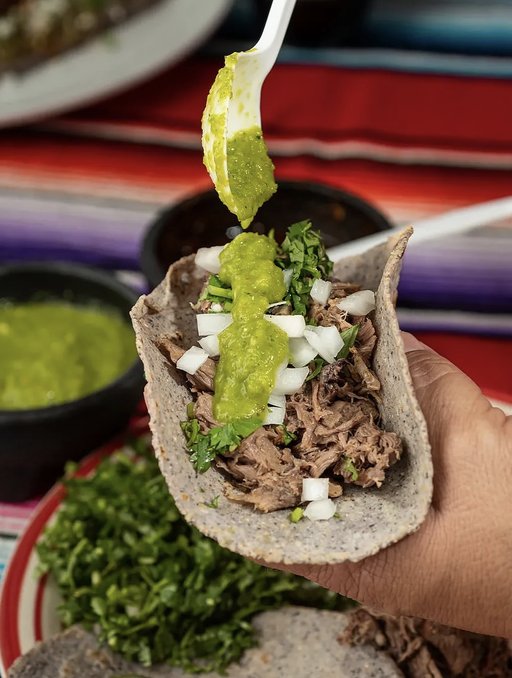
A taco from Barbacoa Mejia
Experience is essential to achieving the desired result. It’s not enough to simply leave the meat in the oven for a set number of hours. “It depends on how hot you get the oven. You can’t measure it; you have to judge it based on experience. You can leave it in for eight or ten hours, but if you don’t heat the oven properly, it won’t cook. Then you have to maintain the heat and keep it hot enough,” explains Omar Mejía.
That knowledge doesn’t come solely from the practice he’s gained in California. Omar began learning as a child, working with his father and other relatives. “We’ve been doing this since I was nine. First we’d wash the lambs, then help with the processing—putting them in the oven, taking them out, and selling them,” he recalls.
Selecting the meat is another key aspect. In the United States, animals must be processed in facilities that comply with the relevant regulations. Omar explains that he also makes sure to monitor the animal’s diet and know their origin.
“For me, the most important thing is the quality of the meat. I can tell the difference. I buy them, raise them, and feed them. I have a pen on a ranch I rent. Here, they’re fed in the same way or similarly to how we do it back home, with grain concentrate and minerals,” he notes.
The Authentic Taste of Hidalgo
One of the reasons Omar decided to start selling barbacoa in California was his desire to offer a preparation different from what many people were familiar with. He had tried versions that didn’t match the flavors he grew up with, and he wanted the public to have the chance to taste his family’s recipe.
“I once tried barbacoa at a place, and to be honest, I didn’t like it. I was used to something different. For me, the idea was for people to try it. There were people from other states in Mexico who didn’t like lamb because they said it had a strong, greasy taste. And I’d say, ‘It’s not like that.’ I wanted them to try Hidalgo-style barbacoa and the flavors of Mexico,” he says.
That’s why, in addition to taking care with the meat and the cooking process, they pay special attention to the ingredients, spices, and sauces. Omar believes that, at times, businesses modify their recipes to suit the tastes of a broader audience, but those changes can end up straying from the original recipe.
At Mejía Barbacoa, the sauces are an important part of that identity. Alondra says that some customers need to get used to their intensity, especially those unfamiliar with the tradition of Hidalgo-style sauces.
“We’ve had to educate people and tell them it’s spicy. Usually, when you go to a restaurant, you order guacamole and it’s not spicy. We don’t serve guacamole—it’s not on the menu—and sometimes people order it thinking our salsa verde is guacamole. But no, it’s spicy,” Alondra explains with a laugh. “Many try it, and I love it when they say they liked the red salsa. I laugh because at first I warn them it’s spicy, and then they end up loving it.”
In addition to lamb barbacoa, the menu includes chicken barbacoa, a traditional dish from Hidalgo that’s wrapped in maguey leaves and served with red adobo, nopales, and pork rinds. They also offer mixiote, where the meat is cooked wrapped in maguey leaves, and blue corn tlacoyos stuffed with beans or requesón, served with nopales, onion, cilantro, and queso fresco.
A Business That Grows With the Family
Although Omar is the one who learned the trade directly from his father and other family members, Mejía Barbacoa runs thanks to everyone’s hard work. Alondra is in charge of administration; she organizes the team and coordinates the tasks needed to keep the stand running every weekend.
Her children also pitch in. The oldest, Omar Joseph Mejía, helps out in the business, as does Ariana, the youngest, who is ten years old. The family also has the support of others who assist with making tortillas and serving customers.
One of the experiences that has made them most proud is seeing how the family tradition has even reached London, thanks to their daughter Vivian Mejía. She is a professional dancer and traveled to London to study acting and dance. There, she connected with the small Mexican community and discovered a taco shop called Proper Tacos. Eventually that led to an opportunity to help the restaurant develop several new Mexican dishes.
“It gives us great satisfaction that our food is making an impact over there and has crossed the U.S. border,” says Alondra. “The experience of having an American audience has also been a joy and a source of satisfaction. Many English-speaking people try our food and say, ‘Oh my God, this is amazing! This is so tasty, so good!’” Alondra explains.
Despite their growth, Omar and Alondra haven’t yet decided whether to open a traditional restaurant. The idea appeals to them, but they’re also aware of the demands involved in running their own establishment in California: permits, regulations, operating costs, and rent.
For now, the food cart in Richmond allows them to keep their day jobs, work as a family, and maintain a structure that fits their needs. They haven’t ruled out growing, but they also don’t want expansion to take them away from what makes their concept special.
From their grandmother’s eatery in Tulancingo to the food cart they run today in Richmond, the Mejía family’s story demonstrates how a culinary tradition can travel, adapt, and reach new audiences without losing its identity.
Mejia's Salsa Verde
5 jalapeño peppers
2 cloves of garlic
¼ white onion
6 or 7 sprigs of cilantro
Fry the jalapeños in oil until the skin is slightly charred.
Then grind them with the cilantro, onion, garlic, and salt.
If you want it spicier, add a few serrano peppers.