
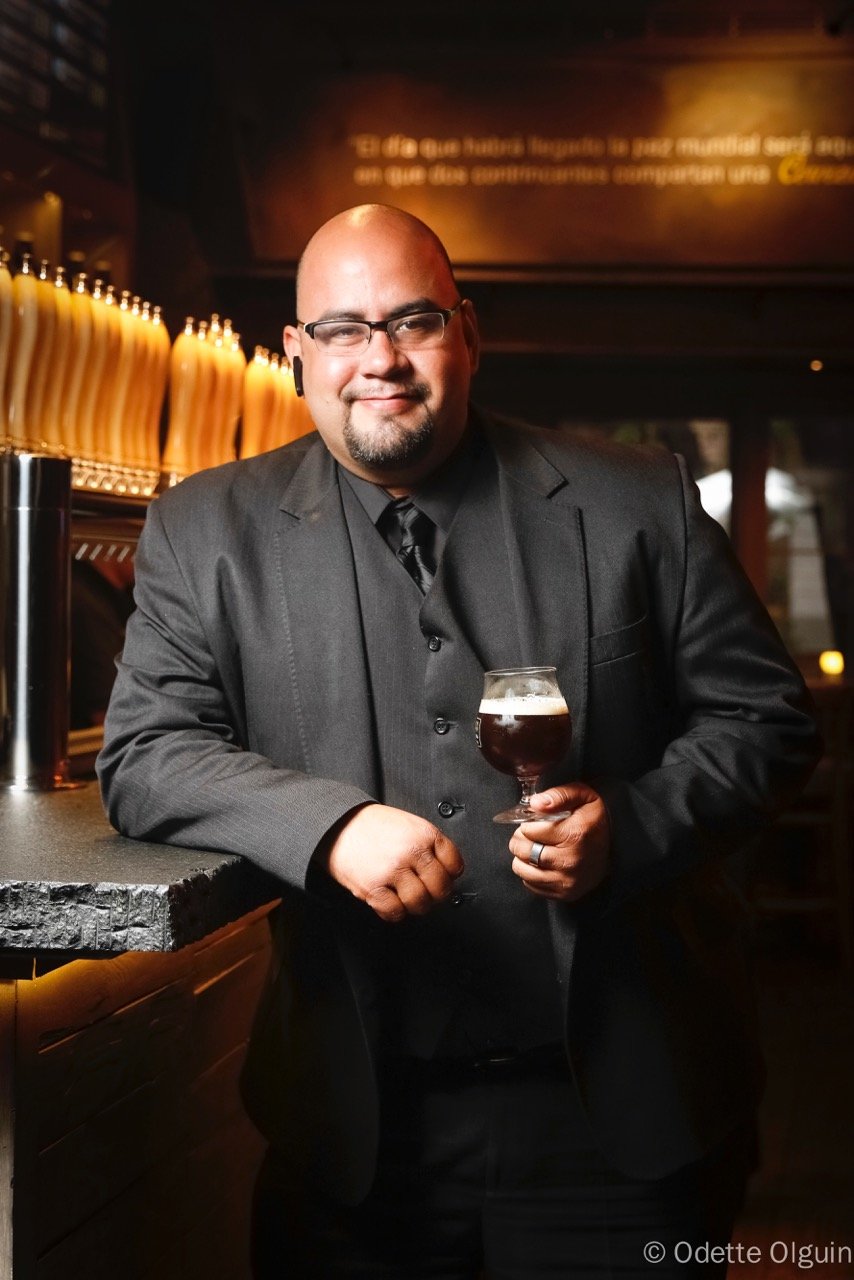
Francisco Olachea
By Alfredo Espinola
Nearly every young man loves beer, of course. But not many use beer to focus their career. That’s exactly what Francisco Juventino Olachea Martínez, a native of Colima, Mexico, did.
Olachea, age 48, is today an instructor on the topics of beer and distilled beverages for Asociación de Sommeliers Mexicanos in Mexico City. He’s also a Certified Cicerone®, Master Mezcalier, Cigar Sommelier, among other titles, and he’s an essential creative figure in Mexico’s liquor industry.
But it all started at age 25, when he decided to focus on beer.
Why beer (other than the obvious reason)? Because it brought together everything that interested him: biology, fermentation, culture, and gastronomy.
He had been studying biochemical engineering and other sciences at National Autonomous University of Mexico (UNAM), while simultaneously developing an interest in social anthropology and economic systems. He returned to Colima and completed his Biochemical Engineering degree, graduating with one of the highest GPAs in his class. That moment marked the beginning of his professional career.
The Starting Point: Beer as a Convergence
His initial academic focus was craft beer. His thesis -- centered on physical, chemical, and sensory analysis -- took him to international stages and introduced him to an industry that was just beginning to take shape in Mexico. But his role was not merely that of a participant, but of a builder.
From that point on, he spearheaded:
- The creation of specialized certificate programs.
- The training of judges.
- The organization of competitions that are now benchmarks in Latin America.
Beer was the starting point, but it became a laboratory where he consolidated his method, language, and community.
Over time, the technical foundation that Olachea built evolved into a broader mission: to professionalize and structure the fermented and distilled beverages industry.
Olachea has served as:
- An international judge in competitions such as the Pacific Beer Cup and Aro Rojo.
- An instructor and trainer on platforms such as Cerveza México.
- A technical consultant on projects involving beer, mezcal, wine, sotol, miske, and mead.
- A contributor to institutional initiatives such as the Mexico Mead Cup.
His impact, however, is not limited to events or certifications.
The Legacy: Building a Network
More than 200 trained judges and over 40 competitions organized in countries such as Mexico, Ecuador, Colombia, and Guatemala are figures that speak to his reach. But what is truly significant is what happens next.
Many of his students have become international leaders, expanding a network that continues to grow today and shares a common premise: “It’s not enough to produce well; you have to deeply understand what you’re producing.”
It is in this transition from training to influence that the true scope of his work is defined.
Three Pillars: Science, Interpretation, and Structure
Olachea’s vision rests on three fundamental pillars:
- Engineering: the producer.
- Sommeliery: the interpreter and communicator.
- Administration: the structurer and sustainer.
This combination allowed him not only to understand the beverages but also to develop ecosystems around them. Understanding a beverage involves traversing these three levels.
That is why, in 2017, he decided to expand his scope and venture into other beverages: mezcal, mead, and cider. His learning was not solely academic; he immersed himself in the field, worked alongside master mezcal makers, and absorbed the empirical knowledge that exists only in the field.
At the same time, he revived his family’s beekeeping heritage, leading him to become a pioneer in training mead judges and, later, cider judges in Latin America.
His approach has always been the same: to elevate the quality and professionalism of artisanal beverages.
Transdisciplinary Philosophy of Mexican Distillates
For Olachea, Mexican distillates cannot be understood through a single discipline: they are transdisciplinary by nature.
“It’s not enough to bring together experts. You have to understand everything,” he says.
In every spirit—whether mezcal, tequila, sotol, or raicilla—the chemistry of fermentation, the biology of agave and other raw materials, the rural economy, the history of communities, and the anthropology of the land all converge.
“It’s not just a drink: it’s a living system,” Olachea asserts.
That vision has made him a bridge between science, tradition, and culture, capable of interpreting the spirit not only in the glass but in everything that makes it possible.
The Real Challenge: Awareness
He speaks of an underlying problem: a lack of awareness. Self-deprecation, disconnection from the countryside, the undervaluation of artisanal work—“We’re destroying mezcal,” he warns.
“While investment is concentrated on brands, restaurants, and marketing strategies, its origin—the countryside—is neglected, and without the countryside, there is no future.”
His stance is clear: the solution lies not solely in opening new markets, but in transforming the way we understand what we consume. Educating the consumer, dignifying the producer, protecting the environment. Creating sustainable models where economic value is not detached from cultural and environmental value.
The Personal Turn: Understanding Oneself
Olachea shares something very personal with us—something many people experience but that is often overlooked, misunderstood, or even hidden. He tells us that his life reached an abrupt turning point. In 2025, he received a diagnosis that reshaped his story: Level 1 autism (Asperger’s) with Attention-Deficit/Hyperactivity Disorder (ADHD).
Far from being a limitation, this was a revelation. “It’s like putting on glasses for the first time,” he says.
What for years had seemed like distraction suddenly made sense; hyperfocus, intensity, and his unique way of processing the world ceased to be noise and became structure. From that point on, he learned to organize, delegate, and direct his abilities with precision.
That “well-directed chaos” not only explains his career path: today it is the core of his method.
Vision for the Future
In the coming years, his vision is focused on reviving traditional beverages that remain overlooked or at risk today: from ancient fermented drinks to regional spirits. He advocates for their protection through mechanisms like geographical indications, as well as a comprehensive revaluation of Mexico’s gastronomic heritage.
“To speak of Mexican spirits is to speak of something far deeper than a drink. It is entering a realm where science explains but does not replace; where tradition guides but is not idealized; and where the future depends on what we are capable of understanding and protecting today.”
In every sip there is an invisible chain: land, time, hands, and knowledge. Breaking it is easy; sustaining it requires awareness.
Olachea puts it bluntly: “True value lies not in the bottle, but in the origin. And as long as that origin remains at risk, any talk of quality or prestige will be incomplete.”
Because in the end, Mexican spirits don’t need to be watered down to conquer the world. They need to be understood.