
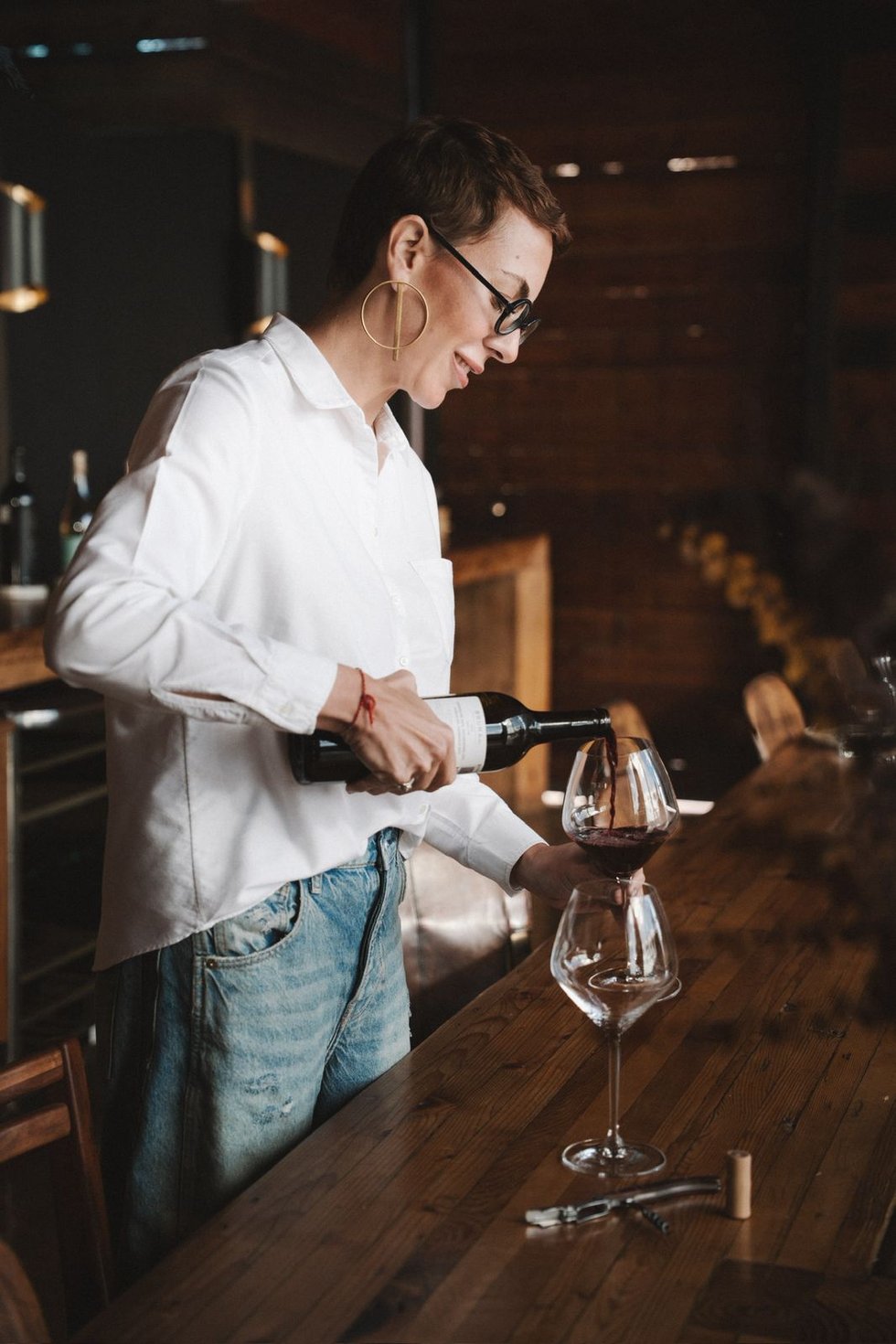
María de Lourdes Martínez Ojeda
By Alfredo Espinola
Some people enter the world of wine for academic reasons or for status, while others are already part of it purely by instinct, even if they don’t yet have the technical knowledge to explain it. In the case of María de Lourdes Martínez Ojeda, wine did not first appear in a glass, but in her family’s memory—which encompasses recollections of those Sundays at the ranch, the endless after-dinner conversations, the scent of damp earth, and the gallons of wine her grandfather would fill in Ensenada, as if continuing an inherited ritual.
Before becoming one of the most important voices in Mexican winemaking, Lulú Martínez was a girl deeply connected to the land. A native of Ensenada proud of her roots, she was aware from a very young age that she belonged to a family that had helped found the city and was shaped by an agricultural heritage that stretched back generations. Her great-grandmother had planted vineyards in San Vicente more than 90 years ago; they didn’t make wine back then, but they grew grapes for Bodegas de Santo Tomás. They also grew tomatoes, onions, chiles, and watermelons. Wine was merely part of a life deeply connected to the countryside.
For Lulú, wine has never been merely a technical matter; much less a luxury, she explains to us, “Wine is togetherness, it is nourishment, it is a way of sitting down at the table and recognizing oneself in others.” She recalls that, “I saw that wine was always linked to those moments of communion, to hugs, to food, to family celebrations.”
At 18, she traveled to France with the intention of studying international law. She wanted to be an ambassador; however, fate—or perhaps intuition—ended up taking her down a different path. In Bordeaux, she discovered the School of Oenology and realized she could represent her homeland from a different vantage point: through wine.
She studied viticulture and oenology in Blanquefort, then agronomy in Bordeaux, and finally specialized at the Faculty of Oenology in the same city. Her career advanced rapidly within some of France’s most important projects: she worked at Château Smith Haut Lafitte and later at Château Brane-Cantenac, where she remained for nearly a decade alongside Henri Lurton.
While France offered her structure, tradition, and prestige, Mexico continued to beat silently within her.
It was Lurton himself who, fascinated by the potential of the Guadalupe Valley and Lulú’s family vineyard, decided to take a chance on Baja California. In 2015, she returned to Mexico after sixteen years abroad to open Bodegas Henri Lurton.
And something changed forever.
Lulú recalls one of those first harvests as a defining moment. It was midnight; the destemmer had broken down, and tons of grapes were waiting. Then a neighbor she didn’t know appeared: Ray Magnussen. He lent them a brand-new machine he had just bought, without asking for anything in return.
“In France, that would never have happened to me,” she confesses.
That night she understood something essential about Mexico: collaboration as a natural, almost instinctive act. That deeply Mexican capacity to help before asking.
“That day I decided I didn’t want to go back to France,” Lulú says.
Since then, her philosophy has been clear: Mexican wine can only grow collectively.
That’s why she speaks of the Guadalupe Valley as a community rather than a competition. A young territory where the possibility of building an identity together still exists.
In 2017, another important phase began: her work as an oenological consultant for Bruma, a project she eventually joined full-time as a partner and director. And in 2025, the story came full circle in an almost poetic way: she became a consulting winemaker for Bodegas de Santo Tomás, the very winery historically linked to her family on both sides of her family tree.
“I don’t even know any more if I chose something or if life simply led me there,” she says wistfully.
But if anything defines Lulú Martínez, it is precisely that blend of intuition and destiny. She constantly speaks of listening to the land, the vineyard, and her intuition.
She asserts that all winemakers leave school with the same technical knowledge, but not all develop the same sensitivity. And for her, that is where the true difference lies: “Making wine is much more than just numbers.”
She tells us that when she walks through the vineyards, she prefers to do so alone. She needs silence. She observes the foliage, the energy of the countryside, the birds, the humidity, the balance of the plant. But above all, she observes what cannot be measured: the emotion, the tension, and the elegance.
Lulú seeks wines that accompany, not that intrude. Wines with depth, but also with subtlety. Wines that have an emotional thread running through them.
That same sensitivity has also led her to question certain elitist discourses surrounding wine; laughing, she tells us, “You don’t need to be an intellectual to enjoy wine—sometimes we take ourselves too seriously.” And then she dismantles any sense of solemnity with a simple yet powerful idea: wine is food.
You don’t need to memorize grape varieties or talk about tannins to enjoy it. Just sit down at the table, share a bottle, and see how your body responds. If the wine invites another glass, if it complements the conversation and whets your appetite, then it works. It’s that simple.
Perhaps that’s why, when she talks about the future of Mexican wine, she doesn’t focus on international prestige or medals. She focuses on the countryside, the terroir, and agriculture.
Because if there’s one thing she’s certain of, it’s that Mexico knows how to work the land. “We don’t have centuries of European winemaking tradition, but we do know how to cultivate. And wine is born from that.”
She’s excited to see new plantations, better agricultural practices, and vineyards more attuned to their climate and identity. She dreams of returning to a more holistic approach to the ranch: livestock, cheeses, orchards, and olive oil. A complete ecosystem where wine once again becomes part of an agricultural way of life and not merely an aspirational product.
She also speaks honestly about being a woman in a historically male-dominated industry. For years she believed the issue had been resolved, but recently she has sensed some resistance.
“It didn’t bother anyone when there was one woman. But when there started to be many, the discomfort began.”
However, far from a confrontational stance, Lulú advocates for something different: leadership through collaboration. “We’re not here to fight. We’re here to build.”
Perhaps that perspective stems precisely from her way of understanding wine: as a space for connection, not imposition.
When asked what wine she herself would be, she smiles and thinks for a few seconds, finally answering, “I’d be a vintage champagne, with a certain maturity, a certain depth; but also with freshness and lightness.”
The description seems spot-on, because there’s something deeply luminous about the way she approaches her craft: a blend of experience, sensitivity, and serene joy.
Perhaps the scene that best sums up who Lulú Martínez is doesn’t take place among barrels or during harvests, but at an imaginary table: three chairs, three glasses, and, across from her, her great-grandparents. There, wine ceases to be an industry and becomes a legacy.
Before recognition came the desert, wagons, nights in a tent, and a family that staked everything on an empty land. That is why, when she thinks of them, Lulú does not speak first of success, but of gratitude.
“I would thank them for the legacy, because it was not just for them; it was for the generations that follow here,” she describes with longing.
For her, the vineyard has never been just agriculture: it is living memory. A silent conversation between those who planted before and those who continue to care for the land today.
The wine she would share with her ancestors wouldn’t be the most prestigious one, but a Sauvignon. The very one that brought her back to Mexico. The one opened on Sundays at her mother’s house to accompany family meals: “It’s not pretentious. It’s a wine that brings people together.”
And perhaps that is the true philosophy of Lulú Martínez: understanding that the most important bottles aren’t always the most complex, but those capable of bringing a family together around a table.
Because in the end, when Lulú speaks of wine, she is really speaking of family, of time, and of those who sowed before so that others might remain.
Today, as she plants new vineyards, experiments with vermouths, and passes on her love for the land to her children, Lulú Martínez understands that the true legacy lies not solely in the bottles. It lies in that silent intuition that, generation after generation, continues to guide the way back home.