
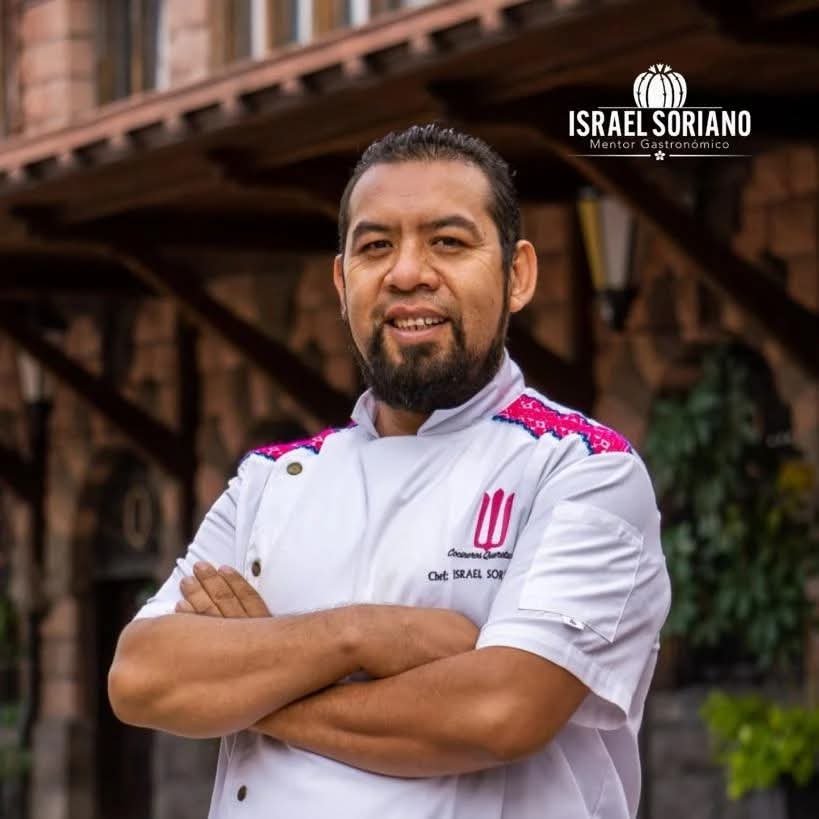
Israel Soriano
By Alfredo Espinola
Israel Soriano doesn’t cook just to feed people. He cooks to preserve memory. Amid casseroles, native corn varieties, and recipes that seemed destined to be forgotten, he has built one of most solid culinary offerings in the Mexican state of Querétaro.
But Soriano’s story does not begin in a prestigious restaurant, nor behind the scenes of a professional kitchen. It begins in a house where the aroma of freshly boiled beans mingled with the silence left by an absence too great for a child to bear. His mother’s untimely death changed the course of his life when he was just five years old. It was then that his grandmother, Esperanza Ruíz, opened much more than the doors to her home: she gave him a different way of understanding the world.
In that house, no one was exempt from learning the daily chores: sweeping, ironing, washing, cooking. Household tasks knew no gender or hierarchy; they were part of one’s upbringing. While other children ran after a ball, Israel discovered that a sauce could tell stories and that perfectly cooked rice demanded the same patience as any great work of art.
Without realizing it, he was building the language that would shape his entire existence.
The first recipes were simple: beans, rice, sauces pounded in a molcajete. Yet behind each dish lay a much deeper lesson: cooking was an act of love—and of discipline—and, above all, of respect for those who would sit at the table. Those lessons were never written down in a cookbook; they remained etched in the memory of a boy who watched his grandmother’s every move with rapt attention.
As the years went by, that curiosity found a new outlet in middle school. While most teenagers chose workshops in electricity, technical drawing, or computer science, Israel made a decision that at the time seemed to defy all conventions: he signed up for the cooking workshop.
When he finished middle school, he announced at home that he wanted to study the food and beverage business. His father objected immediately. To him, cooking didn’t represent a respectable future. He wanted his son to choose another profession—a career that offered greater stability and prestige.
Israel, however, had already made up his mind.
That disagreement ultimately changed the course of both their lives. Israel left home and started at the very bottom of the culinary industry: washing dishes at a corporate kitchen in his hometown of Mexico City. It was endless shifts with his hands in hot water washing utensils, but the work instilled a determination that never left him.
As he progressed in the field, he worked as a steward, grill chef, cook, sous chef, executive chef, corporate chef, and director of food and beverage. Each position represented a new stage of learning. He never considered one role inferior to another, because for him, knowing every corner of a kitchen was essential to understanding it as a living organism.
He worked at iconic hotels in Mexico City—Hotel Nico, Camino Real, Sheraton, and Mustache—as well as at the Bellini at the Omni in Cancún, the Mayan Palace in Vallarta, and the Marqués de los Cabos, where he encountered different approaches to professional gastronomy.
Paradoxically, the place where he would find his true culinary voice would not be the capital where he was born, but a state he had first visited merely as a summer tourist: Querétaro.
There Israel discovered an extraordinary cuisine that almost no one was paying attention to.
Cooking a Region
When Israel Soriano moved permanently to Querétaro a little over two decades ago, he realized that many Queretaro residents were unaware of the richness of their own cuisine, which had been overshadowed by the fame of other Mexican traditions. To learn more, he consulted studies, traveled through communities, and spoke with traditional cooks to document recipes passed down from generation to generation.
The result was the discovery of a culinary landscape as diverse as it was surprising. Across its five regions, moles, native corn varieties, nopales, chickpeas, chiles, meats, and ancestral techniques coexist, each telling the story of its communities. Queretaro’s cuisine was never limited; it was simply waiting for someone willing to reveal the greatness that had gone unnoticed for years.
That discovery completely transformed his professional outlook.
In 2015, he founded the Querétaro Chefs Association with a clear purpose: to position the state’s gastronomy as a heritage worthy of national and international recognition. The goal was to build a community capable of elevating local products, strengthening culinary identity, and demonstrating that Querétaro, too, could speak to the world through its kitchens.
In 2024, he opened Casa Concheros, the first restaurant entirely dedicated to Queretaro cuisine, choosing a path that few dared to take: respecting the essence of traditional recipes while blending them with contemporary techniques.
In his kitchen, yellow chickpeas, Amealco mole, chivo tapeado, pollo al cuñete, and other historic dishes coexist with Querétaro wines, artisanal cheeses, and local producers who represent the state’s current culinary scene. There is no contradiction between the past and modernity. Both eras can sit at the same table when there is respect for their origins.
That same philosophy runs through all his business ventures. Whether in a café, a bakery, or a restaurant, he ensures that most of his ingredients come from Querétaro producers. Organic eggs, artisanal cheeses, fresh ingredients, and regional suppliers are part of a vision that views gastronomy as an economic and social driver. Buying local isn’t a business strategy; it’s a way to strengthen the community that gives meaning to every dish.
The Journey Has Always Been the Destination
Some measure success by the number of restaurants opened, the awards received, or a brand’s expansion. Israel Soriano prefers a different metric: how many people discover, for the first time, that Querétaro also boasts a cuisine capable of inspiring.
His culinary crusade has transcended the state’s borders. He has taken Mexican cuisine to international stages in France, Spain, Portugal, Argentina, and the United States. Every trip has the same purpose: to debunk the stereotypes that for years have reduced Mexican cuisine to a succession of tacos, nachos, and burritos.
“This really tastes like Mexico.”
That’s the phrase he most often hears when he serves a blue corn gordita, a traditional mole from Amealco, or a dish made with ingredients deeply rooted in the Querétaro region. Beyond the culinary praise, those words represent a cultural victory. They mean that someone, on the other side of the world, has discovered a part of Mexico that rarely appears on gastronomic postcards.
Paradoxically, he believes the greatest challenge isn’t abroad. It’s at home.
He often observes that it is Mexicans themselves who are unaware of the richness of their culinary heritage. In Mexico, many traditional dishes are being displaced by passing trends or by offerings that have little to do with local history. For Soriano, restoring that appreciation begins by sparking a simple emotion: curiosity. The fact that someone is willing to travel to a small town to try a traditional dish is already a huge achievement.
That commitment also explains why the Querétaro Association of Chefs has maintained a steady pace of work since its founding. It doesn’t just bring together culinary professionals; it seeks to raise awareness about the value of local products, promote the exchange of knowledge, and strengthen a gastronomic identity that for a long time remained fragmented.
Recognition has, inevitably, followed.
In 2023, Soriano was named Person of the Year by Ciudad y Poder magazine, an honor he views as a commitment rather than a prize. “It’s confirmation that people are noticing your work. You have to keep reaffirming that commitment day by day,” he says.
Challenges and High Points
For Soriano, every stage has been a high point. “The first time I washed dishes, I was at the peak of my career, because that’s what I wanted to do. The first time I put on a chef’s jacket, too. I’ve enjoyed every step of the process,” he says. After a 31-year career, he acknowledges that cooking is a demanding craft that requires constant reinvention. “The main challenge is staying relevant,” he states.
His career includes international certifications, awards in Spain and Mexico, and a spot among the top six chefs in Latin America in 2008, according to Latin American Chef. However, he insists that the most valuable recognition comes from diners at the table. “That’s the real reward,” he affirms.
Memories Are Cooked, Too
There’s one question that breaks the calm with which Israel Soriano has carried the conversation. It has nothing to do with restaurants, awards, or international travel. It’s about someone who is no longer with us.
If you could prepare a dish for just one person, who would you cook for?
The answer comes without hesitation. For his grandmother. For the woman who taught him to cook when life was just beginning to teach him, too, the meaning of loss. The same woman who filled the void left by his mother’s death and turned a home kitchen into the first emotional refuge for a child who needed to feel loved again.
What’s surprising isn’t just the choice, but the dish itself: a lobster.
His grandmother never had the chance to taste it. She once confessed to him that, after a lifetime of cooking for others, that was one of the few flavors she had never experienced. Israel cherishes that conversation to this day. That’s why, if time could grant him one last shared meal, he wouldn’t prepare the most complex or award-winning recipe. He would cook a lobster just to see her smile as she discovered a flavor she’d always longed to taste.
In that moment, it becomes clear that, for him, cooking has never been merely a technical exercise. It’s a way of saying thank you.
The same emotion surfaces when he remembers his father.
For years, the two went their separate ways. His father never understood why a young man insisted on dedicating his life to a profession that seemed so uncertain at the time. That refusal marked a difficult period. Israel left home to pursue a dream that no one else seemed to share.
But time, like good cooking, transforms what seems impossible.
In 2008, when Israel competed in one of the most important contests of his career, he convinced his father to attend the finals. At first, his father agreed reluctantly. He never imagined that that afternoon would change their relationship forever.
When first place was announced, pride overcame any resistance.
His father embraced him through tears and asked for forgiveness. He confessed that he had never understood the extent of his son’s talent or the depth of his calling. He feared he had held back a son who simply wanted to cook. Israel did not respond with reproach. He thanked his father for the upbringing he had received and understood that every decision—even the most painful ones—had also helped shape the man he had become.
Years later, shortly before the pandemic, he prepared a cod dish for his father, inspired by his grandmother’s recipe. His father enjoyed it with the enthusiasm of someone who discovers that flavors can also reconcile families. It was one of the last dishes they shared before his father’s passing in 2020.
Perhaps that is where the true essence of Israel Soriano lies.
Not in the restaurants he runs or the projects that continue to grow. Nor in the national and international accolades that mark his career. His greatest legacy lies in having understood that a kitchen can become a space of identity, memory, and reconciliation.
The story of Israel Soriano is that of a man who turned the kitchen into a destination and a memory. From the beans of his childhood to the sparkling wines of Querétaro, each of his dishes is a story that celebrates the identity of a state and the passion of a craft.