
By Natalia Otero
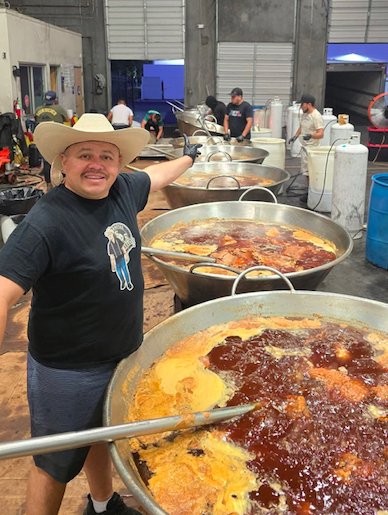
Roberto Rivera, aka Carmelo, shows the carnitas being prepared.
Food businesses choose different paths to expansion, but few take the route of Carnitas Carmelo: When the owners decided to grow the carnitas business north of the border of Mexico, they created a kind of gastronomic circus that crosses the United States, bringing their cuisine to large groups from city to city.
The business’ story began shortly before the pandemic in Quiroga, Michoacán, when the Rivera family launched a business to package the carnitas that they had been making for five generations. The pandemic temporarily dashed those dreams – the company went bankrupt. But they didn’t give up. Roberto Rivera, the fifth generation leader, decided to revive the business and take it on the road.
The Circus is Launched
In 2024 Rivera created a traveling version of the carnitas production facility and drove north over the border. Now, every weekend, in different parts of the country, his team—more than 25 people brought from Michoacán—sets up what he describes as a circus: copper pots, fire, music, endless lines, and a promise that defies all commercial logic: with money or without, there’s always a taco.
For the past two years, this concept has traveled through 42 U.S. states, mobilizing dozens of people, tons of equipment, and a culinary tradition spanning over 140 years. At the helm is Rivera, better known as “Carmelo” — a name he inherited from his grandfather and now a brand that transcends the commercial.
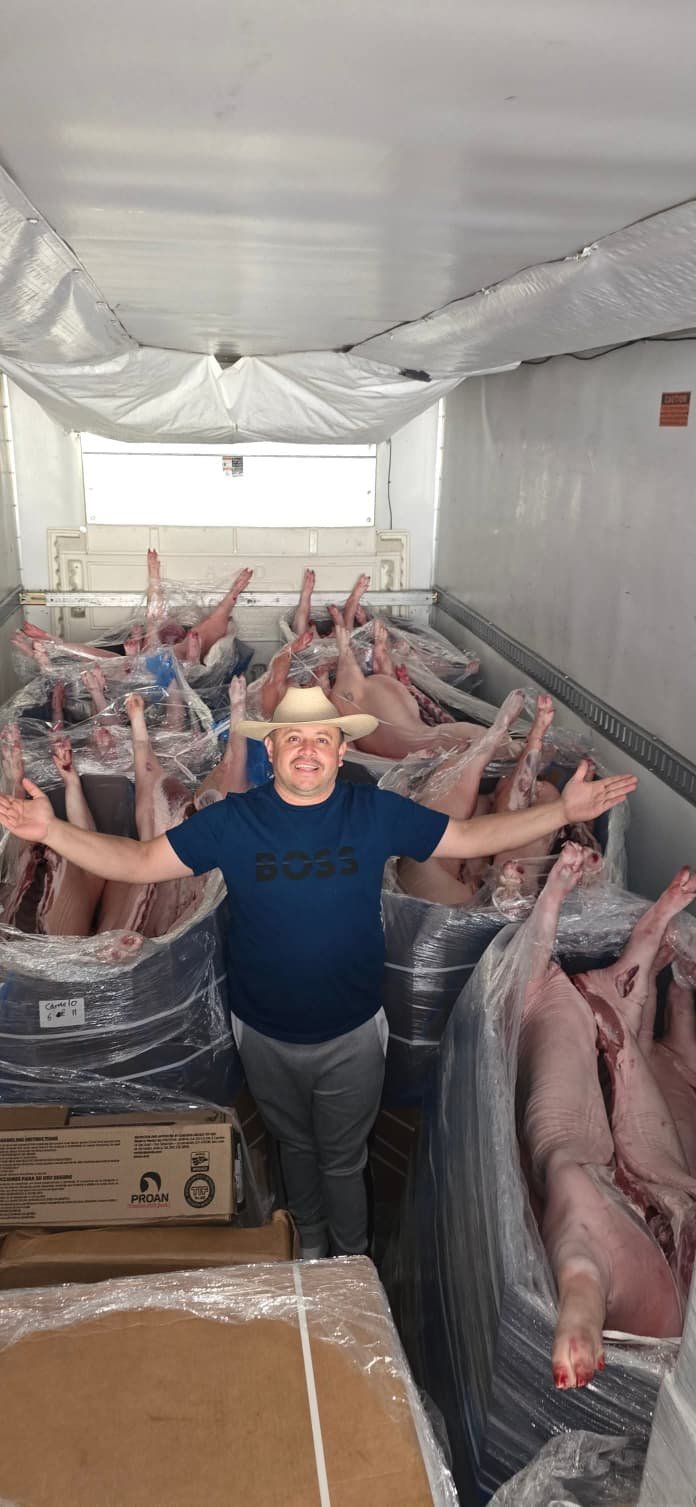
The essential ingredient.
What makes this venture special is not just the scale—events that can draw between 10,000 and 15,000 people over a weekend—but the commitment to preserving an ancestral method.
“What sets us apart dates back to the time of Hernán Cortés. We continue to preserve what is authentic and original: water and salt, fried in the pork’s own fat. Every part of the animal has its own flavor and cooking time; we prepare it authentically so it doesn’t lose that flavor,” Rivera explains.
That respect for the process begins long before the fire. Rivera grew up in that world, in Quiroga, Michoacán, a place where carnitas are not just food, but identity.
“I grew up in that kitchen and learned everything from going to the pen, choosing the animal, bringing it in, slaughtering it, butchering it, and then serving the customer. We make our living from our diners. Every day I learn something different while making carnitas. And in the end, I know only this truth: I haven’t finished learning how to make carnitas. I say this because you never stop learning how to make carnitas. Anyone who says they know how to make carnitas, I don’t believe them. You never stop learning, because every pig is different. “
Tradition, Community, and a Taco for Everyone
Carnitas Carmelo’s operating model combines elements of industrial production with spectacle. They move around the country based on people’s requests. They plan generally a month in advance so they can find an appropriate location in each community they visit.
“Rolling refrigerated units, an industrial kitchen in a trailer… it’s like putting on a circus, a traveling festival, to introduce Michoacán’s carnitas,” says Rivera.
The team follows a precise logistics schedule, he explains: “On Monday we wash up and load the trailer. On Tuesday we travel for 10 or 20 hours. On Wednesday we rest. On Thursday the meat arrives. On Friday we set up the circus with the pots. And on Saturday, we’re open for business.”
Customers are alerted to the upcoming event through social media. Rivera has become a “celebrity influencer” in his own right on social media, including Instagram, TikTok, and Facebook.
The result is an experience that goes beyond food. Entire families come not only to eat, but to socialize, dance, and reconnect with a cultural memory. In times like these, having spaces like this is the best way to resist, as families come together around the tradition of food and music, and everyone has a good time—where it doesn’t matter if you have money or not, you can enjoy good food and a great atmosphere.
One of the most striking elements of the concept is a practice that defies financial logic: giving away food even to those who don’t buy anything.
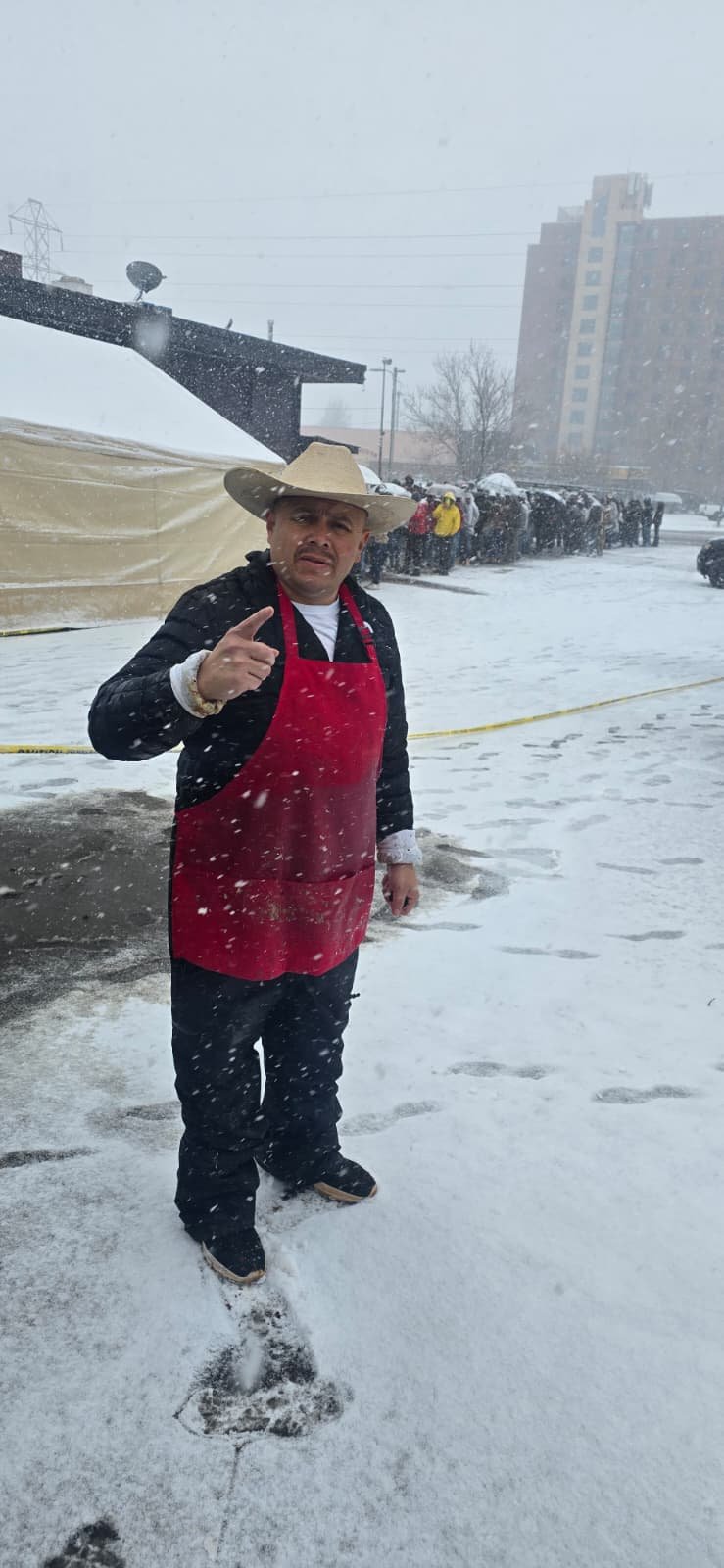
Rivera shows the crowds lining up for his carnitas even on a wintry day.
“The magic of what we do is that, with money or without, I welcome you with a taco. We give away a taco. If a thousand people show up, we give all a thousand a taco,” he says, adding that this philosophy isn’t a marketing strategy, but a direct legacy from his grandfather. “They said that my grandfather, even if you didn’t have money, would give you a taco… ‘just as you give, God multiplies it.’”
Naturally, enough people do pay for their meals that the “traveling circus” can continue.
They work like this, moving around, until November, when they all return to the town of Quiroga, rest, and then start over in March.
Cooking for Thousands… With the Same Flavor
The technical challenge of cooking carnitas for thousands of people without losing consistency is one of the project’s greatest achievements. At recent events, the team has cooked up to 200 pigs in two days.
“It’s not the same to cook one or two pigs, but to cook on that scale and get the same flavor,” explains Rivera. Despite the scale, the method remains the same: copper pots, direct heat, and a cooking process that respects the timing for each cut. “Here, the only secret is love, care, water, and salt—and the hand of God,” he says.
The impact of Carnitas Carmelo also extends to job creation and the promotion of production chains linked to Mexico: from pig farming to handicrafts. Twenty-five people participate in each tour, all from Michoacán. But jobs are also created in agriculture, as the pigs must be fed unprocessed organic corn.
The carnitas packaging plant, which survived the bankruptcy, generates nearly 300 jobs in Quiroga, Michoacán. Added to this is the pork production chain prior to packaging: feeding the pigs, slaughter, cutting, and then packaging.
The project also incorporates cultural elements such as clay pots, copperware from Santa Clara, and references to the region’s artisanal traditions.
“Michoacán is the soul of Mexico… to speak of Michoacán is to speak of gastronomy, culture, and traditions,” Rivera says proudly.
Bringing a Feeling
Carnitas Carmelo doesn’t easily fit into a single category. It’s not just a restaurant, nor just an event, nor just a brand. It is a mobile structure that embodies a way of understanding Michoacán cuisine as a collective act.
In every city, the scene repeats itself: the pots are lit, people arrive, the lines grow, and regardless of the weather or the wait, someone always receives a free taco.
Because, in Rivera’s words: “It’s not a business. What I brought is a feeling.”