
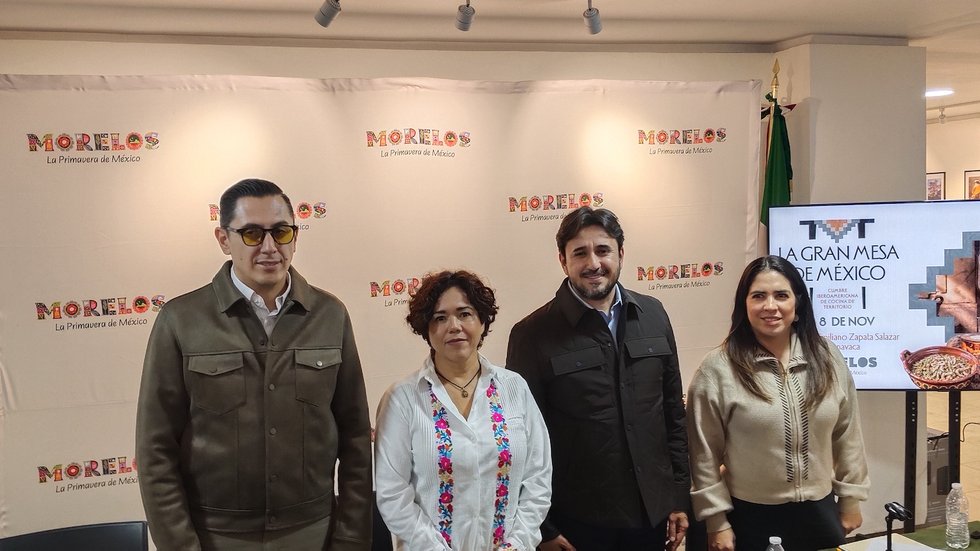
Left to right: Miguel Armando Moreno Madariaga, Gisela Rivera del Ángel , Daniel Altafi Valladares and Fernanda Gaxiola Camacho
CUERNAVACA, Morelos — Traditional cooks, producers, artisans, academics, students and chefs from across Mexico gathered in Cuernavaca from November 6 to 8 for La Gran Mesa de México, an Ibero-American summit on regional cuisine promoted by Morelos state tourism authorities.
The event was held in Plaza General Emiliano Zapata, the square that once served as the center of public life in Morelos. Organizers billed it not as a food festival but as the first step toward a permanent forum on the cultural, social and economic value of traditional cuisines.
Fernanda Gaxiola Camacho, the state’s undersecretary of tourism, said when the summit was presented that its aim was to put traditional cooks — the people who have passed culinary knowledge down through generations — at the center of the conversation. Talking about cuisine, she said, also meant talking about identity, community and the production systems that sustain daily life.
Raising Morelos’ culinary profile
Gaxiola said the cuisines of Morelos remained closely tied to rural life, community festivals and ancestral eating habits, but had long been overshadowed by better-known culinary destinations, including neighboring Mexico City, the State of Mexico, Puebla and Guerrero.
She cited the state’s agricultural output and range of ingredients as grounds for wider recognition, and said its proximity to the capital and its position as a gateway to central Mexico left it well placed to attract visitors seeking food-centered travel.
Organizers said the summit was also meant to recognize everyone along the production chain, from farmers and artisans to cooks and the communities that have kept the state’s culinary diversity alive.
Kitchens, a market and an academy
Miguel Armando Moreno Madariaga, executive director of the Morelos Tourism Trust, said the site was laid out as a single route through the food, crafts and culture of the participating states. The program included about 30 traditional cooks from Morelos and the invited states, along with 40 stands for producers, artisans and entrepreneurs.
The summit was organized into four areas:
Regional Kitchens: Traditional cooks shared recipes, ingredients and techniques, and explained the origins of their dishes.
Regional Market: Selected producers and artisans offered products tied to the land, local crafts and Mexican cuisine.
Cooking Stage: Traditional cooks, chefs and specialists led live demonstrations.
Gran Mesa Academy: Lectures, panels and roundtables addressed biodiversity, ingredient seasonality, culinary tourism, the transmission of knowledge and food sustainability.
Veracruz as guest state
Veracruz was the guest of honor at the first edition and had its own pavilion. Gisela Rivera del Ángel, an adviser to the Veracruz Ministry of Culture, represented Governor Rocío Nahle García and Culture Minister Xóchitl Molina González at the presentation.
Rivera said Veracruz shared Morelos’ commitment to recognizing the communities that preserve culinary and cultural traditions. She announced that the state’s delegation would bring four traditional cooks from different cultural regions of Veracruz, along with some of its signature products.
The Veracruz program centered on the state’s vanilla and coffee and also included art, workshops, talks and community tourism projects. Among them was a presentation by researcher Sagrario del Carmen Cruz Carretero on Afro-descendant heritage and its influence on regional culture.
91 custodians of culinary knowledge
The Morelos Ministry of Tourism had identified 91 traditional cooks it considers custodians of the state’s culinary knowledge, 36 of whom had been included in a catalog of recipes, stories and other elements of the state’s food identity.
Organizers said participants would be chosen to give balanced representation to each of the state’s seven regions.
Heritage designation and a manifesto
Daniel Altafi Valladares, Morelos’ secretary of tourism, closed the presentation by placing the summit within a broader state strategy to recognize and preserve its culinary heritage. Every dish, he said, reflected a chain of relationships that ran from the soil through production to the table, sustained by producers, cooks, artisans, merchants and their families.
Altafi said the summit was intended as a starting point for consolidating existing preservation efforts, including a proposal to declare Morelos’ traditional cuisine part of the state’s intangible cultural heritage, accompanied by a plan to protect and strengthen its practices and knowledge.
He also said a manifesto based on the conclusions of the summit’s working sessions would be presented at its close, with the aim of turning the discussions into concrete action for the future of traditional cuisines.