
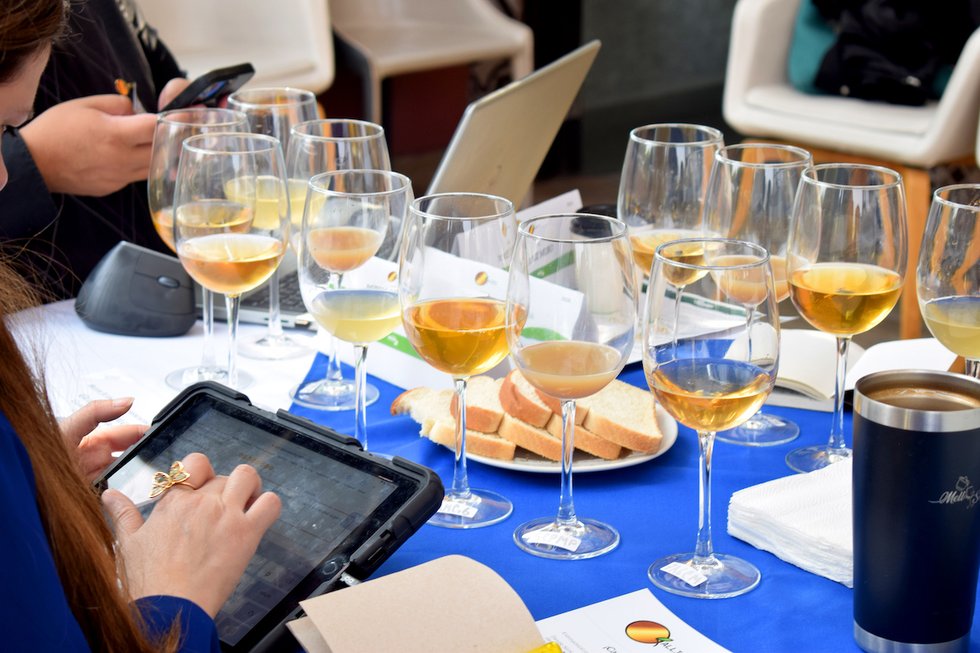
Judges evaluate ciders at Copa Kallisti
By Alfredo Espinola
The inaugural edition of Copa Kallisti—the first Mexican competition specializing in cider, perry, and related products—took place from August 13 to 15, 2026. More than just a competition, the event sought to spark a conversation about Mexican cider products, recognize the work of their producers, and help professionalize a category with growing gastronomic and cultural potential.
The response was significant: 62 samples from Puebla, Coahuila, Querétaro, Chihuahua, Guanajuato, Jalisco, and Tlaxcala were submitted to this inaugural edition, bringing together producers, judges, sommeliers, industry professionals, and individuals interested in learning about the present and future of cider in Mexico.
From Tree to Glass
The story began on August 13 in Tlaxcala, at the facilities of Sidra y Vinos Pelayo, where judges, sommeliers, industry professionals, and media representatives were able to get a firsthand look at the drink’s origins.
Trucks loaded with apples, the reception of the fruit, the crushing process, the freshly extracted juice, and the fermentation process offered a glimpse into a process rarely seen once the bottle is already on the table.
There was also an opportunity to taste the fresh juice and get an up-close look at the work that goes into a bottle of cider. The event was hosted by Sidra y Vinos Pelayo and Sidra Robin Hood, who opened their facilities to share the process and document the experience.
For Copa Kallisti, taking industry professionals and the media to the source was also a way to remind everyone of something essential: behind every bottle lies a region, raw materials, knowledge, hard work, and, above all, people.
The following day, the 62 samples were evaluated at the Bodegas Alianza Terrace in Mexico City. The first edition concluded on August 15 with the awards ceremony at Wine Bar by CMB.
A Category That Deserves to Be Taken Seriously
Evaluating a beverage is also a way to recognize it.
The 62 samples were scored by a panel of six judges under the direction of Víctor Fajer, Chief Judge of the Copa Kallisti. The panel consisted of Steve Ayon, Jacqueline Jiménez, Jorge Muro, Erik Novas, Mirell Riviello, and Nayeli Estrada.
The competition was supported by the Mexican Academy of Sommeliers and featured judges affiliated with the Beer Judge Certification Program (BJCP).
The results included gold, silver, and bronze medals. But the purpose of the Kallisti Cup does not seem to be merely to hang a medal around a bottle’s neck.
The intention is for each award to serve as a tool to recognize the work done and, at the same time, to continue strengthening a category that still has a lot of ground to cover.
Beyond December
For years, for many Mexican consumers, the word cider has been inextricably linked to December, to celebrations, and to end-of-year toasts.
Copa Kallisti aims to broaden that perception.
Mexico has producers, regions, and offerings capable of demonstrating that cider can come in different styles, profiles, and culinary possibilities. It can accompany a meal, be part of a tasting experience, or simply be enjoyed for what it is.
The goal, then, is simple but important: for cider to be discovered, appreciated, and enjoyed throughout the year.
Many Hands Behind the First Edition
Copa Kallisti was led in this first edition by Francisco Olachea, Director of Copa Kallisti; Víctor Fajer, Head Judge; and Ivonne Soto, Coordinator of Copa Kallisti.
The project also benefited from the work of the Copa Kallisti Committee, composed of Lizbeth Hernández, Casandra Lozano, Pamela Escamilla, Sandra Corales, Mega, and Julio César Cruz.
Behind the event, as with any project that seeks to build something from scratch, was a collective effort. The goal: to establish a professional foundation for the development of cider, perry, and their derivatives in Mexico.
The Start of a Conversation
The first edition of Copa Kallisti left behind more than just medals.
It created a forum where producers, judges, sommeliers, industry professionals, media representatives, and enthusiasts could come together to discuss a beverage that is part of the history of various regions and is now seeking a new place within the Mexican gastronomic scene.