
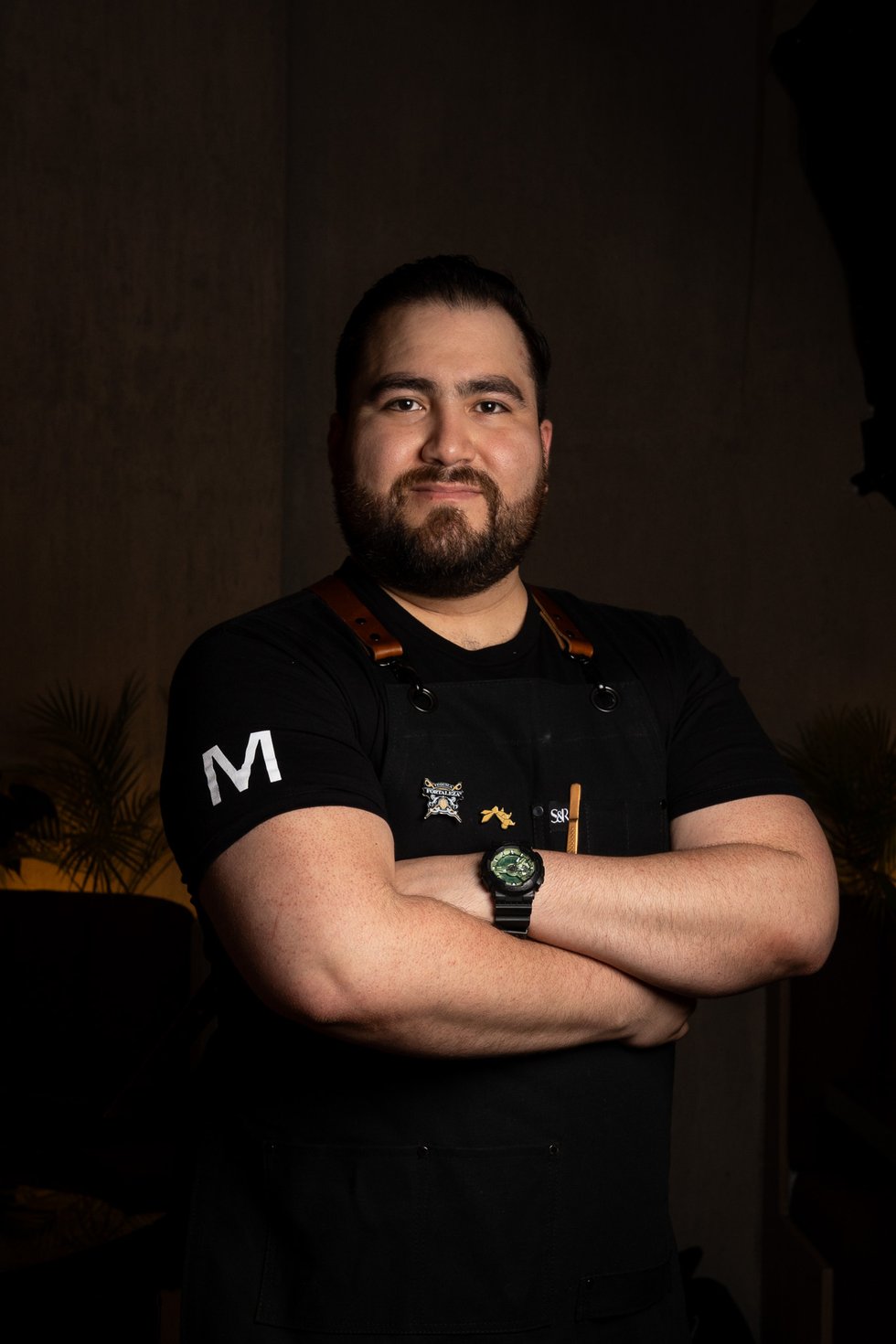
Gilberto Mendez
Mexican wines are trending, and some restaurants are ahead of the trend. One is Matilda, a Mexican-Peruvian fusion restaurant in Chicago's River North neighborhood that is part of the hospitality group Éxodo. The wine list at Matilda exclusively features Mexican wines. Ed Avis, publisher of el Restaurante, interviewed Éxodo's beverage director, Gilberto Mendez, about those wines.
Why did you decide to focus on Mexican wines on the menu at Matilda?
I wanted to build a wine program that showcases Mexico, the same as the chefs want to do with the cuisine. I mean, they are showing Mexican gastronomy at a super high level. If we’re showing it at that level, the wine program has to be like in that level.
And do you find that wine from a specific region works better with food from that region?
It totally does. I’m from the northern part of Mexico, so I was familiar with some of the wines from there. If you start from the northwest, you have Valle Guadalupe and Baja California, where it’s kind of a Mediterranean climate, so all the Italian grapes grew super good there. They have bold reds and expressive whites.
Then let’s go to Querétaro, a little bit southern. It’s the Bajío. In the Bajío the climate varies with the altitude. So you have like this acidity, freshness. So you see already, even if it’s just two regions, they’re completely two different wines.
And then we go my motherland, Coahuila in the northeast. Coahuila is super earthy. People don’t know [about it], but Casa Madero is there, the first vineyard in America. I want to represent that. You have the more structured classic styles from Coahuila, the super crisp and super earthy reds.
So the diversity is there. And I just want the customers to feel the full spectrum of wine. If a customer says, oh, I like French wine, OK, we have something like French from Baja. Then if you go a little bit to the north and you have Casa Magoni, where they only grow Italian grapes and they’re amazing.
When customers at Matilda order a specific dish, are the servers trained to recommend a specific wine to match it?
Yes. When we are training with the servers, I say let’s start from zero, forget about what you know, and let’s focus on areas, the specific regions, because they’re not the same. [With training] you can learn a glimpse of what each region has.
So if a customer, for example, orders the birria, the server can say, “OK, birria’s super earthy and super charged with the chiles and everything, so I would recommend a super light red, like a Sangiovese from Baja California, it behaves like a pinot noir.”
Or if a customer orders something that goes with a sauvignon blanc and they say, “Don’t you have a sauvignon blanc from New Zealand?” the server can say, “No, but have you tried the Casa Jipi sauvignon blanc? It’s not the same mineral like a New Zealand, but give it a try.” And they love it.
Can you give me one or two more examples of dishes that pair well with certain wines?
Yeah, so we have aguachiles, which is super acidic and super bold. So in my perspective, a wine with good skin contact would be amazing because the acidity, the tannins, that the skin has, pairs with the aguachiles. Maybe a good sparkling wine from Guanajuato, super crisp, like Dos Búhos.
Or do want to do good steak tacos? Then we have a Cotes du Rhone from this house that I love called Bruma. That goes really well with steak tacos or something greasy.
How did you personally learn about the wines of Mexico?
Well it’s not about learning, it’s about trying. Just trying, trying, trying. Because even if you know the characteristics of the regions, the wines behave different. So I source from Maverick in Chicago, and my rep was new, so she and I learned at the same time. So I said let’s try, let’s compare. Bring a Super Tuscan from Casa Magoni, and they have a Sangiovese Cab that’s super good. So we tried them and said, oh, this is blowing my mind.
I also like learning about the stories and the history behind the small houses like Bruma, Casa Magoni, Dos Búhos, Henri Lurton. They just make super, super good wines. So it’s this constant learning phase.
Some restaurant owners complain that they can’t get Mexican wines consistently. But you’re not experiencing that?
Consistency can be pretty challenging. But for me it comes down to relationships and planning ahead. Learning what you are moving and the pace that you’re moving it. So you can say, OK, I have my three best-selling. “Maverick, hey, I’m moving this. Are you ready? No? Let me call Tomas [Bracamontes, owner of La Competencia Imports] and see if he can get it.”
Also, I’m super flexible. So if we can’t get a wine, we don’t just take it off the menu. My rep might say, “Try this instead,” and if it works, I’ll make a quick training with my staff and explain the similarities and differences.
[Sometimes it’s about managing the quantity you can get.] I’ll put it this way: Dos Búhos Chenin Blanc is my absolute favorite. It’s maximum special. But they don’t produce a lot. So I don’t sell it by the glass, I only sell it by the bottle. But I have another chenin blanc from Baja, a white blend. The customers try it by the glass, and they’re like, “Oh, this chenin blanc is good…and this other one [Dos Búhos] is expensive, so it should be beautiful.”
What percentage of your customers order Mexican wine?
I’m super heavy on cocktails in my bars, but I would say like 40% order wine. Mexican wines are not cheap. It’s not like a Napa, where you can get a really good wine for $10 a bottle. Here, the cheapest is $16. So technically I’m forcing them to try it. “You want wine? Try Mexican because it’s the only thing I have.”
You’ve got to be proud and super confident about your product, and people are going to buy it and then come back for the wine.
There is still a feeling among some wine drinkers that Mexican wine is low quality. How do you counter that?
I don’t even try too hard. I mean, I let the wine speak. Once they taste it, the perception changes immediately. The quality’s there. Mexican wine doesn’t need to compete with Europe and Napa. I tell them it’s not a competition. The wine just should be appreciated. We have our own unique expression of terroir, our culture, innovation and processes.
It’s about making customers feel confident that I’m confident about my list, you know?
Let’s say you were opening a new restaurant, and you only wanted six wines on your list. Which would you choose?
I’ll choose sparkling whites from Querétaro, I’ll choose reds from Coahuila, and I’ll choose naturals and whites from Baja.
Can you give an example from each of those three regions?
From Valle de Guadalupe, Ocho from Bruma, all the line from Ocho: the Ocho Blanco, the Ocho Rose, which is the new one that they have, it’s incredible with the minerality.
The whites from Querétaro, specifically the sparklings are crazy. Queretaro and Guanajuato, they share the Bajío, so it’s high altitude, high humidity, it’s super delicious. My favorite house in Bajío is Vinaltura by Hans Duer. They don’t produce a lot, but whatever they produce, it’s beautiful.
From Coahuila, I would choose the most famous Mexican wine that exists, in my opinion: 3V from Casa Madero. It’s tempranillo, merlot and cab. Crazy!
Those are the ones I would choose.
That’s the end of my questions, Gilberto, but is there anything else you’d like to add?
Yeah, I will say this: This program is bigger than just the wine. It’s about shifting the perception of the people, and more than anything giving the Mexican producers the platform that they deserve. This is my entire purpose, because I’m a proud Mexican, and I know the work that’s behind the processes, so I just want to give them the platform that they deserve.