
By Alfredo Espinola
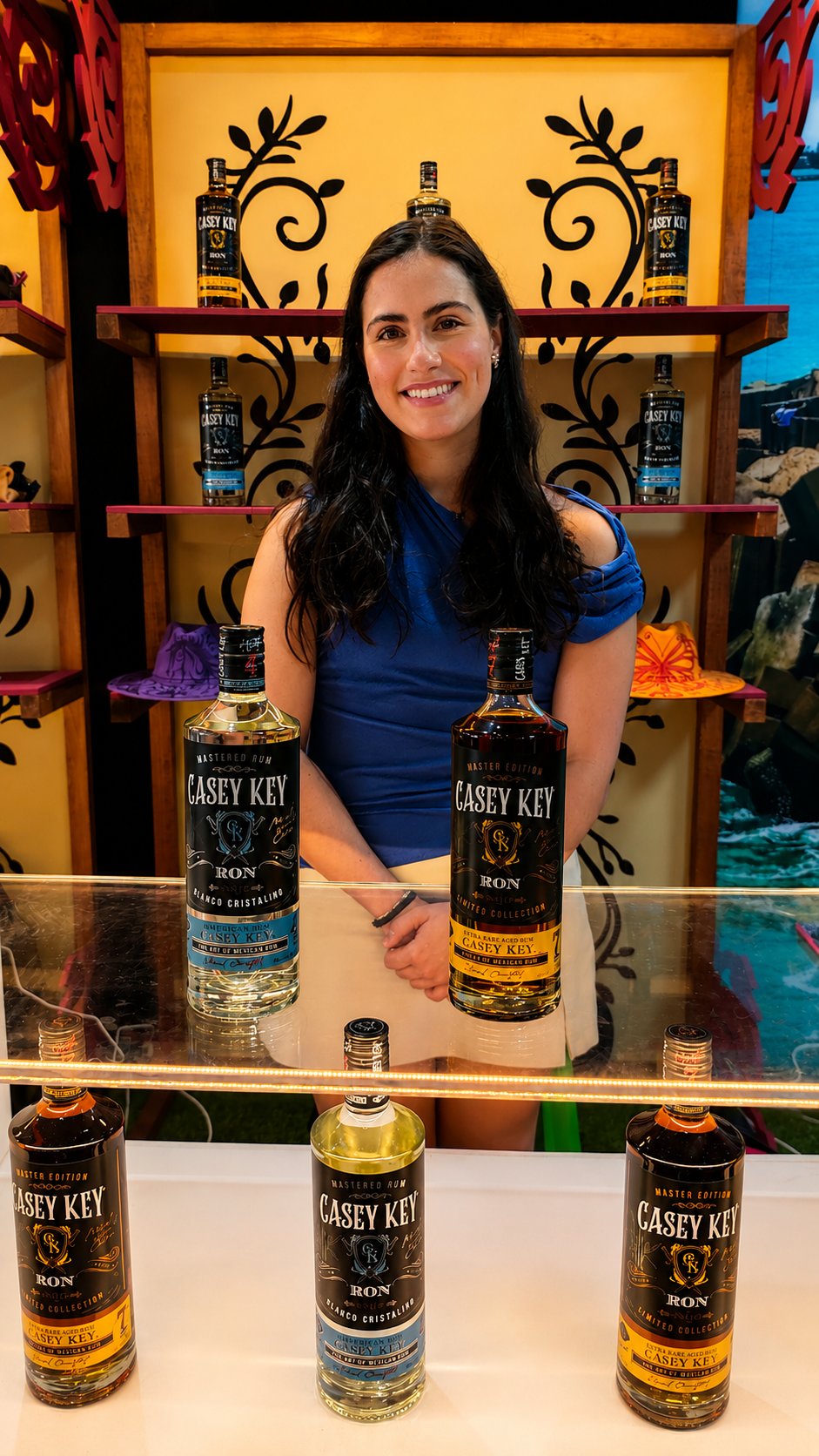
Alejandra Bretzfelder
When you think of spirits from Mexico, tequila and mezcal come to mind, perhaps followed by sotol. But not excellent rum. That may be about to change.
Today, Alejandra Bretzfelder represents the fourth generation of a family business that began by producing spirits, aged liquors, and bar products. But there was a dream that lingered in her father’s mind for years: to create a premium Mexican rum.
The project began about a decade ago. The launch, however, is much more recent. It’s been only about a year and a half since those ideas, tests, and years of work finally came together in a bottle.
That’s how Casey Key was born.
“We always say it’s the art of Mexican rum,” explains Alejandra. And that’s not a phrase chosen at random. For her, making rum involves much more than just distillation. It includes caring for the barrels, aging, blending, and the precision needed to ensure that each batch retains the product’s identity.
The family uses Cuban-inspired techniques and ages the rum in fruit-infused barrels, experimenting with different combinations until they find the desired profile. It’s a process in which time plays its part, but in which the human touch also plays a key role.
The result is two expressions: a crystal-clear white rum, aged for four years and then subjected to a special filtration process, and a seven-year-old aged rum—the family’s favorite and also the one that has won over the most tasters.
The Spirit of the Pirates
The name and identity of Casey Key also have a story behind them.
The brand draws inspiration from a Florida island associated, in family lore, with pirates of old who are said to have reached Isleta Pérez in Tampico, where the company has its roots.
The connection felt natural. Rum and pirates share a powerful imagery: voyages, adventure, ports, and characters who cross borders.
That’s why the label aims to be elegant without straying from that world. It doesn’t try to disguise Mexican rum as something it isn’t; it wants to tell its own story, using contemporary language and an identity that can travel.
That last point is important to Alejandra. The goal is for the rum to eventually reach international markets. That’s why the label incorporates phrases in English—considered a universal language—while retaining elements of Mexican identity.
The challenge, she explains, was finding a balance.
They didn’t necessarily want to rely on the visual cues that consumers typically associate immediately with other Mexican spirits. They wanted something different—something that would feel premium, elegant, and Mexican without being predictable.
From Sugarcane Honey to the Barrel
The rum’s character begins long before it reaches the bottle.
Casey Key is made from virgin sugarcane honey, an ingredient that, as Alejandra explains, preserves the sugars from the sugarcane and helps shape the spirit’s profile.
Next comes one of the elements that most distinguishes the process: aging in first-use American oak barrels.
For Alejandra, new barrels allow for a unique concentration of flavors. And it is precisely in that interplay between wood, time, fruit, and alcohol that another part of the story begins. The process transforms its characteristics and can produce aromas and flavors that consumers end up associating with other ingredients: chocolate, cloves, raisins, nuts, or candies.
It’s one of the moments Alejandra enjoys most when someone tastes the rum.
“That’s the cool part,” she says. That a person can come closer, smell it, and begin to recognize for themselves what they perceive in the glass. The rum then becomes a personal experience, almost a conversation between the product and the person tasting it.
A Company Where Family is Key
Casey Key remains a small, family-run business. And that family atmosphere is also reflected in the way they work.
Alejandra focuses primarily on sales and opening new distribution points. She has worked to get the product into chains and stores, while the rest of the family participates in different stages of the business.
Her connection to the world of spirits began when she was a child. It was her father who gradually introduced her to that world, teaching her about the products and processes.
Today, she works alongside him on the project.
But behind that involvement lies something deeper: the chance to continue a story that began long before she was born.
A rum that aims to put Tampico on the map
In Mexico, rum has a loyal following, but Mexican rums remain relatively few in number.
For Alejandra, that’s precisely where the opportunity lies.
Casey Key began by focusing much of its efforts on Tamaulipas, where it has been met with an especially enthusiastic reception. The product started to feel like something close to the hearts of the region’s people.
“They feel like it’s theirs,” she says.
And that phrase perhaps explains better than any marketing strategy what it means to produce a spirit from a region not typically associated with rum. Just as tequila evokes one region and mezcal evokes other parts of Mexico, Alejandra wants people to one day hear “rum” and think of Tamaulipas as well.
To achieve this, the strategy is as simple as it is time-honored: be present, let people smell, taste, and talk about the product. Social media helps. Digital advertising does too.
But Alejandra still believes in something more tangible: the face-to-face experience. A tasting. A conversation. A glass poured for someone who’s never tried rum before.
“I feel like there’s nothing quite like something physical,” she says.
The Story They Almost Never Tell
There’s a part of this story that Alejandra admits they don’t usually talk about much.
It’s the story of her family.
The brand prefers to talk about pirates because it’s a story that excites, sparks curiosity, and immediately connects with Tampico’s identity. But behind that narrative lies a much more intimate one.
The family started from the bottom. Her father inherited a tradition passed down from his own parents and grandparents, and there was a time when producing liquor was a very different endeavor.
Alejandra recounts that her grandmother and great-grandfather worked together making liquor at home. It was mainly women who participated in the process, especially in tasks such as bottling.
Then came a time when alcohol production was banned.
Police officers would enter the house armed with machetes, destroy the copper stills, and either take away or destroy the product on which the family depended for their livelihood.
For Alejandra’s grandmother, that experience left a deep mark. Liquor production became associated with difficult times, fear, and the loss of the family’s livelihood.
That’s why, for a long time, she tried to convince her son to pursue a different path.
Years later, the story took a different turn: her son didn’t give up on spirits, and that dream—which once began in a home with much more modest operations—eventually became a high-end Mexican rum.
The Seven-Year-Old Rum
Interestingly, the grandmother ended up becoming one of the biggest fans of the final product.
She doesn’t like the liquor business. The experiences from her youth are too vivid for that. But she does really like the rum.
Alejandra says, with a laugh, that her grandmother is the number one fan and enjoys a glass every night—and there’s an image that perhaps sums up the meaning of this entire project better than any other.
A hacienda, a table, her loved ones, Alejandra—and if she had to choose a bottle to share with them, she wouldn’t hesitate.
The seven-year-old rum is the family’s favorite, and when she imagines that moment, what she wants to tell them has nothing to do with sales, exports, or growth.
She wants to thank them, tell them she’s proud of them, that she’s grateful for all the opportunities they’ve given her, that she loves them—perhaps that, after all, is the true spirit of this rum.
It’s not in the pirates on the label, not in the barrels, not even in the seven years of aging.
It’s in a family that started out making liquor at home, that went through tough times, that started over, and that today looks outward with the intention of bringing a piece of Tampico to the world.
In five years, Alejandra hopes to see Casey Key become an international brand.
But her simplest ambition is also the most beautiful: that one day it will be a rum found in homes, on tables, and at dinners where people gather to share good times.