
By Alfredo Espinola
From the Altos de Jalisco, a biomedical engineer turned winemaker stands by his conviction: Mexico doesn’t need to imitate the world’s great wine regions, but rather discover and develop its own personality. His vision goes beyond simply producing fine wines; he seeks to bring wine closer to the people, strip away its formality, and make it part of everyday culture.
A biomedical engineer by training, Casillas had a close connection to the Altos de Jalisco, where his family owns a dairy ranch. It was precisely on that land that his desire to experiment with viticulture first took root.
“One day I said to my father, ‘What if you let me plant some vines, just to see what happens?’ He replied, ‘Well, it’s your responsibility—let’s see how it turns out.’”
Thus began an adventure that, over time, would evolve from a hobby into a fundamental part of his life.
That initial curiosity soon gave way to a need to learn. Casillas delved into the study of oenology at the University of California, Davis, continued his training in the field of sommelier studies, and earned his WSET Level 3 certification. His return to Mexico brought with it a new perspective on the project: he realized that some of his initial decisions needed to be reevaluated and that producing quality wine required much more than just enthusiasm.
Today, in addition to maintaining his professional career in biomedical engineering, he runs Bodegas Tierra de Origen, participates in other winemaking projects in Jalisco, Aguascalientes, and San Miguel de Allende, collaborates with the Mexican Wine Council, and coordinates wine certificate programs and courses as part of the continuing education program at the Universidad Iberoamericana.
It’s a schedule that leaves little room for rest, but one that reflects a passion that has grown over the years.
Tierra de Origen: Discovering What the Land Has to Say
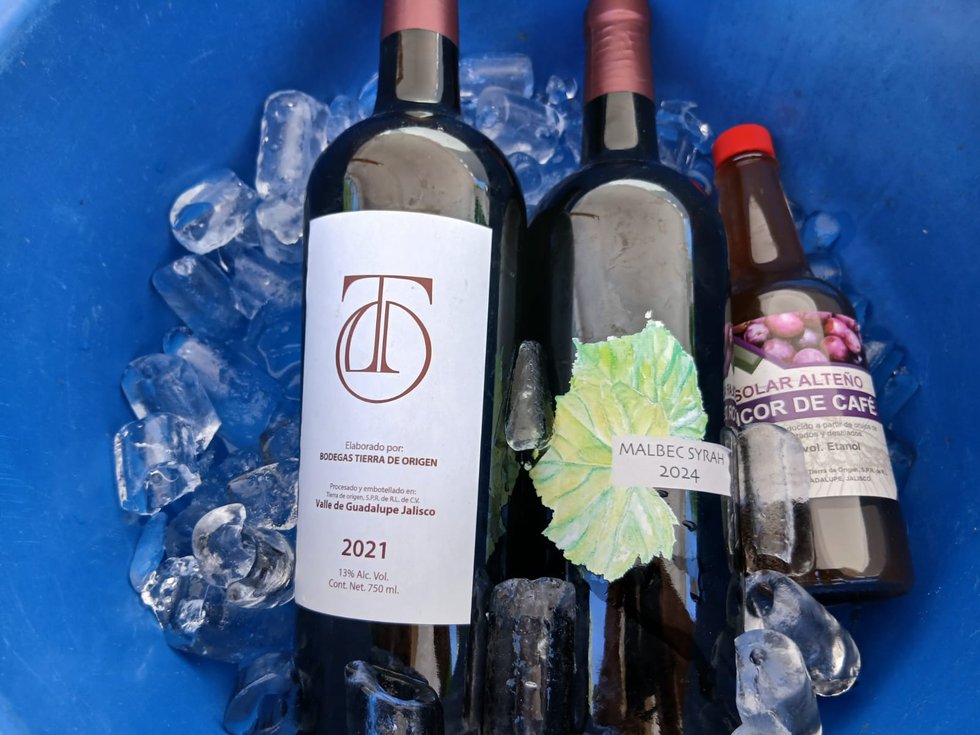
Bodegas Tierra de Origen began its journey in 2017 in the Altos de Jalisco, a region traditionally associated with agave cultivation and tequila production. Choosing to grow grapes in a region with such a strong agricultural heritage was a decision driven by curiosity, an entrepreneurial spirit, and a desire to explore new agricultural possibilities.
Casillas acknowledges that, at first, his decision was largely based on intuition. With some basic knowledge of the conditions required for grapevines to thrive, he decided to take the plunge. However, his academic training later allowed him to understand the complexity of the process and make significant changes to the vineyard.
He currently grows Cabernet Sauvignon, Merlot, Syrah, and Malbec, as well as a small plot of Chardonnay. His first label is a blend of red varieties through which he seeks to develop his own style.
“My approach is to make wines that are different—wines that don’t simply copy existing styles. I’m experimenting with these four varieties to discover what each one can contribute and how they complement one another.”
The vineyard’s youth is also part of this process. The vines are still developing, and for Casillas, that means having the opportunity to experiment, learn, and build an identity without rushing the results.
The inclusion of Chardonnay in the winemaking process opened the door to a new phase: expanding the lineup with white wines and continuing to explore the region’s potential.
But his interest isn’t limited to producing a technically sound wine. There’s a deeper drive that runs through his work: giving Mexican wine a recognizable personality.
A wine that tastes like Mexico
In a wine world where the great historical benchmarks come from France, Italy, and Spain, it’s natural for many producers to seek inspiration from those models. Casillas believes that learning from them is necessary, but he warns against the risk of turning that benchmark into an imitation.
“We can learn from the age-old processes of other regions, but the goal must be for our wine to come out differently. We don’t have to force the grape to produce the same style we find in France, California, Chile, or Argentina.”
For him, every country and every region has unique conditions that should be expressed in the glass. Mexico needs to find its own winemaking language—one that reflects its soils, its climates, its grape varieties, and its way of understanding wine.
“Mexican wine will have to develop its own style, its own distinctive character, and taste like Mexico.”
In the Altos de Jalisco, these distinctive characteristics are determined, among other factors, by an average altitude of nearly 1,800 meters, climatic conditions, and a rainfall pattern that represents both a regional characteristic and a challenge during winemaking.
The concept of terroir takes on special importance here. It’s not just about growing grapes, but about understanding how the environment influences them and allows for the development of wines with their own distinct characteristics.
For Casillas, Mexico’s geographic diversity represents one of our industry’s greatest strengths. A country with so many climates and microclimates has the potential to explore numerous grape varieties and develop wines that are very different from one another.
The Big Challenge: Getting Mexicans to Drink More Wine
Although Mexican wine has gained recognition and domestic consumption has shown signs of growth, there is still a long way to go.
Casillas believes that one of the main obstacles is cultural. For decades, Mexican consumers have developed a special familiarity with Spanish wines, while Chilean and Argentine products have also established a significant presence in the market.
However, he observes a positive shift: there is an increasing openness toward domestic labels.
According to the figures he shares during the conversation, approximately one in every three bottles consumed in Mexico is domestically produced. For him, this is significant progress, though insufficient given the market’s potential.
His approach is interesting because he doesn’t start by demanding that consumers choose Mexican wine. First, he proposes something much more fundamental: getting more Mexicans to incorporate wine into their drinking habits.
“Before telling people to drink Mexican wine, I think the first step is for them to drink wine at all. Let them drink whatever they want. Later, once they have knowledge and a cultural understanding of wine, they’ll be able to choose between a Mexican, Chilean, Argentine, French, or Spanish wine.”
This line of thinking makes sense in a country where per capita consumption remains low and where wine is still often reserved for special occasions.
And here lies one of his greatest concerns: the perception that wine is an exclusive beverage, associated with fine-dining restaurants, formal celebrations, and consumers with specialized knowledge.
For Casillas, that image must change.
Wine shouldn’t be reserved for a multi-course dinner or require a special occasion to open a bottle. It also belongs on the everyday table, alongside traditional dishes and popular Mexican cuisine.
A torta, some tacos, or a family meal can become an opportunity to discover new pairings.
“The day wine becomes part of our daily food, of our everyday diet, that’s when we’ll see a drastic change.”
Mexican cuisine, internationally recognized for its diversity and richness, represents an extraordinary opportunity to develop that relationship. Its intense flavors, spices, heat, fat, salt, and the country’s characteristic ingredients offer fertile ground for exploring pairings with domestic wines.
It’s not about transforming our cuisine to adapt it to wine, but rather about finding wines that engage in a dialogue with it.
An Industry with Potential, but with Challenges
The growth of the Mexican wine industry faces obstacles ranging from a lack of sufficient support for the agricultural sector to production costs and the tax burden.
Casillas points out that many Mexican wineries are small and, as a result, face higher costs. Some do not have their own vineyards and rely on purchasing grapes or outsourcing services to produce their wines.
Added to this is an aspect he considers particularly important: traceability.
In his view, consumers must have clarity regarding the origin of the grapes and the actual provenance of the wine they are purchasing. It is not enough for a label to identify a region if the raw material comes from another territory.
Transparency regarding origin is essential for building credibility and strengthening the identity of wine-producing regions.
In this regard, the Altos de Jalisco region has a significant opportunity to develop a wine industry that can distinguish itself on the national stage.
However, growth does not depend solely on producers. It also requires greater integration among organizations, authorities, distributors, restaurants, educational institutions, and all other stakeholders involved in the wine supply chain.
Casillas believes that relationships and agreements exist between different organizations, but these contacts still need to be transformed into ongoing collaboration.
“We have the door, but we haven’t opened it,” he remarks, referring to the relationship between the various organizations in the sector.
His assessment is clear: concrete commitments, follow-through, and shared goals are needed. It is not enough to meet occasionally or hold isolated events. The industry needs to work in a coordinated manner to achieve sustained growth.
Wine also needs to get out into the community
Perhaps one of Casillas’s most interesting insights concerns the way Mexican wine is promoted.
During our conversation, we agreed that many events and tastings end up attracting practically the same audience: people who are already familiar with wine, who regularly attend tastings, and who have a certain interest in the industry.
The real challenge lies in reaching those who don’t yet feel part of that world.
For Casillas, one of the first steps should begin in restaurants, particularly with those who have direct contact with consumers.
“We have to start by talking to the server. If the person selling the wine doesn’t know how to explain it—if they’re afraid of being asked what grape variety it is or where it comes from—they’ll probably end up offering a beer.”
Training service staff, head waiters, and sommeliers can be a key tool for introducing wine to new consumers.
But he also proposes going further: bringing wine to places where it traditionally hasn’t been present.
Why not find a way to incorporate wine into tortilla shops, taquerías, and casual dining spots? Why continue to associate it exclusively with upscale restaurants?
The idea isn’t to impose a particular way of consuming wine, but to expand the possibilities.
Along those same lines, he considers it important to reach out to young people, who represent a generation that is fundamental to the industry’s future. Education should start early, with accessible experiences that allow people to discover wine without fear of making mistakes.
And that openness also involves recognizing new trends.
Regarding the growth of mixology and the use of wine in different preparations, Casillas maintains a flexible stance. He does not view these new ways of consuming wine as a threat to tradition.
The same applies to wine in cans or other formats that may seem far removed from the romanticism that has historically accompanied a bottle.
“There are wines for every taste and every occasion. We have to understand that our country needs a wide variety of styles, from a wine in a Tetra Pak to a high-end wine uncorked with a fine cork.”
His argument is simple: if the goal is to expand wine culture, it makes no sense to set barriers on how it should be enjoyed.
The Future Is Built on Partnerships
When discussing the future of Bodegas Tierra de Origen, Casillas has specific goals: to continue improving quality, strengthen traceability, and achieve greater consistency across different vintages. He also aims to expand the number of labels and develop a wine tourism project that he hopes to consolidate over the next five years.
But his aspirations extend beyond his own winery.
Through his involvement with the Mexican Wine Council and his work as an educator, he believes that education is one of the fundamental pillars for the industry’s development.
It is not enough to produce good wines if consumers lack the tools to learn about them, understand them, and enjoy them.
That is why he emphasizes the need to forge partnerships with universities, restaurants, distributors, and industry organizations. Everyone must find a way to participate and benefit from a common goal.
“No one can do it alone. We need to strengthen communication and ensure that everyone sees the benefit of working together.”
He would like the Altos de Jalisco to be recognized as an important wine-growing region, capable of producing unique wines. And, above all, he would like to contribute to an industry where wine is truly accessible.
“Wine is for friends. Everyone has the right to enjoy a glass with whomever they choose.”
An identity yet to be defined
At the end of our conversation, we return to a question that runs through virtually all of his reflections: Are we still copying styles from abroad?
Casillas believes that this tendency still exists, even in some international competitions, whose evaluation criteria may favor certain stylistic references.
For him, the challenge lies in learning to value wines for their identity and not solely for their resemblance to traditional models from other regions.
Mexico needs time, patience, and confidence in its own potential.
The national wine industry still has a long way to go, but it also boasts extraordinary regional diversity, committed producers, and a market that is beginning to discover what is being produced within its own borders.
Javier Casillas is part of a generation that views wine not merely as an agricultural or commercial product, but as an expression of the land, the culture, and the people who make it possible.
His story began with a question while standing before a plot of land in the Altos de Jalisco. Today, that question has evolved into a project that seeks to demonstrate that Mexico has much more to learn about itself.
Because perhaps true international recognition for Mexican wine will not come when it manages to resemble the world’s great wines, but rather when it succeeds in making someone, upon tasting a glass, recognize in it something that only Mexico can offer.