
By Alfredo Espinola
In Huitzilac, where the forest envelops the roads and the humid air heralds the presence of the so-called Bosque de Agua, the maguey continues to grow with the same patience it has shown for centuries. It is a plant that demands time, knowledge, and respect. It is also the centerpiece of a family history that began nearly a hundred years ago and continues to be written today amid farm rows, the kitchen, and tradition.
Since 1928, the Acosta family has cultivated maguey pulquero in this mountainous region of Morelos. What began as an agricultural activity passed down from generation to generation has become IXTI, an agritourism project that seeks to preserve ancestral knowledge and share it with those who wish to understand the deep connection between the land, pulque, and Mexican cuisine.
“The pulque maguey is a plant endemic to Mexico, famous for being the source of the drink of the gods,” explains Don Mauro Acosta, who now leads this family project. “Since pre-Hispanic times, it has been used to produce beverages, food, fibers, and various materials.”
His words sum up the importance of a plant whose history has accompanied that of the country since long before the arrival of the Spanish. At IXTI, that legacy does not remain static like a museum piece: it lives on in the daily work in the fields.
Don Mauro, his wife Lourdes Aguilar, and their children participate in every stage of the process. From planting and tending the maguey to processing its sap, the family has found new ways to make use of the plant without losing sight of the knowledge passed down by their ancestors.
The result is a sustainable project where practically nothing goes to waste. Pulque and maguey syrup are made from the aguamiel; crafts are woven from the fibers; they also produce soaps, balms, seasonings, spirits, and jewelry that showcase the extraordinary versatility of a plant capable of offering much more than just a traditional beverage.
But IXTI cannot be fully understood through its products alone. It is best understood by exploring the countryside.
The experience begins among the maguey plants, which take years to reach maturity. Visitors learn about the cultivation process, observe how the aguamiel is extracted directly from the heart of the plant, and discover the delicate balance required to make pulque—a living beverage whose fermentation remains, to a large extent, a process guided by experience and intuition.
The visit culminates around the table.
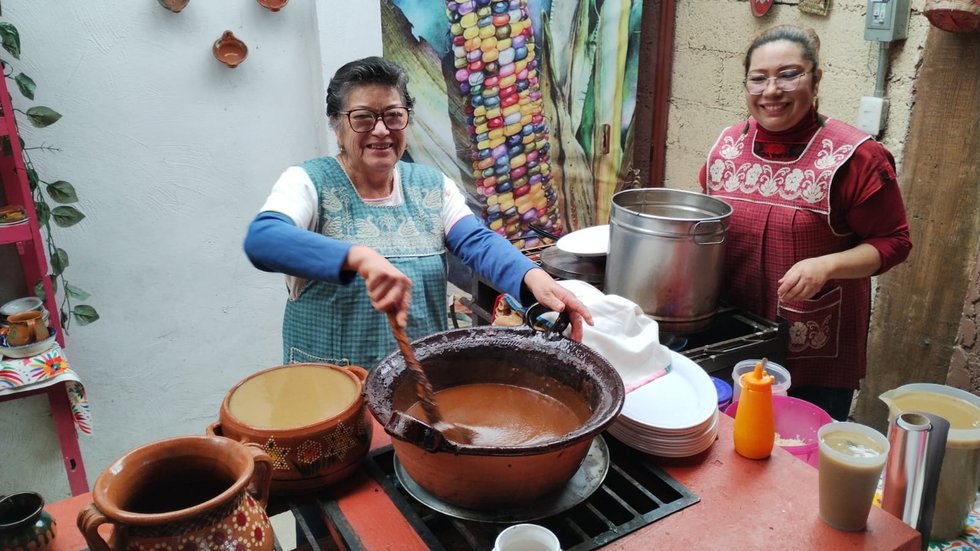
In the kitchen, Lourdes Aguilar revives traditional Morelos recipes prepared with seasonal ingredients. Huitlacoche tamales with cheese, wild mushroom tamales, pork tamales, atole made with aguamiel, and a mole enriched with pulque make up a menu that reflects the region’s rural cuisine: simple in appearance, profound in technique, and closely tied to the surrounding landscape.
Each dish pairs with beverages produced on the property, helping guests understand that the maguey is not merely a crop, but an ingredient that has been a staple of the diets of communities in central Mexico for centuries.
IXTI’s location adds another dimension to the experience. The project is situated more than 2,200 meters above sea level, within the Bosque de Agua, one of the country’s most important forest corridors. This natural system connects protected areas in Morelos, the State of Mexico, and Mexico City, and plays an essential role in capturing and recharging the aquifers that supply millions of people.
In this environment, where the forest protects the water and the maguey withstands the passage of time, the Acosta family has found a way to preserve much more than an agricultural tradition.
They have preserved a way of understanding the land.
Because at IXTI, pulque is no longer merely an ancestral beverage; it has become the expression of a family history, a landscape, and a culture that remains alive thanks to those who continue to cultivate it with the same patience required for a maguey plant to grow.