
By Alfredo Espinola
San Francisco de Campeche, November 2026. Amid centuries-old walls and streets that still echo with the sounds of privateers and galleons, Mexico’s walled city prepares to host a festival that promises to be more than just an event: a sensory journey. The International Pirate and Rum Festival was created as a bridge between history and modernity, between the sea’s foam and the crystal of a glass, between the memory of pirates and the sophistication of premium spirits.
From November 20 to 22, Campeche will transform into a port of aromas, flavors, and stories. There, Mexican rum, with its golden cane and mestizo character, will take center stage in a celebration aimed at positioning the state as a hub for tourism, culture, and gastronomy.
Rum: liquid fire and the memory of cane
Although tequila and mezcal often dominate public conversation, rum maintains a solid presence in the domestic market. With sales exceeding 20 million liters per year and a share of nearly 10% of the Mexican spirits and distilled beverages market, the category is undergoing a phase of evolution driven by new brands, origin-focused offerings, and a generation of consumers seeking authenticity, meticulous processes, and greater complexity in their drinks.
“As part of the Campeche government’s vision to boost sectors with growth potential and generate economic development, this festival aims to become a platform for promoting tourism, gastronomy, culture, and industry around Mexican rum. We want to create opportunities that support producers, entrepreneurs, and brands that today represent a new era for this category in the country,” said Jorge Luis Lavalle Maury.
Today, the Mexican rum industry exists between two complementary worlds: on one hand, established brands with a broad national and international presence; on the other, a new generation of artisanal and regional producers that is beginning to gain recognition for the identity, quality, and diversity of their labels.
Mexico currently has 72 production facilities dedicated to the production of rum and other sugarcane spirits, distributed across ten states in the country. Campeche, Veracruz, Oaxaca, Chiapas, Jalisco, Tabasco, Michoacán, Tamaulipas, San Luis Potosí, and Yucatán are part of this productive landscape that is becoming increasingly visible today thanks to consumers who value the origin, craftsmanship, and artisanal quality behind each bottle.
But in Campeche, rum also finds a land steeped in history.
The only walled city in Mexico and one of the few fortified cities in Latin America maintains a deep connection to the sea, to the trade that for centuries traversed its shores, and to the tales of pirates that are part of its historical identity. There, amid stone, saltpeter, and the Caribbean, the festival finds a natural setting to unite heritage with contemporary experience.
“Mexican rum has quality, identity, and enormous growth potential. We want to create spaces to showcase the diversity and creativity that already exist in the national industry,” said Gerardo González, Director of Ron Cannavera, with the conviction of someone who knows that every sip is also a journey.
Voices Driving the Journey
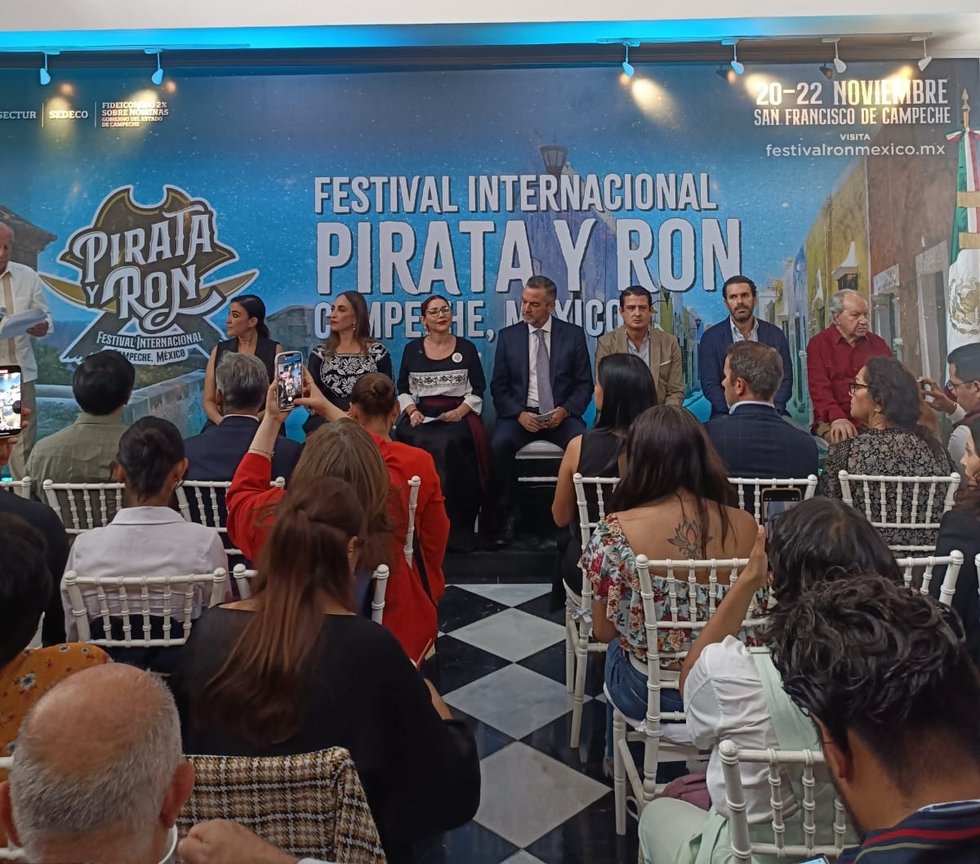
The official presentation at Casa Campeche, Mexico City, brought together representatives from the government, business, and gastronomy sectors. Among them, Jorge Luis Lavalle Maury, Secretary of Economic Development, underscored the state government’s vision:
“We want to create opportunities that support producers, entrepreneurs, and brands that today represent a new era for this category in the country.”
The presence of business leaders, chefs, and representatives from the rum industry confirms that this festival is not just an event: it is a strategy to strengthen the regional economy and position Campeche as a destination of luxury and tradition.
A feast for the senses
The festival program is a map of experiences:
- Over 100 exhibitors of rum, sugarcane spirits, crafts, and gourmet products.
- The first national rum and cane distillate competition, the Rum and Cane Distillate Cup.
- More than 50 artistic and cultural events, which will fill the streets with music, dance, and theater.
- More than 50 restaurants and traditional cooks, guardians of recipes that taste of sea and land.
- Over 10 specialized tastings, where every glass will be a sensory journey.
- An expected turnout of over 10,000 attendees, who will turn Campeche into a meeting place.
Each activity is an invitation to discover: rum as liquid fire, gastronomy as living memory, culture as a whisper that pierces the walls.
Rum and Signature Cocktails
Contemporary mixology has given rum a new language. At signature bars, the spirit becomes a canvas: it is blended with spices, tropical fruits, and citrus notes that evoke the sea. Each cocktail is a liquid poem, a story that combines tradition and modernity.
The festival will showcase this creativity. National and international mixologists will present creations that celebrate rum as a luxury drink, capable of engaging with haute cuisine and the legacy of sugarcane.
Beyond rum: tourism and heritage
The festival isn’t limited to the drink itself. It’s an invitation to explore Campeche: its bastions, its plazas, its cobblestone streets. To savor its cuisine, which combines fresh seafood with ancestral recipes. To discover a heritage that bridges history and modernity.
The strategy is clear: to establish Campeche as a platform for connection between culture, tourism, and gastronomy. A destination that honors its past and projects its future.
A port open to the world
The International Pirate and Rum Festival is more than an event: it is a journey. A celebration that combines history, flavor, and sophistication. An invitation to discover that, behind every glass of rum, there is a story of sugarcane, sea, and memory.
Campeche opens its walls to the world, and in every sip of rum, you can hear the echo of pirates, the murmur of the sea, and the promise of a future where tradition and modernity meet.