
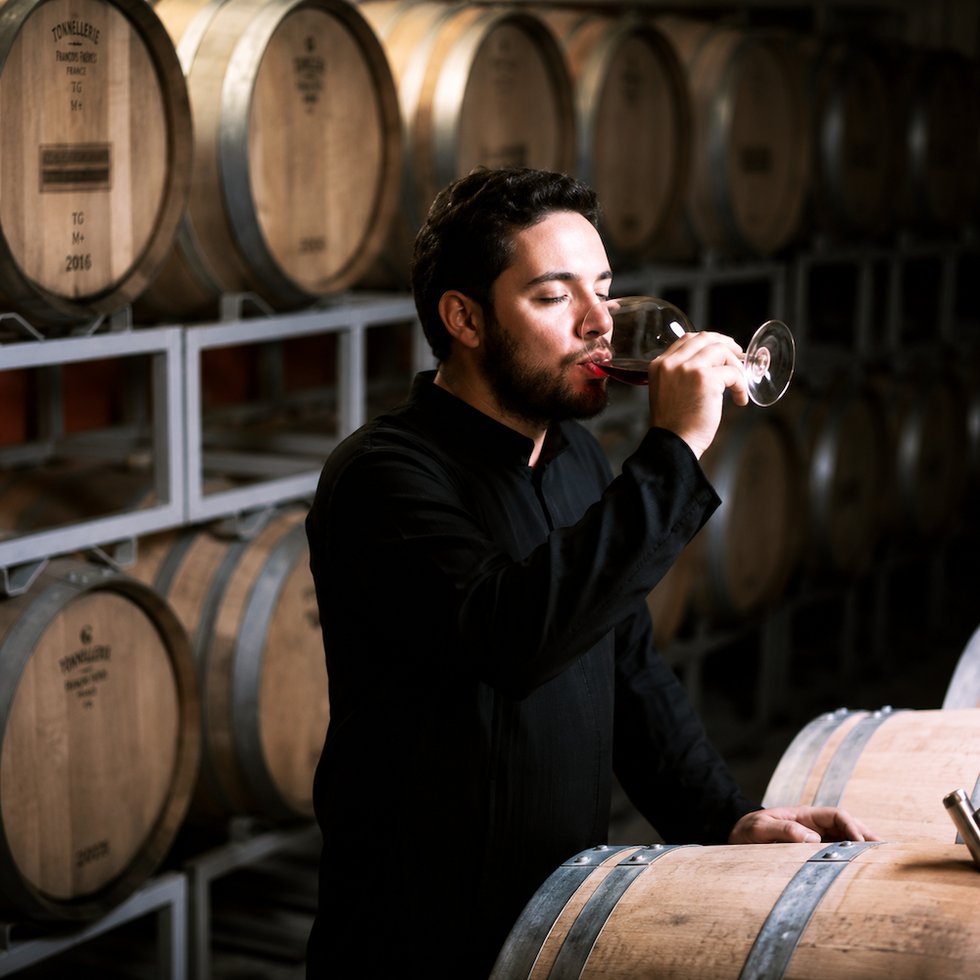
Luis Fabricio Hernández Navarro
By Alfredo Espinola
Luis Fabricio Hernández Navarro grew up in Mendoza, Argentina among rows of grape vines, conversations about the harvest, and aromas that, over time, he would come to understand had shaped his destiny long before he could even name it.
“The apple doesn’t fall far from the tree,” he says with a laugh, as his memory takes him back to his grandparents—grape growers who once owned a small family winery. Those afternoons among the vineyards, the natural way wine was woven into daily life, and the Mendoza landscape stretching as far as the eye could see—all of this ultimately forged something deeper than a profession: a calling.
However, the path wasn’t immediate.
Although sports took up much of his youthful passion, he decided to study enology at the Catholic University of Cuyo, after graduating from the historic Don Bosco Rodeo del Medio School in Mendoza. It was there that the quiet intuition, which had been brewing for years, finally became a certainty.
“Winemaking draws you in,” he says. “Once you start to understand it, you can’t walk away from it.”
The Familiar Scent of the Winery
Fabricio doesn’t speak of a single mentor when he recalls his early days. He speaks of people, places, and shared experiences. He mentions his uncles and cousins during harvests, his first jobs in the winery, and those winemakers who generously extended their workdays to teach him a little more.
But above all, he remembers a scent: “The scent of the winery was a familiar one.”
Perhaps that is the key to understanding his story. For Fabricio, wine was never just an industry. Before it was a business, it was home.
That emotional connection to winemaking evolved over the years into a philosophy of life grounded in lifelong learning and the responsibility to pass on knowledge.
“I don’t know anyone who stays in winemaking unless they’re passionate about it. The harvest demands too much sacrifice to stick around for any other reason.”
When Two Young People Decided to Defy Tradition
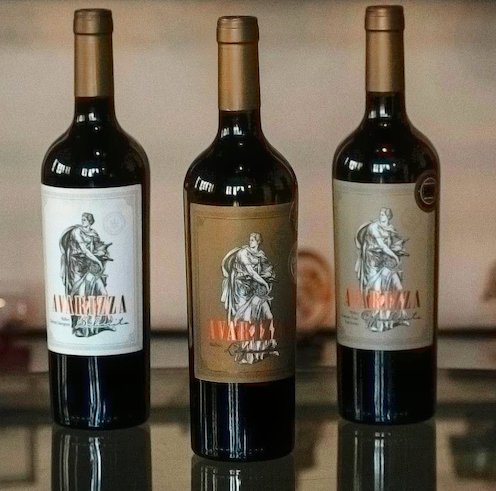
The story of Luis Fabricio Hernández cannot be told without mentioning Agostina, his wife, business partner, and life companion.
They met in college and shared something deeper than just a profession: curiosity, creative restlessness, and an almost inevitable need to question the status quo.
Fresh out of college, they made a decision that many considered madness: to make a wine using a variety that had practically disappeared in Argentina—Canarí.
They then discovered a fact that seemed straight out of another era: throughout Mendoza, barely seven hectares planted with that variety remained. Four of them belonged to Fabricio’s family.
With limited savings, a generous loan from a small winery, and that courage that often accompanies those who have yet to know the fear of failure, they produced their first thousand bottles.
“We never thought of selling them. They were meant to be shared with friends and family,” he recalls.
The thousand bottles disappeared quickly.
That’s when they realized two things. First, that they might have something truly special on their hands. Second, that making wine was infinitely more complex than they had imagined.
And so, in 2008, Wines of Sins was born.
Sin as a Statement of Principles
In Argentina in the late 2000s—dominated by Malbec and deeply traditional structures—Wines of Sins burst onto the scene like a manifesto.
The seven deadly sins ceased to be merely religious concepts; they became labels, aesthetic discourses, and philosophical statements.
Each wine was meant to express a character, an emotion, and a particular way of understanding the terroir. Wrath, made with Malbec and Cabernet Franc, at a time when that combination still seemed like a provocation. Pride, conceived from classical tradition. Lust, interpreted through Cabernet Franc. Sloth, crafted using techniques that were unusual for the time.
These were just a few examples of the conceptual universe that Fabricio and Agostina built around the seven deadly sins. Each label represented a distinct personality, its own narrative, and an invitation to question the conventions of traditional wine. More than just a collection, Wines of Sins became a statement of principles: a way of demonstrating that wine could also be irreverent, emotional, and deeply human.
“We always wanted to break with the status quo,” he explains. “Being disruptive wasn’t a business strategy. It was simply our way of understanding wine—and life as well.”
Over time, the project expanded to include exports to nearly ten countries and established itself as one of the most personal and original ventures of the new generation of Argentine winemakers.
Mexico: Love at First Sight
In 2015, a phone call once again changed the course of his story.
Carlos Quintanilla was looking for a winemaker capable of developing an emerging project in San Luis Potosí. Fabricio agreed to travel to Mexico for a few weeks.
He never imagined that trip would end up redefining his life. “It was love at first sight,” he recalls.
There was no established brand, no labels, and no built-up reputation. There was only a vineyard, an idea, and the once-in-a-lifetime opportunity to create something from scratch.
For several years, Fabricio and Agostina split their time between Argentina and Mexico, crossing borders and racking up kilometers while simultaneously developing Wines of Sins and the project that would eventually become a benchmark for contemporary Mexican wine: Cava Quintanilla.
“My heart will always be in San Luis,” he admits.
Later came Tres Raíces and dozens of consulting projects in regions as diverse as Querétaro, Hidalgo, Chihuahua, Jalisco, Sinaloa, Guanajuato, and Baja California.
The Identity of Mexican Wine is Still Being Written
Few people know the differences between Argentina and Mexico as intimately as Fabricio.
In Argentina, he explains, wine is part of everyday life; in Mexico, the industry is still undergoing an extraordinary process of development and discovery.
“Here, the terroir changes radically every twenty kilometers. That’s what’s so fascinating: the versatility this country offers.”
After more than a decade working in Mexico, he observes with admiration the sustained growth of the national industry, the increasing sophistication of consumers, and the enthusiasm of the younger generations.
For him, Mexican wine’s identity is still being shaped—a reality that, far from worrying him, excites him.
He sees it as a historic opportunity to experiment, make mistakes, start over, and discover which grape varieties, regions, and stories will define the future of Mexican wine.
“Every year, we have the chance to do things better than the year before. That’s what makes this journey so exciting.”
Happiness as a Destination
When asked how he feels when walking through a vineyard, Luis Fabricio Hernández responds without technical jargon, without academic references, and without seeking a memorable phrase.
He answers with a single word: “Happiness.”
A word repeated several times throughout the conversation, emphasizing the happiness he feels while observing winter pruning, during budbreak, upon receiving the grapes at the winery, and when a wine finally takes its definitive form.
For him, making wine is like solving a puzzle whose answer may take years to reveal itself.
“We’re always searching for a perfection that never arrives. But that’s precisely why we keep doing it.”
Wine as a Way of Life
If he could go back in time and meet that young man from Mendoza who dreamed of making wine alongside Agostina, he wouldn’t speak to him of sacrifices or difficulties. He would tell him something much simpler.
“Keep going. Persevere. You won’t regret it.”
Perhaps because, after traveling across continents, launching projects, building a family, and building bridges between Argentina and Mexico, Luis Fabricio Hernández has discovered something that transcends technique, industry, and business.
That wine is not just a drink: it is memory, identity, and territory.
And, above all, it is a very special way of experiencing the world.