
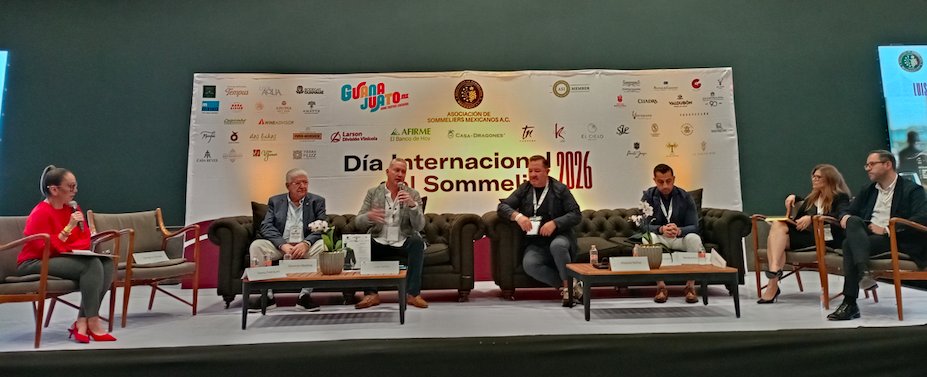
Panel discussion on the future of the wine industry. From left to right: Teresa Rodríguez, Salomón Abedrop, Luis Valdez, Horacio Núñez, Luis Morones, Sandra Fernández, and Carlos Borboa
By Alfredo Espinola
In a landscape where the wine industry is undergoing profound changes, seven experts gathered on a panel during the International Day of the Sommelier celebration on June 3 in San Miguel de Allende, Mexico. The panel agreed that the real challenge lies not only in production, but in understanding consumers and their new ways of engaging with wine.
Carlos Borboa, LATAM director of the Concours Mondial de Bruxelles, emphasized that the global discussion has shifted its focus from the bottle to the person drinking it. “The consumer has changed,” he stated, noting that young people do drink wine, but they do so seeking different, more conscious, and less ritualized experiences.
Horacio Núñez, managing partner of ISCAM, provided the wholesale channel’s perspective, where table wine has established itself as the third most important category, with a 5.7% compound annual growth rate by value. However, volume has barely increased by 0.3%, reflecting the strain on Mexican consumers’ wallets due to the economy. “The downtown area has become a key showcase, with more establishments than ever before in history,” he noted, highlighting the opportunity to capitalize on this expansion.
Luis Morones, wine director at Grupo Presidente, described the decline in revenue for restaurants and hotels following the post-pandemic boom: 28% in 2024 and 11.6% in 2025–2026. Even so, the average ticket price per bottle has grown, driven by consumers seeking premium wines. “The challenge lies in making wine accessible to diners, for example, by selling it by the glass,” he explained.
Luis Valdez, CEO of Wine Advisor, agreed that Mexican consumers base their decisions more on brand than on variety or region, which opens an opportunity to strengthen the identity of domestic wines. “Mexico ranks second in restaurant sales, surpassing countries like Spain and Argentina,” he noted.
Salomón Abedrop, president of the Mexican Wine Council (CMV), pointed out that in Mexico, only 8 million people consume wine regularly, while 90 million adults do not yet do so. “The future lies in that potential market. Mexico remains an atypical country, with natural growth and appeal for international producers,” he stated.
Sandra Fernández, director of SFG Estrategias, offered the perspective of the premium segment. “The sophisticated consumer demands consistency between what the brand promises and what it delivers. They seek simplicity, clear origin, and sustainability, but also hyper-personalized experiences that integrate them into a lifestyle,” she noted.
Finally, Víctor López, speaking from the hospitality and restaurant sectors, described a shift in habits: fewer bottles on the table, but of higher value. “Consumers want less intimidation and more conversation. Young people seek stories behind each wine, and that forces us to be storytellers, not just salespeople,” he concluded.
The moderator, Teresa Rodríguez, vice president of communications at the ASM, summarized the discussion: wine faces a future full of challenges, but also of opportunities. The key will be listening to the consumer, adapting to their new ways of experiencing wine, and building experiences that make it part of their everyday identity.