
By Alfredo Espinola
Some products simply make their way to the table. Others arrive accompanied by a story. A mezcal can speak of the land where the agave grew. A tequila can carry the memory of a family. A raicilla can become a bridge to a region that, for those who drink it far from Mexico, exists first in the imagination and then on the palate.
But behind many of those bottles, there are also women.
Women who inherited a tradition, who took the reins of a family business, who came to lead a brand, or who decided to forge their own path within an industry historically dominated by men.
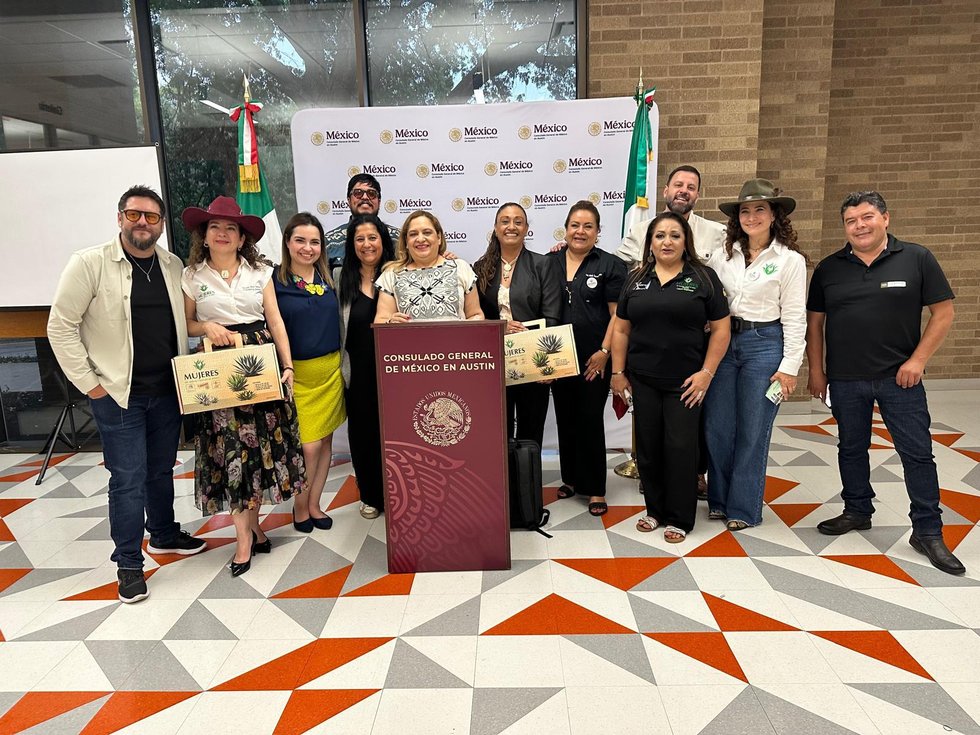
It is precisely this story that “Destilados Mexicanos con Aroma de Mujer” seeks to bring to the forefront—an initiative launched on September 17 at the Consulate General of Mexico in Austin, Texas, with a program that combines promotion, education, and culture.
The event aims to shine a spotlight on the women behind some of the tequila, mezcal, raicilla, and bacanora brands coming from Mexico, while also creating a space to learn about their stories, their challenges, and the deep connection between these spirits, their communities of origin, and Mexican identity.
The project has its roots in Houston, where a collaboration between Mexican producers and the Mexican consulate began approximately three years ago. The initiative began with an initial tasting dedicated to Mexican wines, featuring ten brands primarily from the Guadalupe Valley and Parras.
The response from restaurateurs opened up a new possibility: to also bring the diversity of Mexican spirits to the United States.
Thus, tequilas, mezcals, and other spirits began to be incorporated, and with them came a deeper question: How can we ensure that these beverages not only reach the United States but are also understood, appreciated, and have a real chance of staying in the market?
The answer they found was simple to state, though much more complex to implement: education, structure, and support.
When Exporting Is Just the Beginning
For Luz María (co-founding secretary of the Association of Women of Mezcal and Maguey in Mexico), expanding beyond Mexico represents a necessary opportunity for many brands.
Exporting, however, is not the ultimate goal.
Once a bottle crosses the border, another phase begins: finding importers, distributors, retail outlets, and restaurants; understanding the rules of the U.S. market; and learning to navigate a commercial structure that is very different from Mexico’s.
That’s where Ninfa Segovia comes in
Born in Chicago to parents from Michoacán and raised between Mexico and Texas, Ninfa knows that bridge between both worlds from a particularly intimate perspective. Her family was involved in cattle ranching in Mexico and later in the Mexican grocery business in Texas. She studied business and eventually joined the family business.
Her involvement in chambers of commerce and her relationships with Mexican suppliers and businesspeople led her to participate in trade missions and business partnership projects.
Over time, she founded ANROB, a company dedicated to supporting the marketing and promotion of Mexican businesses in the United States, as well as working with entrepreneurs from other Latin American countries.
Her experience allowed her to identify a recurring problem among Mexican producers: they often have an excellent product but lack information on how to introduce and develop it in the U.S. market.
And that lack of knowledge can be costly.
Ninfa recalls seeing entrepreneurs arrive full of enthusiasm, with capital and a brand built up over the years, only to face a system they knew nothing about.
That’s why she also launched a business mentoring program that brought together specialists in areas such as law, binational accounting, trademark registration, banking, consulting, and marketing. Twenty companies participated in the program and received support for 90 days.
The premise was clear: it’s not enough to have a good product; you have to be prepared to bring it to market.
Austin: A New Door
The experience gained in Houston opened the door to Austin.
The proposal presented to the Mexican consulate sought to provide exposure to women producers and entrepreneurs who had already come a significant way.
Of the fifteen brands participating in the first edition in Austin, some already had a presence in the United States. Others were specifically looking to find importers and distributors.
The selection includes a diversity that reflects the richness of the category: raicilla, bacanora, mezcal, and tequila.
The intention is for the event to be more than just a tasting.
Austin restaurant owners, representatives from chain restaurants, importers, distributors, and liquor store buyers from various Texas cities were invited to learn about the brands and, above all, to hear the stories behind them.
Because a bottle can be sold just once. A story, on the other hand, can stay in people’s memories.
Consumers also need to learn
In an American liquor store, a bottle may be surrounded by dozens of options. But how does a consumer know what they’re buying?
What does it mean for a spirit to be artisanal? What does a designation of origin imply? Where does it come from? How is it produced? How should it smell and taste?
The initiative believes that answering these questions is a fundamental part of the work.
In Houston, training sessions have already been held for restaurants and their staff to help them better understand Mexican spirits.
It’s not just about teaching how to serve a drink. It’s about teaching how to recognize it.
It’s about explaining its aromas and flavors. It’s about knowing its characteristics. It’s about understanding its origin and, ultimately, being able to tell the consumer what’s inside the glass.
For those driving the project, the server, the bartender, or the restaurant owner can become an essential part of that story.
Because when someone recommends a drink based on knowledge, the experience ceases to be a simple sale. It becomes a discovery.
The Women Behind the Bottles
There’s another story the project wants to tell—one that doesn’t necessarily appear on the label.
Many of the women participating in this initiative have risen to leadership positions due to circumstances they did not always choose. Some took the helm of a brand after the death of a family member. Others are mothers who took on sole responsibility for the business. Some are entrepreneurs who built their own brand from the ground up.
There are also those who work alongside their husbands, children, and other family members.
Every story is different.
But they share one thing: carving out a path in an industry where men have long dominated.
Even finding buyers and distributors can become an additional challenge.
That’s why creating a network of women takes on a business dimension—but also a human one. Together, they can open doors that would be harder to open on their own.
The organization is taking this vision beyond Texas. Plans are underway to create international chapters, and discussions are already underway to replicate the model in places like Italy and France.
Houston was a starting point. Austin represents another step. San Antonio and Dallas are on the horizon, followed by other cities.
Chicago. Los Angeles. New York.
The goal is to build a network capable of supporting Mexican women producers as their products find new markets.
Much More Than a Bottle
Perhaps the most moving part of this story comes when the conversation shifts from markets to communities.
Because behind a bottle, there’s more than just a company.
There’s a family; there’s a region.
There are agave producers, workers, farmers, and entire communities that depend on these brands being able to sell and grow.
For Ninfa, that connection also holds personal significance.
Her father emigrated from Mexico and built his life and business in the United States. Seeing products from Michoacán now making their mark in Texas represents, for her, a way to reconnect with her family’s homeland.
It’s a feeling she understands well.
For many Mexicans living far from their homeland, certain flavors have a special power: they can transport us.
A drink can bring to mind a family celebration. A meal can take us back to our parents’ kitchen. A scent can evoke a town thousands of kilometers away.
Nostalgia, in that sense, can also have a taste.
And that is one of the central ideas behind “Destilados con Aroma de Mujer”: that those who taste these beverages come to know not only their quality, but also the history and place they represent.
A Project Focused on the Community
The social dimension comes through particularly strongly in the stories of the producing communities.
In Santa María, Michoacán, for example, there is a group of about thirty children, ranging in age from four to sixteen, with whom the project members organize activities and workshops.
Their dreams are simple yet immense: a world free of crime and the ability to do everyday things like going to the movies or eating a pizza.
These stories remind us that a brand’s success isn’t limited to its sales.
When a company survives, when it can export, when it gains new customers and maintains its production, it can also sustain jobs, families, and communities.
That’s why, for these women, moving forward has a meaning that goes beyond business.
Every bottle that finds its way into a restaurant can indirectly become an opportunity for someone living on the other side of the border.
The Soul Behind the Spirit
At the end of the conversation, a seemingly simple question arises:
If you had to describe “Destilados con Aroma de Mujer” in a single sentence, what should people remember?
The answer comes almost immediately:
“A spirit that embraces your soul.”
And then another idea emerges: spirits infused with dreams and nostalgia.
Perhaps that is the essence of the entire project.
Because these drinks don’t just aim to win over palates. They aim to spark curiosity. To tell stories. To reconnect a migrant community with its roots and introduce American consumers to a part of Mexico they don’t always have the chance to experience.
The goal is for someone to raise a glass of mezcal, tequila, raicilla, or bacanora and know more than just its name.
That they’ll know its origin, understand its production process, discover the woman behind it, and—upon tasting it—be able to travel, even if only for a moment, to Mexico.
To its land, its people, its memories.
Because when a drink manages to do that, it ceases to be just a spirit.
It becomes a memory. And perhaps also a way to return home.