
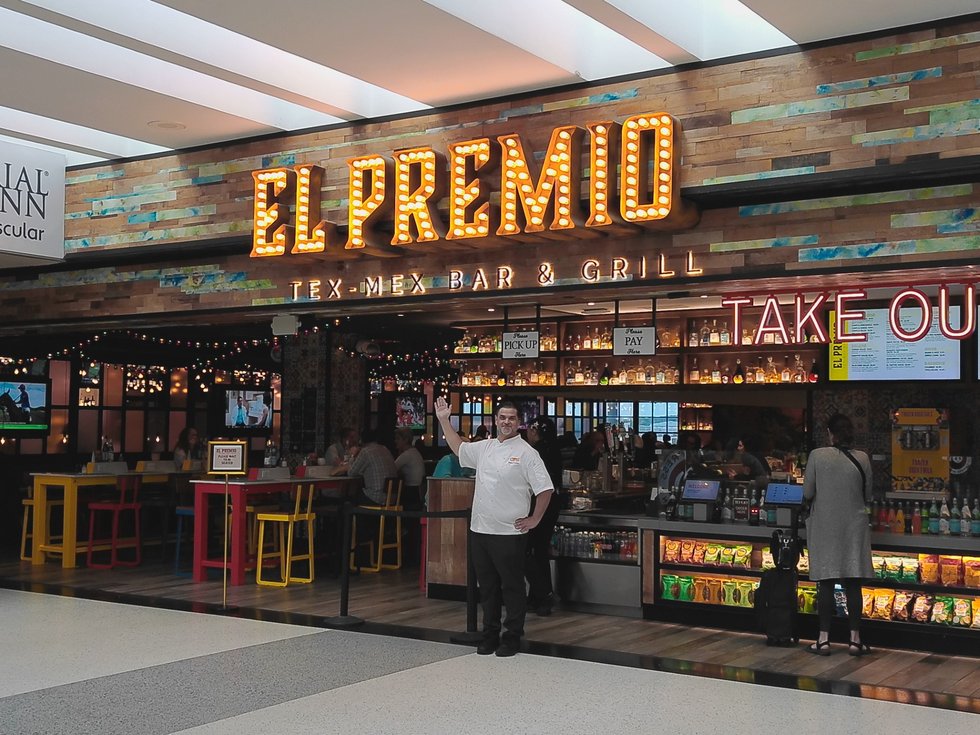
A location of El Premio Restaurant in George Bush International Airport in Houston operated by OTG.
By Ed Avis
Since 2021, travelers passing through Terminal B of LaGuardia Airport in New York have been able to enjoy a tasty burrito or plate of tacos at Dos Toros Taqueria. When that location opened it was the first Dos Toros in an airport; today there are six airport locations and three more in development.
Clearly, airport locations have paid off for Dos Toros.
“The average unit volume for airport locations is traditionally higher than what you would find for street locations,” says Jeff Drake, president of Dos Toros, which also has 20 stand-alone locations. “It might do the sales volume of two locations on the street or three locations on the street, depending on the airport and the [volume of passengers]. They’re very complicated and take a lot of work to set up and run correctly, but if you make the investment up front and you’re really thoughtful and understand all of the responsibilities that come along with giving someone else the rights to operate your business, it can be a very good way to build your brand.”
TRAINING PROGRAM, MENU, SUPPLY CHAIN ARE KEY
The first step towards opening an airport location is making sure your restaurant is set up in a fashion that can be reproduced with the same quality and standards as your stand-alone restaurant.
A good employee training program is essential.
“The process by which you get employees to be able to master your brand and to execute your brand — from the perspective of a cashier or a grill cook or a manager — is critical because you’re not going to be there every day to watch your restaurant being run,” Drake says. “Someone else is going be running it, so making sure that you have the foundation of training really well established is critically important.”
A menu that is appropriate for an airport location is also essential. Some travelers want a full meal, while others want to grab a quick bite, so the menu must accommodate both preferences. The menu also must feature items that can be efficiently produced in a fast-paced environment.
The right menu for an airport location might be smaller than the menu in your stand-alone location, Drake adds. Passengers have less time to peruse the menu, so the restaurant should focus on sure winners.
Manuel Trevino, vice president of culinary at OTG, a major airport concession management company, says restaurants that offer signature dishes that can be executed well in airport settings have an edge when the company considers restaurants for partnerships.
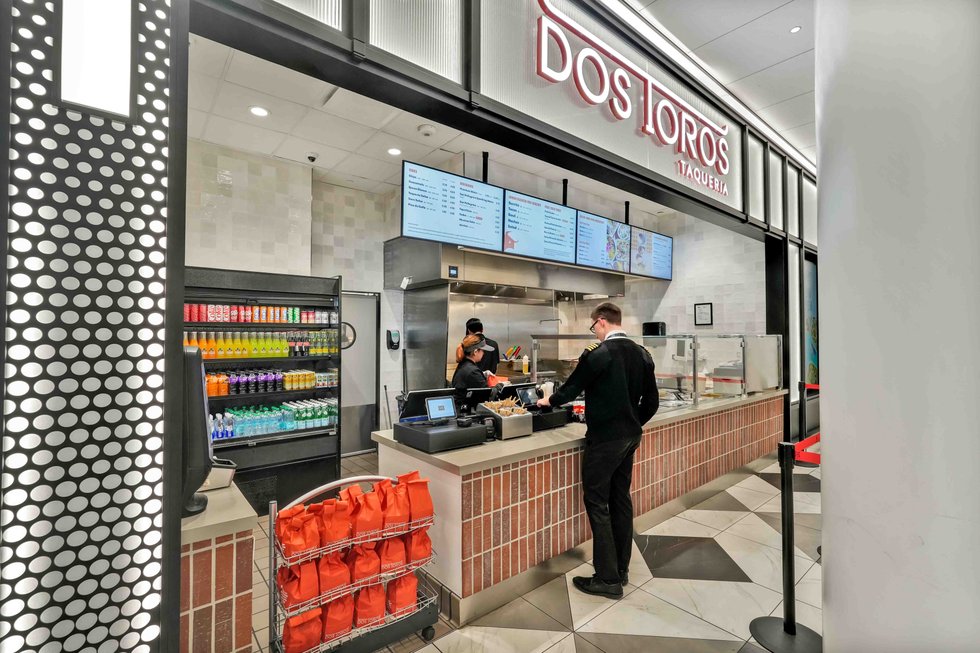
The Dos Toros location in LaGuardia Airport
“The strongest menus are focused, flexible and designed for consistent execution,” Trevino says. “They work across multiple dayparts, accommodate fluctuating passenger volume and balance speed with quality.”
A correctly designed menu is tightly connected to the supply chain. Since the majority of airport locations are run by airport concession management companies, rather than by the restaurant owners, the ingredient suppliers often are not the same as those that supply the stand-alone locations. Consequently, the ingredients specified for the menu might need to be adjusted to accommodate what the airport supplier has available. Drake explains that ingredient issues are addressed in the license agreement the restaurant has with the concessionaire. He says the agreement will have “hard specs” and “soft hard specs.”
“In other words, one of the hard specs for Dos Toros is that you have to use this specific brand of tortilla. If you don’t use those tortillas, you can’t have a Dos Toros, because those tortillas are a critical component of the experience,” Drake says. “Then there are other things, like produce. We have specs on produce, but we’re not going to say that you have to buy from this farm for our lettuce. You just have to buy domestic lettuce.”
GETTING INTO THE AIRPORT
So how do you get your foot in the door? In most cases, you should start by learning which concession management companies are active in your local airports and reach out to them. Airports generally work with those types of companies, rather than with individual restaurants, because it’s easier to work with one big operator than multiple small restaurants. OTG, for example, runs the restaurants in 11 major airports, ranging from LaGuardia to O’Hare to Denver.
In a smaller market, however, it’s possible that your nearest airport runs its own concessions. In that case, reach out to the airport manager to ask about concession opportunities.
When an airport needs to select restaurants — for example, when an existing concession agreement expires or the airport expands — it asks concession management companies for proposals (small airports may request proposals from local restaurants directly). Fortunately for local Mexican and Latin restaurants, the airports often tell the management companies to include quality local restaurants in their proposal so that the airport has a local feel.
Sometimes restaurants reach out to OTG and ask to be included in their proposals, and sometimes OTG reaches out to restaurants, Trevino explains. Either way, the company seeks restaurants with credibility in the market and a good local following.
“We are especially interested in brands that immediately connect travelers to their destination,” he explains. “Our restaurant portfolio should ‘scream’ the city we are in — its neighborhoods, people, food culture and personality. The goal is to introduce travelers to restaurants that locals genuinely know and support, rather than simply placing a concept in an airport because it is convenient to replicate.”
Obviously, as you surely saw the last time you were in an airport, concession managers also love familiar national brand restaurants.
Randy Hazelton, the CEO of H&H Hospitality, which operates restaurants in Hartfield-Jackson Airport in Atlanta and two other airports, notes that national brands are often favored because they have proven operational models and travelers quickly recognize them.
“National brands tend to do better than local, independent brands — that’s not true 100 percent of the time, but it’s substantially the case,” Hazelton says. “Part of that comes down to operations: Airport restaurants need streamlined, tight operational models so throughput is fast, because travelers are moving, they’re focused on getting to their flight, and they don’t have a lot of time to spare. The more familiar the brand, the better it tends to perform.”
So, whether you have a great local brand or represent a national Mexican/Latin restaurant brand, airport opportunities exist.
Dos Toros — which falls between those two extremes, since it has 20 stand-alone locations in New York, Washington D.C., and Chicago — developed marketing material and presentations to help persuade airport concession operators to include them, Drake says.
“Then we started making sure that people were aware that Dos Toros was open for business in the airport space,” he says. “We networked within the industry to let everyone know we’re good at this, we’re excited about it.”
Attending airport conferences is part of Drake’s strategy. Hazelton recommends that tactic as well.
“There are a few good industry conferences I’d point people toward,” Hazelton says. “AXC — the Airport Experience Conference — is one. AMAC is another, which focuses on minority- and women-owned businesses in airports. And ACI, Airports Council International, brings together airport stakeholders to talk through a lot of these industry issues.”
ONCE YOU’RE IN
Getting chosen for an airport location is a giant first step, but there’s still plenty of work to do, even if your restaurant is part of a proposal made by a concession management company that will run the restaurants.
The agreement between your restaurant and the management company or airport will drive the relationship. Issues in the agreement include everything from the location of the restaurant inside the airport to the training of staff to the finances. All of those issues are important.
Location, for example, can make a significant difference in sales.
“People assume that just having a spot in the airport guarantees success, but that’s not true,” Hazelton says. “You want to be near the center of the concourse or close to where passengers enter, which is often where the food courts are.”
Jenn Reynolds, CEO and founder of Ideation Design Group, a firm that designs airport restaurant locations, agrees. She stresses that airport authorities often dictate the type of restaurants they want in certain locations when they issue the request for proposals.
“They may identify a space specifically for a quick-service restaurant, coffee concept, local brand, national brand, burger concept, chicken concept, sandwich shop or another particular use,” Reynolds says. “Concessionaires then respond with brands and concepts that fit those requirements, and the airport ultimately selects the operator and concepts.”
If location decisions are made at that level, how can the restaurant affect that? For Dos Toros, if the location doesn’t seem right, they simply say “no,” Drake says. “Sometimes you’re excited about the partner, you’re excited about the airport, but at the end of the day, [you realize] the location in the airport isn’t going to be a good fit for the brand.”
The financial terms also are essential.
If the restaurant is working directly with the airport operator, it will pay the airport some percentage of sales, Hazelton says. That percentage is typically 15 to 20 percent, and there’s a minimum — the Minimum Annual Guarantee (MAG) — that the restaurant must pay whether it has one dollar or a million dollars in sales.
If the restaurant is partnering with an airport concessions manager, the manager assumes more of the risk.
“In terms of deal structure, the concessionaire licenses the brand’s intellectual property rather than the other way around,” Trevino explains. “OTG pays the brand for the right to operate under its name and system. Terms vary, but the payment is typically a lump sum up front plus an ongoing royalty on gross sales.”
In the latter case, once the agreement is signed, the concession management company pays for the buildout of the space in the airport, hires the staff, pays rent to the airport or developer, and runs day-to-day operations.
But that doesn’t mean the restaurant just sits back and collects the checks, Drake stresses. The airport staff must go through the same training as other employees, and the training staff provide support after the opening to ensure the restaurant is running well.
In the long term, menu changes that occur in the stand-alone locations must be implemented at the airport locations, too. Furthermore, to make sure the airport location is maintaining standards, Dos Toros managers visit the airport locations regularly.
“If you do not show up and you don’t pay attention to how they’re operating your brand, mission creep can take place where all of a sudden your brand gets further and further away,” Drake says. “At Dos Toros, our standard is we visit once a month in the first three months, and then we’re visiting quarterly.”
The quarterly visit includes an audit on food, food safety, cleanliness, hospitality, and other important factors, Drake adds.
Ultimately, for Dos Toros, the effort clearly pays off.
“We’re excited to bring our version of Mexican food to travelers across the country,” Drake says. “If you can put your brand into a non-traditional venue, such as an airport location, and have the confidence that other people can operate your brand and deliver the delicious food that you do on the street, it’s a great opportunity.”
Sidebar: Mexican Fare: An Airport Crowd-Pleasing Cuisine
We asked Manuel Trevino, vice president of culinary for airport concessions manager OTG, if Mexican/Latin cuisine works well in airports. Here is his reply:
“As a Mexican-American chef, this is something I feel strongly about. People genuinely love Mexican food. It is consistently one of the most popular ethnic cuisine choices among diners, and its flavors are both familiar and exciting to a very broad audience.
“Mexican food also translates naturally into an airport environment. Tacos, tortas, quesadillas, bowls and breakfast tacos can be served quickly and travel well, while regional specialties and composed entrées can support a more complete sit-down experience. The cuisine works throughout the day and offers tremendous flexibility for different dietary preferences.
“There is also a strong beverage component, from coffee, aguas frescas and fresh juices to margaritas, tequila and mezcal. That versatility allows a Mexican concept to serve many different types of travelers and occasions.
“However, authenticity matters. Mexican cuisine is incredibly regional and diverse, just as Latin cuisine represents many distinct countries, cultures and traditions. The strongest concepts have a specific identity and an honest story. They should celebrate those differences instead of presenting a generic version of ‘Latin’ food. Today’s diners are more informed, adventurous and able to recognize when the food is genuine.”
Sidebar: Design Matters
We interviewed Jenn Reynolds, CEO and founder of Ideation Design Group, to find out how the design of an airport restaurant differs from that of a stand-alone concept. Here she explains what sets concourse locations apart:
“Airport restaurants have to tell the brand story faster and work harder operationally. In an airport, you may only have a few seconds to capture a traveler’s attention as they move through the concourse. The concept needs to be immediately recognizable and communicate what it offers from a distance.
“Operationally, airport restaurants also experience significantly higher traffic and turnover, often within a much smaller footprint. Every square foot has to work incredibly hard. We are designing around luggage, circulation, queuing, food pickup, seating and the movement of employees, all while maintaining a strong guest experience.
“What I find particularly important when designing Mexican and Latin concepts is maintaining cultural authenticity while adapting the experience to an airport. Color, materiality, pattern, artwork and food presentation can all be incredibly powerful. We want to understand the origin and personality of the concept rather than simply applying decorative elements that are associated with a region.
“Food visibility and the bar experience can also play a major role. In an airport, seeing the energy of the restaurant, the preparation of the food or a vibrant bar can immediately communicate what the experience is going to be.”