
By Ed Avis
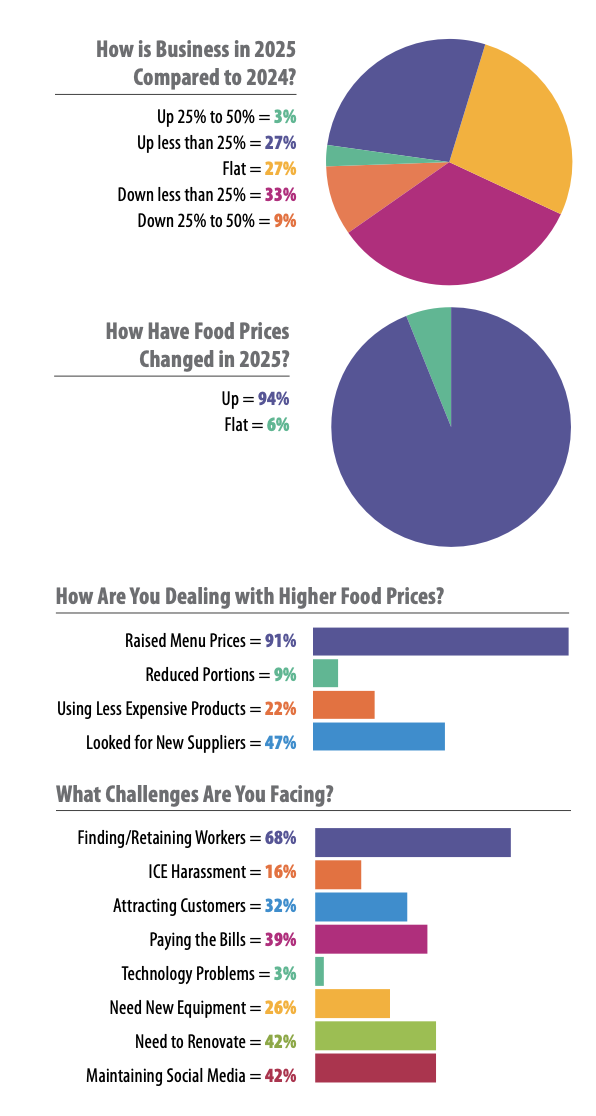
It’s been a tough year for Mexican restaurants. Food prices are up, good employees are hard to find, and managing social media is a hassle. On top of all that, masked government thugs are harassing workers and keeping customers away.
It’s no surprise then that our 11th annual State of the Industry Survey revealed that 42 percent of restaurants report a drop in business so far this year. That compares to 32 percent who reported that sales dropped in 2024 and only 25 percent in 2023. That’s a 17 percentage point jump in two years.
However, despite the ugly data, the survey revealed bright spots. Almost a third of respondents reported that business is up this year, including Pancho’s Southwestern Grille in Green, Ohio, which has seen sales increase 7.3 percent this year.
“We’re fortunate. We’ve been blessed,” says owner Maury Sullivan, who partly attributes the restaurant’s success to community involvement. “We’re so entrenched in this community. We support the community whenever and however we can.”
Food Prices Drive the Pain
The el Restaurante survey, which 44 owners of Mexican/Latin restaurants across the country answered during the last week in October, clearly showed that climbing food prices are a primary concern. Ninety-four percent of respondents said their food bills are up this year.
“Everything is more expensive right now,” says Jose Castellanos, owner of Pollo Picosito in San Antonio, Texas. “Especially the beef — it used to be $3 or $4 a pound, now it’s $7.”
Ruben Nunez-Martinez, the owner of El Pueblo Taqueria in Cape May, New Jersey, also has been hit hard by beef prices. He pays nearly $7 a pound for top round beef; a couple of years ago that beef cost $3.50 a pound.
“And chicken was really expensive this summer. We were buying a case of chicken for almost $90 for a while,” he says. “A couple of years ago it was like $40 a case.”
Prices like that make it hard for Mexican restaurants to keep menu prices reasonable. Nunez-Martinez says many of his customers are high school students who visit two or three times a week. The taqueria also attracts landscapers and construction workers — some eat lunch there nearly every day, Nunez-Martinez says.
“We’re one of the few restaurants around here that keeps the prices real reasonable,” he says. “Like we sell al pastor tacos for $14 for four tacos, and lot of other restaurants here sell al pastor tacos for $20 and you only get three tacos.”
Raising menu prices is the main way Mexican restaurants are responding to climbing food prices, our survey showed. Ninety-one percent of respondents raised some or all menu prices this year.
Nunez-Martinez raised prices between 75 cents and a dollar on every item. But he believes his loyalty program took some of the sting out of that increase.
“I say to the kids, ‘Hey, put your phone number down and a few visits down the line you’ll get 20 percent off your whole order.’”
Sullivan from Pancho’s also raised prices: “We just went through one of our bigger menu price increases — 2 or 2.5 percent pretty much across the board. That’s a pretty good price increase all at once, but we just felt that we needed to do that.”
His customers didn’t complain. “I think the guest is willing to absorb that as long as you’re keeping your product quality and portion the same,” he says.
Most restaurant owners agree with Sullivan on that point, according to our survey. Only 9 percent of respondents who face higher food prices combatted that by reducing food portions, and only 22 percent switched to lower-priced products.
Nearly half, however, did search for other food suppliers this year.
“Now we have like five different companies that we buy from, and every week we’re checking prices before we buy,” Nunez-Martinez says.
Labor Challenges Jump This Year
Finding good employees was tough after Covid — in 2022, 78 percent of survey respondents said finding labor was harder than before. But by 2024, that number dropped to just 30 percent. Sadly, this year it’s back up again — 68 percent of respondents said finding and retaining employees is a challenge.
Mark Casale, corporate executive chef of Dos Coyotes, a 12-unit chain in northern California, says the restaurant often hires college students for its lower-level management jobs, but fewer of them are applying these days.
“We’ve always had a significant amount of turnover there, because college age workers come and go, and we expect that. But they’re just not coming as much as we would like them to,” he says.
Adding to the problem is that some of the younger people who join Dos Coyotes at the lower management levels don’t understand the demands of hospitality management work.
“It seems like people don’t want to work nights and weekends and holidays anymore,” Casale says. “And they don’t want the responsibility: ‘You mean I have to work if someone doesn’t show up?’” Casale laughs.
ICE Harassment Adds Pain
ICE raids in some communities are exacerbating problems. Sixteen percent of survey respondents said dealing with immigration raids, or the fear of those raids, is currently a challenge they are facing.
Castellanos says ICE has not raided his restaurant and his workers continue clocking in, but they are anxious about the situation.
“All the workers are afraid because ICE isn’t stopping only people who don’t have documents, but everybody,” he says. “Everybody that looks brown is being persecuted.”
Harassment by ICE is also affecting overall business, Castellanos believes.
“The immigration situation creates some fear with the community. The people don’t want to go out because they’re being harassed by these masked men,” he reports.
Another Hurdle: Managing Social Media
Restaurants rely on social media for promotions more than ever; but keeping up with them can be a hassle. Forty-two percent of survey respondents noted that as a challenge.
One restaurant that has succeeded with social media is Dos Coyotes. Casale says the company hired a social media director this year.
“I think it was Warren Buffet who said, ‘When things get tough, fire your assistant and hire a marketing team,’” Casale laughs. “So, we’re pushing into Instagram and doing collabs with some of our suppliers.”
Those collaborations cross promote the businesses, he explains. For example, the restaurant’s tortilla supplier, Mi Rancho, sent nine “influencers” to the restaurant for a tasting that led to social media posts. And they are working on a collaboration with their dairy supplier to show off that company’s manufacturing process, which in turn will demonstrate the quality dairy ingredients Dos Coyote uses.
“We feel like we have a great story and that we source really high-quality products, so we want to show that value to our guests,” Casale says.
Optimism Persists
Despite the challenges Mexican restaurants face, an entrepreneurial energy still surges underneath.
El Pueblo Taqueria is a good example. Nunez-Martinez started the restaurant eight years ago, using his mom’s recipes. He says his restaurant is one of the few Mexican restaurants in Cape May, a summer tourist destination, that stays busy year round.
“We actually just got a food truck that we started with this summer that just passed,” he says. “It was kind of amazing — we did a lot of private catering, a lot of farmer’s markets in the summer. It was awesome. So ,we’re trying to learn, you know. We’re trying to grow.”