
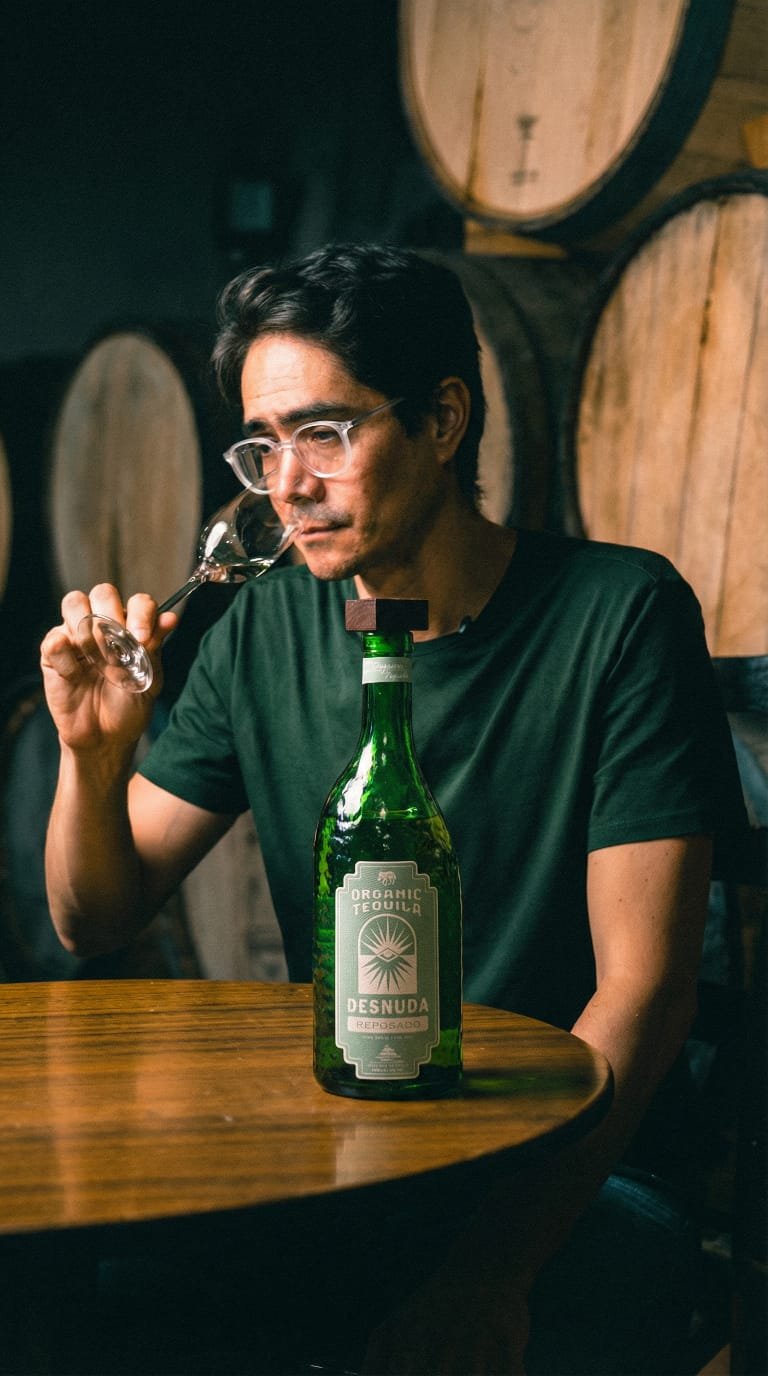
Santos Ochoa
By Alfredo Espinola
At times, the history of tequila seems to have been told so many times that it risks being diluted. Amid repetitive rhetoric, loud marketing, and a proliferation of brands that rise and fall with equal speed, the industry’s credibility has become an uncomfortable but urgent issue.
Santos Ochoa speaks with rare clarity: no posturing, no forced folklore, no artificial nostalgia. He didn’t inherit land or a historic surname; he is, as he defines himself, “Someone who went from concrete to the countryside, from the city to the agaves”. A certified public accountant by training, he now has more than 23 years of experience in the tequila industry—a journey that began with numbers and ended, through determination and obsession, at the heart of the production process.
From the Desk to the Agave
Santos Ochoa tells us that he started in the accounting department of a premium tequila brand, back when that segment was just beginning to take off: “At that time, there were perhaps ten premium brands—not hundreds like today.” Over time, his career led him to hold executive positions, including that of CEO of operations—an experience that forced him to become fully immersed in materials, processes, and production. He collaborated with investment funds seeking to professionalize brands from the ground up. Along the way, he came to understand something essential: “Tequila cannot survive on marketing alone.”
Aware that financial knowledge wasn’t enough, he decided to study distillates to round out his skill set. Thus, beyond his title or accumulated experience, he earned the title of master tequila maker. “Not just because of what I’d already experienced in the industry, but because I understood that tequila demands technical training and respect for the process.”
Craft Over Rhetoric
Santos explains clearly, “The NOM is not an identity; it’s a standard. My intention is for people to recognize a style, a way of making tequila—not just a number.” That is the foundation of his current project: Casco Lobo, a distillery founded in September 2024 and designed to take the craft concept to the extreme in terms of detail and consistency.
Casco Lobo is conceived as a small-batch distillery, obsessed with consistency. Each batch is precisely controlled—temperature, oxygenation, timings, and volumes—not to industrialize the process, but to ensure that an artisanal tequila can be replicated without betraying its essence.
“I don’t believe that ‘artisanal’ should be synonymous with chaotic variation,” he states. For him, true mastery lies in ensuring that a small batch tastes the same today as it will five batches from now. That requires hands-on oversight, rigorous controls, judicious innovation, and consistent production—even on a small scale.
“Craftsmanship shouldn’t be synonymous with inconsistency,” he emphasizes. “If you produce consistently, month after month—even in small quantities—you can achieve defined and authentic profiles.”
At Casco Lobo, they produce blanco, reposado, añejo, and extra añejo tequilas, always starting with the process, never with post-production tweaking.
Desnuda: Returning to the Truth of Tequila
Following that same logic, in August 2025 in Nashville, Tennessee, Tequila Desnuda—one of the brands Santos develops within Casco Lobo—was relaunched. The name -- "desnuda" means "nude" in Spanish -- may seem provocative at first glance, but it is actually a statement of principles: “To show the product as it is, without embellishments or pretense; but we take it to the natural, to the organic.”
The commitment goes beyond the liquid itself; the bottles are handcrafted in Tonalá and Tlaquepaque, and some are even made of blown glass. The corks are made from recycled micro-agglomerated wood. Every decision is made with consistency in mind: “It makes no sense to say your tequila is organic and then seal the bottle with a synthetic cork,” he explains.
Tequila Desnuda is available in blanco, reposado, and añejo varieties, all certified organic. In addition, Santos is preparing the launch of a 12-year-old organic Extra Añejo, born—paradoxically—from a previous agave crisis. A tequila that remained forgotten in the barrel and is now having its moment.
Organic Is Not Just a Label
For Santos, organic goes beyond the mere absence of additives. It begins in the field: agaves grown without pesticides or genetically modified organisms, cultivated using cycles that return to the soil what is taken from it. “We let the land rest for a year; we close the cycle. That is true sustainability.”
In the industrial process, the philosophy remains the same: extreme cleanliness, no chemicals, and controls that prevent invisible yet persistent contamination. “Many people talk about additive-free, but they ignore everything that happens before and during production. You can add nothing at the end and still have disrupted the process from the very beginning,” he clarifies.
He explains that the difference isn’t always organoleptic; it’s chemical, structural, and, above all, ethical.
Innovating to Tell the Truth
Santos doesn’t idealize the concept of “traditional tequila.” He respects it, but he also questions it. He knows that much of the industry today operates using highly industrialized processes, even if the official narrative suggests otherwise. That’s why he insists on something he considers urgent: “Restoring credibility”.
“The tequila industry can harm itself if it doesn’t protect the truth,” he warns. He speaks bluntly about ambiguous practices, unclear certifications, and associations with conflicts of interest. Not out of a desire for confrontation, but out of the need to lay everything out on the table.
In his view, the future doesn’t lie in romanticizing the tahona stone for the sake of a photo, but in honestly explaining what is done, how it’s done, and why it’s done that way. Innovation isn’t a betrayal of tradition, but using knowledge to do things better.
The Real Challenge Facing Tequila
Santos doesn’t shy away from uncomfortable topics; he’s concerned about the overexploitation of agave, the romanticization of processes that are no longer entirely authentic, and the use of marketing as a substitute for the truth. “If the industry loses credibility, we all lose.”
He openly questions certain certifications, competitions, and narratives that, in his opinion, aren’t always consistent. Even so, he recognizes competition as a necessary driving force: “Competition is healthy, as long as it’s based on clear and honest rules.”
For him, consumers are becoming increasingly aware; they may accept a recommendation, but not a lie that’s sustained over time.
The Market and Pride
Currently, Tequila Desnuda has a stronger presence in the United States, especially in California and the Midwest, where bourbon and barrel-aging culture naturally complement its reposado and añejo tequilas. “My favorite tequila is the reposado. Crafting a good reposado requires mastering two arts: the blanco and the wood.”
Paradoxically, Mexico is not yet his main market. “It’s different—more complex from a business standpoint. I prefer to grow steadily and with a genuine presence,” he explains.
That decision to prioritize consistency over speed found unexpected validation this year. In just one year of existence, Tequila Desnuda went from being an idea to becoming one of the industry’s most recognized projects, earning the highest honor as Tequila of the Year at the 2026 Bartender Spirits Awards. The jury also honored the brand with awards for Best Packaging Design, Spirit of the Year (Mexico), and Tequila Producer of the Year, in addition to awarding it an extraordinary score of 98 points.
More than just a collection of trophies, these accolades represent the validation of a philosophy. In a category where many brands build the narrative first and the product second, Desnuda took the opposite approach: it prioritized process, technique, and consistency. The fact that this approach has been recognized by industry experts demonstrates that excellence doesn’t always take decades to make its mark.
On Pride and Persistence
For Santos, seeing a bottle of Tequila Desnuda finished for the first time was an act of validation—not of arrival, but of consistency, the culmination of years of study, perseverance, and a quiet obsession with doing things right. The fact that, just one year later, that same project was recognized as Tequila of the Year does not alter the meaning of that quest; it simply confirms that, when integrity guides the process, recognition eventually finds its way.
When asked what he would say to the Santos of 23 years ago, he does not speak of success or recognition; he speaks of values, of integrity, of remaining true to the aging process, even when it seems to go against the grain. “In the long run, that’s what sustains you,” he says.
Looking back on his early days, Santos reaffirms the importance of staying true to his values: “Even if the path goes against the current, integrity eventually finds its place.”
Because in the end, laying yourself bare—in tequila as in life—takes courage.