
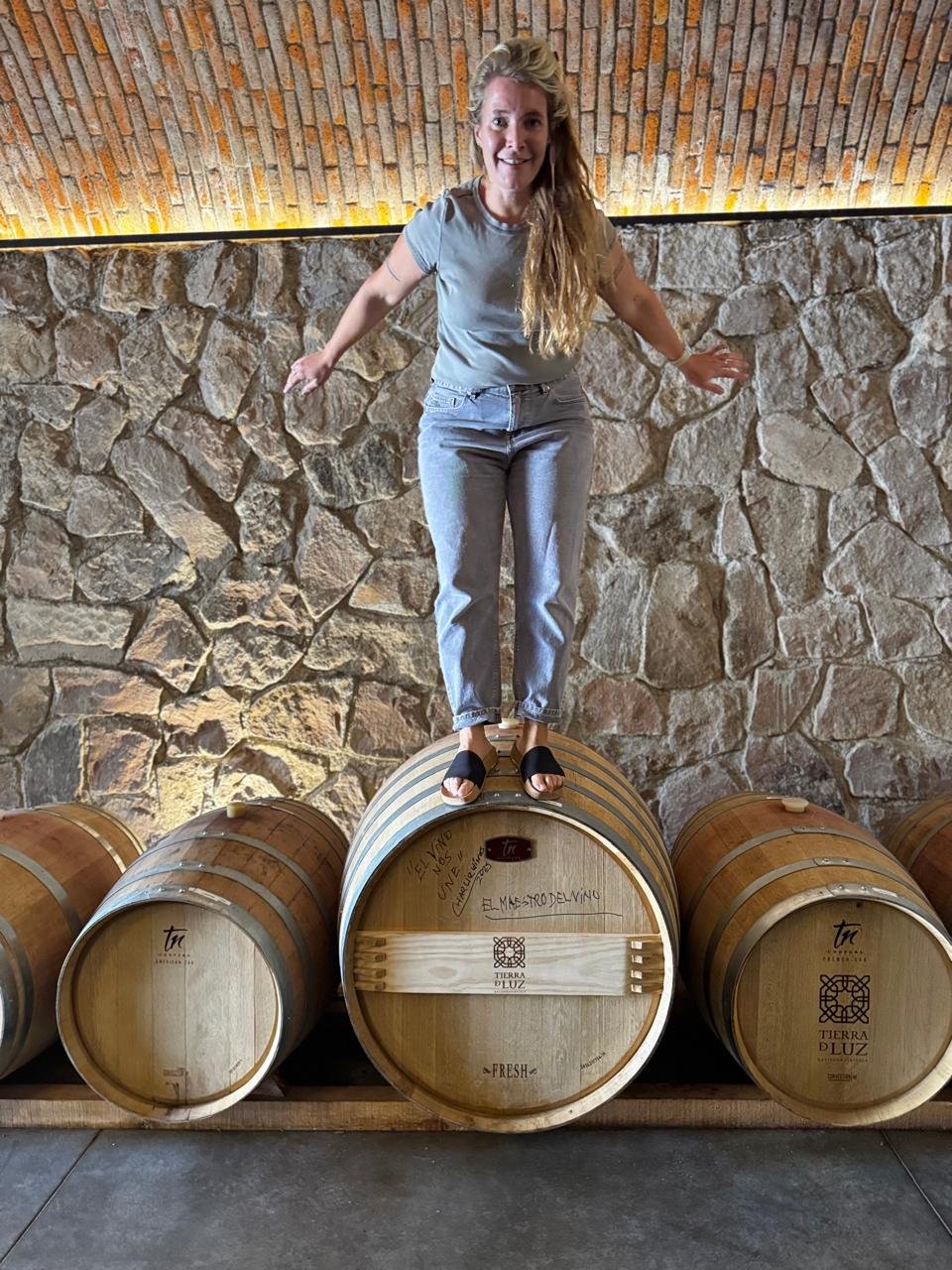
Agostina Astegiano
By Alfredo Espinola
Agostina Astegiano was born in Mendoza, Argentina, and at age 12 moved with her family to a farm in Rivadavia. There she met Don Bianchi, a winegrower who taught her that love for the land is expressed through patience and dedication. Bianchi’s death in his own vineyard cemented her conviction that wine would be her calling.
After earning her degree in Enology from Don Bosco University, she met her husband, Fabricio Hernández, her partner in life and in her profession.
Astegiano rounded out her training by participating in harvests in France, Australia, and the United States—experiences that revealed to her that wine is a universal language with its own distinct accents in every region.
“It was in Australia where I had my first immersion in the world of white wines, working alongside Tom Carson, one of the most renowned and internationally acclaimed winemakers, who was named International Winemaker of the Year in 2004.”
Wines of Sins: A Project with Soul
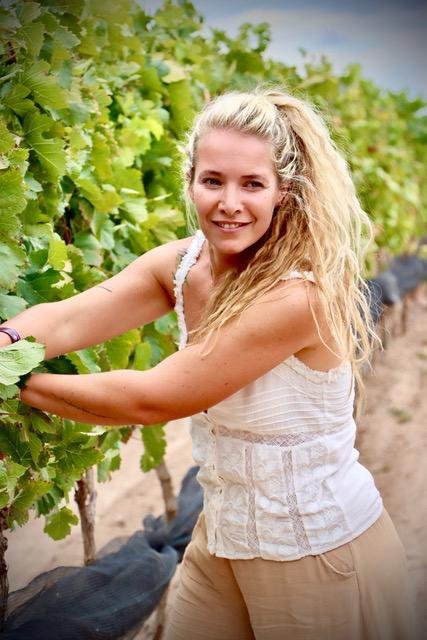
Agostina Astegiano
In 2008, she and her husband founded Wines of Sins in Argentina, inspired by the deadly sins. They started with 2,000 bottles of Canarí and now produce 25,000 bottles a year. The brand became a creative laboratory where they explored styles and narratives.
Their work expanded to Mexico, where they consult on projects in San Luis Potosí, Hidalgo, Querétaro, Guanajuato, Aguascalientes, Chihuahua, Ensenada, and Jalisco. Each winery represents a different challenge and a shared dream.
Astegiano has advised wineries such as Casa de Quesada, La Escondida, Cerca Blanca, Tierra de Luz, Cava 57, Puente Josefa, Cordelia, Piscis, El Refugio, Azteca, and Silvestre; in Querétaro, she has advised 17 wineries. Her husband leads the major Valle de los Encinos project for the Bafar group; and in Ensenada, they are involved with 12 Piedras.
Each name represents a dream, a story, and a distinct challenge; each project is part of a map that reflects their commitment to Mexican wine.
Mexico: Belonging and Transforming
The definitive leap came in 2019, when they decided to move to Mexico following her husband’s success at Cava Quintanilla in San Luis Potosí—an achievement that saw the winery’s production grow from 10,000 to 400,000 bottles in just a few years.
Astegiano’s restlessness led her to pursue professional independence, starting with Piscis, a Chardonnay that now produces 12,000 liters.
In 2021, together with Viviana Parra and Joana Vallejo, she founded the association Mujeres Intaninos (MIT), which grew from a WhatsApp group into a network of more than 250 women in the wine industry—a space for sisterhood and professional support.
Wine Philosophy
Astegiano argues that Mexico should not imitate foreign traditions but rather build its own identity. “For years, Tempranillo was planted because it was the familiar choice, but it often doesn’t thrive here. Mexico must build its own winemaking identity. The challenge is to listen to the land and let it show us which varieties can shine here.”
True Luxury
For her, wine is neither a status symbol nor a technical discourse: it is a bridge between people. “A glass of wine should bring you closer to people, not make you feel inferior for not knowing how to pronounce the name of a French region.”
Regarding sommeliers, Astegiano notes that they are indispensable communicators, building bridges between those who produce wine and those who drink it. The problem arises when the focus shifts from the wine to the person explaining it. “Wine should never feed egos,” she says, urging a return to the essentials.
She emphasizes that behind every bottle are farmers, pruners, tractor drivers, lab technicians, and winemakers—whose stories rarely appear on the label. “Wine begins long before it reaches the glass; it begins in the soil.”
The Patience of the Grape
Beyond medals or scores, what moves her is the grape’s capacity for transformation. “At first, it seems impossible to achieve a good result; however, with patience, time, and hard work, the wine eventually finds its balance.”
She says this with the serenity of someone who has watched vineyards grow and knows that no harvest can be rushed by force of will. There are things that only time can grant, and wine, like life, always belongs to those who know how to wait.
With serenity, she affirms, “The grape teaches you that things can get better; it’s probably the noblest drink that exists.”
The Woman Who Learned to Listen to the Vine
There’s a subtle difference between making wine and building a wine culture. The former is learned through technique; the latter requires patience. Astegiano is convinced that Mexico is going through precisely that moment: the moment of sowing a tradition that is still writing its first pages.
That’s why, when she talks about her team, she doesn’t mention production figures or hectares planted. She talks about people.
At first, many of her workers had never seen fermentation; over time, they began to observe, asked questions, used all their senses, and finally understood the entire process.
Behind this evolution lies a philosophy that is constantly reiterated: no one makes wine alone—confirming what she learned at a very young age—the vineyard always speaks to those who know how to listen.
Between Two Countries, One Passion
In Argentina, wine is part of everyday life. In Mexico, it is still perceived as a drink reserved for special occasions. She dreams of a country where wine ceases to be intimidating and begins to be enjoyed as a companion.
For Astegiano, while it’s true that Mexico is a young country, it’s also true that it’s advancing at a pace of learning that few regions have experienced. She sees producers willing to take risks, consumers who are increasingly open-minded, and new generations who no longer ask whether Mexico can make good wines, but rather what style it wants to develop.
Wine Finds its Meaning When Shared
In the world of wine, medals, price, and the producer’s reputation are highly valued; but Astegiano is convinced that the best wine will never be the most expensive, the most famous, or the most award-winning—but rather the one that brings people together.
Her conclusion is as poetic as it is critical: “Wine on its own tastes of loneliness and sadness.” She asserts that perhaps this is the true work of a winemaker: not to produce great wines, but to create the perfect excuse for someone to linger a little longer at the table.
“Because in the end, wine isn’t measured in glasses or awards, but in the memories it leaves with those who share it.”