
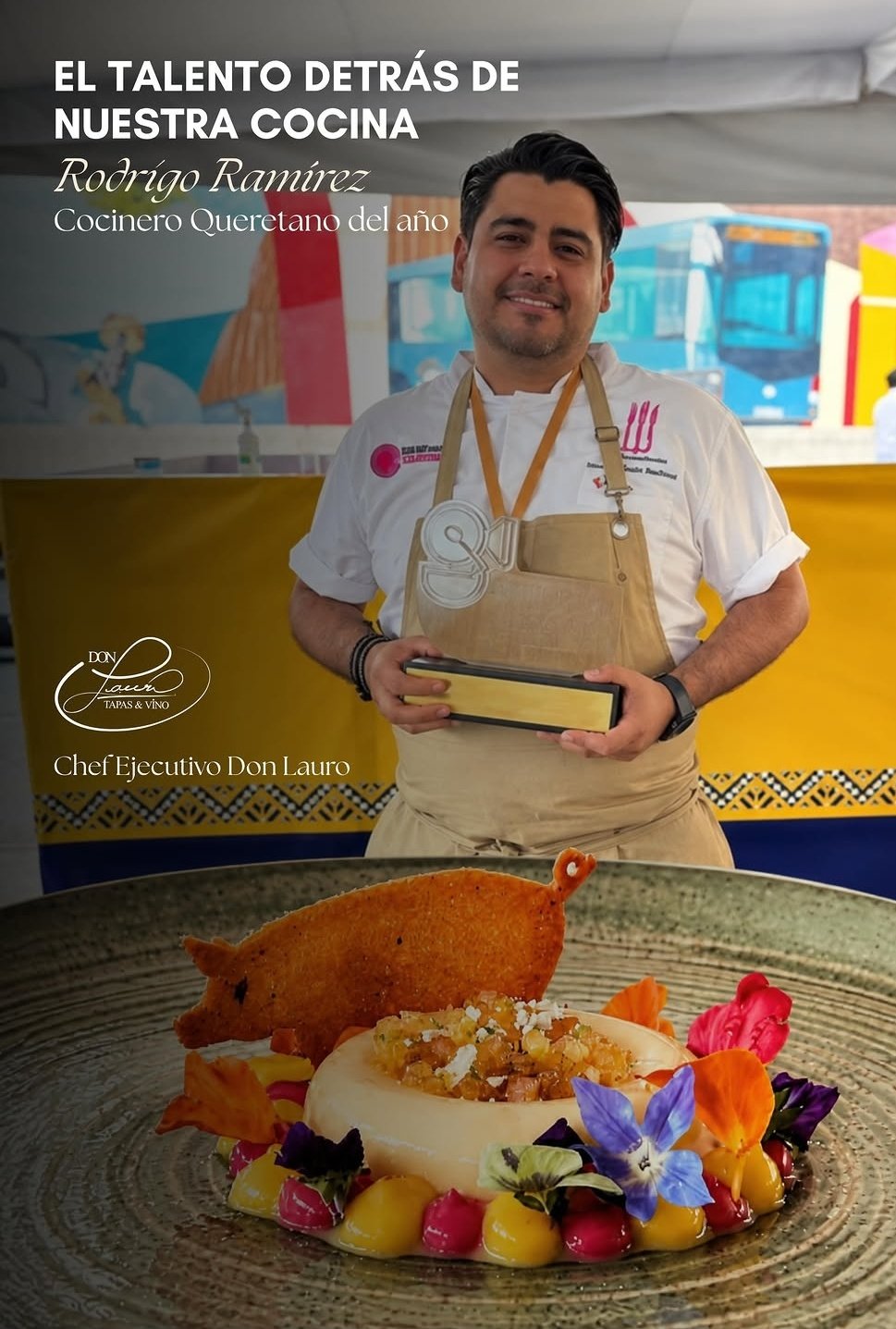
By Alfredo Espinola
After a series of culinary battles marked by technical skill, creativity, and pride in local ingredients, the 2026 Querétaro Chef of the Year competition came to a close on October 3. The grand finale brought together three chefs for a challenge that demanded much more than skill at the stove: interpreting Querétaro’s gastronomic identity through a three-course menu.
The event took place at the Manuel Gómez Morín Cultural Center as part of the Festival of Mexican World Heritage Cities and the celebration marking the 30th anniversary of the designation of the Santiago de Querétaro Historic Monuments Zone as a UNESCO World Heritage Site.
The finalists—Rodrigo Ramírez of Rancho Santa Marina; Luis Calderón of Cao Cao Cocina; and Juan Pablo Inés of Envero de Vinaltura—were presented with a surprise basket filled with products and ingredients from Querétaro. Using this as a starting point, each participant had to design, prepare, and present an appetizer, a main course, and a dessert, demonstrating technical mastery, the ability to improvise, and a keen sensibility for transforming the region’s flavors.
Rodrigo Ramírez: From Garden to Table
The winner was Rodrigo Ramírez, executive chef at Rancho Santa Marina—an agroecological project located in El Marqués, Querétaro—whose farm-to-table philosophy prioritizes local produce, seasonality, and respect for biodiversity. His work is also linked to Don Lauro, in Huichapan, Hidalgo, where he develops a signature culinary concept that connects tradition, the region, and sustainability.
His winning menu was a personal interpretation of Querétaro, built around recognizable ingredients and techniques that gave them a new dimension.
The experience began with a cream of fresh roasted corn soup, accompanied by a corn crisp, esquites, and epazote oil. The dish revived flavors deeply rooted in Mexican cuisine, with different textures and nuances that enriched a familiar preparation.
For the main course, Ramírez presented pork tenderloin glazed with xoconostle mole, served with white rice, a salad of nopales cured with sea salt, and ayocotes. The combination created a dialogue between traditional ingredients and a contemporary execution, without losing sight of the regional character of the dish.
The meal concluded with a chocolate and walnut brownie accompanied by a nopal and xoconostle compote—a combination that brought the region’s ingredients into the realm of sweets and showcased another facet of their versatility.
More than just a succession of dishes, the menu told a personal story: the way the chef understands Querétaro through its products, its roots, and his own experiences.
Three Chefs, Three Ways of Telling the Region’s Story
The final round also highlighted the diversity of approaches that coexist in Querétaro’s gastronomy.
Luis Calderón, of Cao Cao Cocina, stood out for a concept centered on technique and creativity, offering a contemporary take on the region’s ingredients and stories.
For his part, Juan Pablo Inés, of Envero de Vinaltura, emphasized locally sourced ingredients and pairings—a perspective closely tied to the state’s wine-growing region.
The three concepts demonstrated different ways of tackling the same challenge: transforming local ingredients into a culinary experience capable of expressing Querétaro’s identity.
A cuisine that looks to its roots
For Rodrigo Ramírez, this recognition builds on a career in which Querétaro cuisine has found a place on the international stage, such as at the Museo de América in Madrid and FITUR 2025 in Spain.
His approach is based on a simple idea, yet one that is increasingly relevant to contemporary gastronomy: the origin of ingredients matters just as much as how they are prepared. The relationship with producers, the efficient use of resources, and respect for biodiversity are not secondary elements, but rather part of a culinary vision that seeks to connect the farm to the table.
The finals of the 2026 Querétaro Chef of the Year competition thus painted a clear picture of the current state of the region’s cuisine: a gastronomy that draws on its roots for the raw materials needed to innovate, tell stories, and project its identity beyond its borders.