
By Alfredo Espinola
In the heart of Querétaro’s wine region, Viñedos Azteca has built its identity through patience, discipline, and a clear conviction from the very beginning: to produce quality wines rather than quantity.
Jesús Cardoso Muñiz, the project’s head of viticulture and oenology, sums up his role simply: to oversee everything that happens in the vineyard and in the winery. But behind that definition lies more than a decade of continuous work at a vineyard that has grown prudently, learning from the land and the market at the same time.
A project that was born before it existed
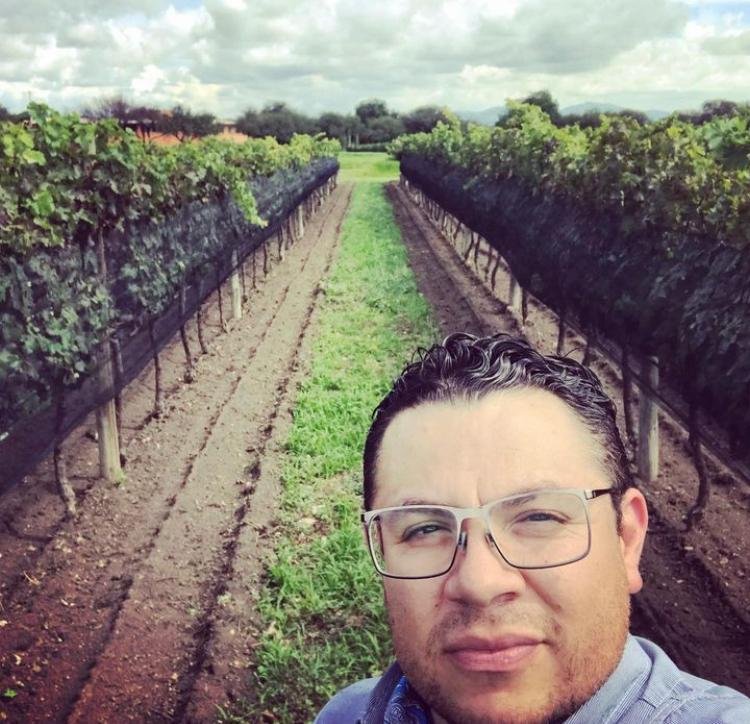
Jesús Cardoso Muñiz
Although Viñedos Azteca formally opened in 2010, the idea began to take shape around 2005, when partners Jorge Ferreira and José Antonio Jaquet started designing a unique project within Querétaro’s burgeoning wine scene.
The intention was never to produce large volumes, but rather to achieve the best possible wine within the terroir’s conditions.
During the early years, winemaking trials were conducted using grapes purchased from nearby vineyards, experimenting with different varieties and seeking a unique style before planting a single vine.
The first blends were literally crafted in the kitchen, through small-scale winemaking experiments that helped define the profile that would later give rise to the vineyard.
From that process came the decision to plant six red varieties: Cabernet Sauvignon, Cabernet Franc, Syrah, Merlot, Malbec, and Tempranillo, which still form the foundation of the project today.
The rootstocks were planted between 2008 and 2009, and two years later the final varieties were grafted.
It took the estate nearly four years to produce its own grapes, so the first vintages relied on fruit sourced from the region.
Growing cautiously to ensure sustainability
From the start, the vineyard’s development was approached with an unusual philosophy: to produce only what could be sold.
“Many projects are born out of passion, but later discover they also need to be a business,” explains Cardoso.
Avoiding overstocking, controlling costs, and understanding the market have been fundamental principles for sustaining growth without compromising the project’s stability.
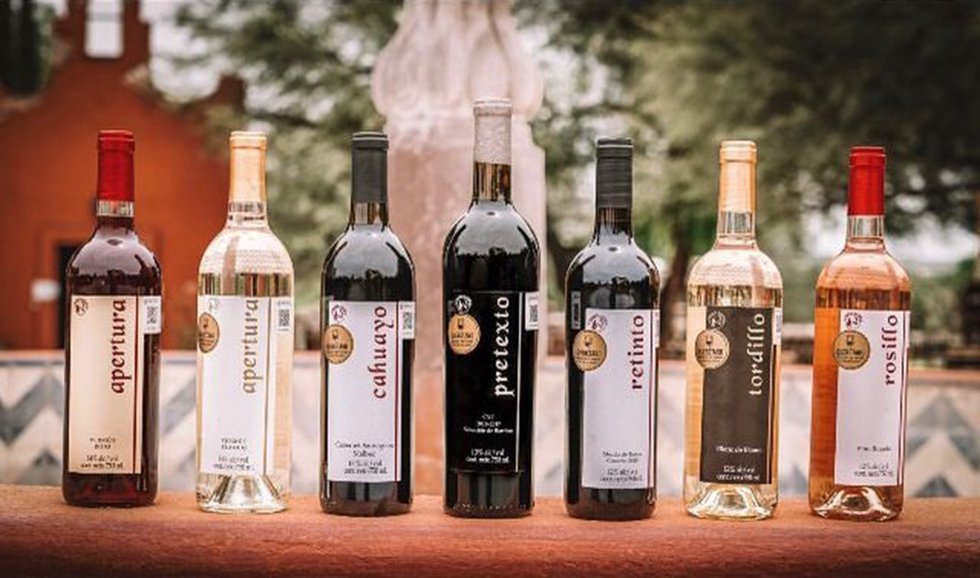
Over time, the portfolio expanded from a single wine to ten labels, which today include reds, whites, rosés, vermouths, and experimental editions.
The flagship wine, Pretexto, remains the winery’s signature, accompanied by labels such as Caguayo, Retinto, Rosillo, Colibrí, and various white and aromatic expressions.
When tourism changed course
In parallel with the business learning process, the region began to transform.
The boom in wine tourism in Querétaro brought more and more visitors to the winery’s doorstep, seeking to explore the estate and taste the wine directly at its source.
That shift forced a rethinking of the strategy. Direct-to-consumer sales became more viable than traditional distribution, where margins, payment terms, and taxes make it difficult to sustain small projects.
Reducing intermediaries allowed us to maintain competitive prices without sacrificing quality, while simultaneously strengthening our connection with the public.
Philosophy: Artisanal, but Flawless
Although production is small and many describe it as artisanal or boutique, Viñedos Azteca’s philosophy is technically rigorous.
The goal is clear: to produce wines free of defects, even if the process is manual.
The winery, with a capacity for about forty tons of grapes, works with basic equipment but enough to control every stage.
Fermentation, filtration, stabilization, and aging are carried out with the same rigor as in a large-scale facility.
Cardoso is critical of the indiscriminate use of the term “artisanal wine,” which in some cases has become a justification for unstable products.
“Today there is enough technology to avoid problems," he says. "If a wine has defects, it is not due to a lack of tools, but rather the producer’s decision.”
For that reason, the winery maintains a traditional approach, without yet venturing into organic, natural, or biodynamic practices.
The priority is to fully master the process before exploring new trends.
Extreme Viticulture in Querétaro
Growing grapes in Querétaro means working outside the classic wine belt of the Northern Hemisphere.
The latitude is lower than in Europe or California, but the altitude compensates for that difference and provides a suitable climate for the vines.
The greatest challenge is climatic irregularity.
Harsh winters, variable springs, warm summers with moderate rainfall, and a semi-desert environment force precise decisions in the field.
Annual precipitation, between 400 and 600 millimeters, can be a problem or an advantage depending on how the vineyard is managed.
“Rather than fighting the rain, we must learn to use it,” says the winemaker.
The region is still in the process of defining its identity. Many plantings were established without prior studies, and today producers continue to evaluate which varieties perform best.
For this reason, it is still premature to speak of an iconic grape for Querétaro. Building a style and reputation can take decades.
The Value of Competitions
Since 2013, Viñedos Azteca has participated in national and international competitions.
Beyond the medals, Cardoso believes that the most valuable aspect is the technical reports they receive after each tasting.
Competitions, when well-organized, offer an objective evaluation by professionals, free from the influence of brand or prestige. This analysis allows for correcting processes and refining details in each vintage.
Awards, on the other hand, serve another purpose: building consumer confidence.
For a young region, external recognition helps build credibility with a public accustomed to labels with centuries of history.
A Winemaker Forged in Practice
Jesús Cardoso joined the project in 2009, when the vineyard was just getting started.
He trained as an agroindustrial engineer, a field that combines agriculture, chemistry, and food technology—and in Mexico, this is typically the closest foundation to winemaking.
There aren’t many formal programs in the country to train winemakers, so most specialize abroad or learn directly in the winery.
In his case, daily experience ultimately defined the craft.
“You learn about wine in the vineyard and in the winery. Theory helps, but practice is what teaches you to make decisions.”
A young project in a century-old industry
Fifteen years may seem like a long time, but in the world of wine, they barely represent the beginning.
The regions that are now benchmarks took generations to establish themselves, and Querétaro is just beginning to build its legacy.
For Viñedos Azteca, the goal is not to grow quickly, but to endure, maintain quality, understand the terrain, and move forward with a steady hand.
Because in wine, as in the vine, time is not an obstacle; it is the only way to prove that a project has deep roots.