
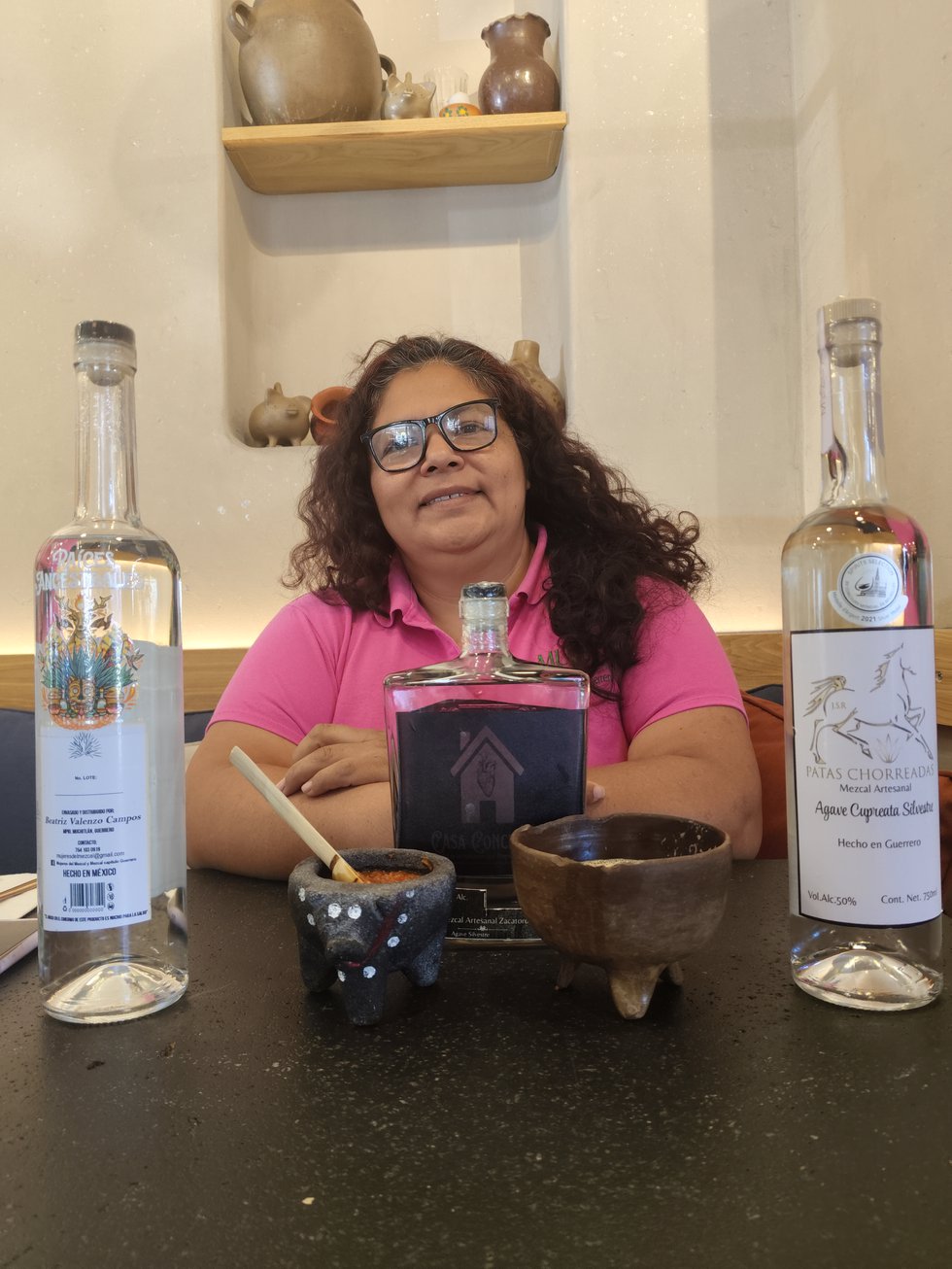
Beatriz Vanessa Valenzo Campos
By Alfredo Espinola
We arrived at our conversation with Beatriz Vanessa Valenzo Campos with the clear impression that we were in the presence of a woman who embodies the strength, memory, and struggle of Guerrero mezcal. President of the Guerrero Chapter of the Association of Women of Mezcal and Maguey of Mexico, Beatriz has been a witness, heir, and tireless promoter of this drink that accompanies life in her state from cradle to grave.
The origins: mezcal as destiny
“I think I was conceived in mezcal!” she says with a laugh. Her story begins in the factory of her maternal grandfather, Abdon Campos Peralta, a master mezcalero and owner of the only factory in the town of Tlacotitlanapa of the municipality of Mochitlan Guerrero. As a child, she watched with fascination as the maguey was baked, crushed in a canoe, and danced around in fermentation vats to extract the must. That world left a lasting impression on her.
Later, when she lived with her paternal grandparents, history repeated itself; her grandfather, Francisco Valenzo Espíritu, was a communal landowner and had the right to his own maguey vat. When he passed away, her grandmother, María Concepción Taquillo, took on responsibilities in the meetings with the communal landowners, but over the years she lost the energy to continue. “She said, ‘Even if it’s you, go.’ And so I went. I always acted as if she were there. That was my guide.”
The birth of the Guerrero Chapter
In July 2019, in Acapulco, Beatriz was sworn in as president of the Guerrero chapter along with 13 women producers. Since then, municipalities such as Mochitlán, Chilpancingo, Tixla, Zihuatanejo, Mártir de Cuilápan, Eduardo Neri, and areas of Tierra Caliente have joined.
Today there are 37 affiliated families, some with production and others with small plots that distill seasonally.
One of the pillars of the chapter is the presence of Dr. Jeiri Toribio Jiménez, a researcher at the Autonomous University of Guerrero, whose work in biotechnology, certifications, and training of mezcal teachers has been key. In fact, students linked to the chapter have already obtained international recognition, such as the Kuaa Nani brand, which won two gold medals in Brussels.
Leading through commitment
“It was an honor for me to be considered president, but also a huge commitment,” explains Beatriz. Her leadership is based on closeness and transparency. "I didn't want to just feel like the president. I wanted to be a companion, a friend, to represent each family as if they were walking with me.”
This work has involved opening doors, reaching out to institutions, and also facing harsh realities: misinformation, misogyny, mistrust, and even the belief that women “only help“ but are not protagonists in mezcal. “The first challenge is for them to believe that mezcal is also theirs.”
The historic achievement: access to resources
One of the most significant achievements of the Guerrero chapter was to secure earmarked resources from the Mexican government for the mezcal guild for the first time.
After several refusals, a tasting and presentation to members of Congress changed the course:
· First year: 2 million pesos for 21 families
· Second year: 3.5 million for another 21 families, plus resources for trademark registration and a fair in Acapulco.
· This year, the fund amounted to 4 million, which is in the process of being allocated.
“It's a women's initiative. And we share it with all families, whether or not they are part of the association.”
Members and non-members; open doors
The association supports both its members and non-members.
What does a member family get?
· Support in national and international competitions
· Advice on packaging, labeling, S.A.T., certifications, and formalization.
· Links to specialized accountants, universities, and support programs.
· Visibility and opportunities to export.
What does a non-member get?
· Advice when requested.
· Support in specific processes.
“This is not a closed club. It's not about excluding, but about adding,” says Beatriz.
Guerrero mezcal in the world
Although Oaxaca is the global benchmark, Guerrero has a clear distinction: the agave cupreata, which is wild, complex, and deeply influenced by Guerrero's geography.
“The cupreata from Guerrero does not taste the same in cold areas as it does in warm areas. The soil changes, the trees change. There is life underground, and our agaves are flirtatious; they absorb aromas and flavors.”
Today, mezcal from Guerrero is reaching Greece, Australia, England, and the United States. In many cases, it is being transported via diplomatic pouch for trade fairs and market openings; pure ingenuity.
The urgency of sustainability
The rapid growth of mezcal came with a risk: agave scarcity. In the absence of federal support, families have taken their own measures:
· Community nurseries.
· Wild reforestation.
· Five-year bans by area
· University research to combat pests.
· Reintroduction of endemic species.
“When people see results, they open up the mountains to us. And there are communities where the picudo (a pest that attacks the maguey) has been eradicated thanks to biofertilizers and biocultures.”
Young people and mezcal
Although young people drink less alcohol, Beatriz observes a positive trend: “They know how to taste. They enjoy it. They take a little sip of mezcal, close their eyes, and tell you the notes. I would never encourage drunkenness, but rather enjoying it with family and friends.”
Guerrero identity; mezcal in all cycles
“Mezcal is in everything. Births, baptisms, birthdays, weddings, wakes... and divorces too,” she says humorously. "However, the people of Guerrero themselves still need to realize the magnitude of their mezcal tradition."
The future: ten years ahead
Beatriz is clear:
“To grow, we need more government support. We have passion, love, and hard work, but without resources, it's difficult to compete with states like Puebla, where there are millions of dollars in investments every year.”
The chapter's vision:
· Producers exporting at a good price.
· Formalized brands without disproportionate tax burdens.
· Lotification respected as a characteristic of origin.
· A sustainable agave chain.
· National visibility; that mezcal from Guerrero is also drunk in Mexico, not just around the world.
A message for new women mezcal producers
“To women who want to enter the world of mezcal:
· Lose your fear.
· Ask for help.
· Knock on our door.
“I also felt embarrassed for not knowing, but when you lose that fear, paths open up. You can enter international competitions, have a documentary made, export, grow. And if one day I leave the presidency, I would like to see all my colleagues enjoying their pallets crossing customs and enjoying the fruits of their labor.”