
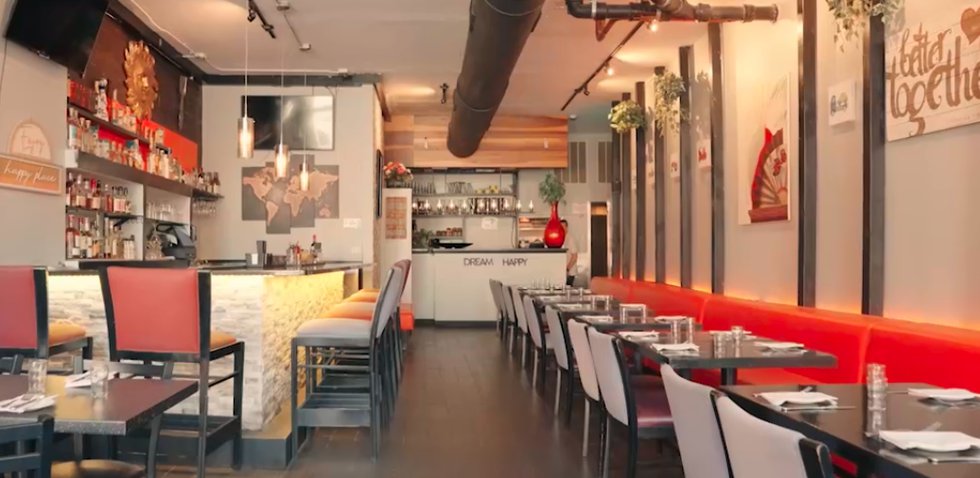
Chi-Latin's interior
By Natalia Otero
In West Town, Chicago, there is a place that, in November 2023, was born not only as a restaurant but as a cultural manifesto. It is one of the restaurants recognized as the best in the city. A tribute to Latin roots, to the mix of worlds that define the city, and to the dream of a man who spent 30 years preparing to open its doors. That place is Chi Latin, created and led by Freddy Orellana, who is now going through the most difficult chapter of his career: putting on hold a project that was born from his soul.
From the beginning, his intention was clear: to create a space that reflected the reality of Chicago's Latino community, a hybrid and vibrant community where Mexican, Caribbean, South American, and American influences coexist. Orellana says it with pride: “Chi comes from Chicago, and Latin represents the mix of cultures that live here every day.”
“I am the original owner of this place, as they say, from the foundation to the roof,” he explains. “It's a project I've been working on for a long time. I've been in the hospitality industry for 30 years, working with renowned chefs such as Charlie Trotter and Bill Clinton's personal chef, Keith Luce, and learning a little from everyone.”
His cuisine, therefore, is a celebration of cultural fusion: Caribbean fish with Peruvian chili and coconut rice, grilled meat accompanied by South American chimichurri and Mexican salsa roja. A menu that was not intended to be fusion for the sake of fashion, but rather a reflection of the neighborhood and the city.
The community welcomed him from day one. But the city that embraced him also began to change, and at a pace that no small business could anticipate.
The economic storm
Like many restaurateurs in Chicago, Orellana has had to navigate an economic reality that has become unpredictable. Tax increases, commercial rents going up, high utility and supplier rates, and a general increase in the cost of supplies hit his operation faster than any financial plan could absorb.
Added to this was something more difficult to measure but evident to anyone walking the streets: less movement, less consumption, fewer people outside. All this due to two reasons: people's fear of going out for fear of being profiled by ICE agents, and the general difficulty for the population to afford luxuries such as dining out at a restaurant.
“Sometimes we only have two or three tables full, there are no longer people walking or chatting in a bar,” he acknowledges. “I've seen this even in restaurants that used to be filled with 400 people and today have 60 or 80.”
To combat the problem, he reduced staff, shortened hours, and cut expenses. But, as he himself concludes, “when the business is no longer profitable, it's no longer profitable.”
Unfortunately, things changed with the new administration. “Details such as the card payment process, meat, vegetables, toilet paper, towels, all of that has gone up in price,” he says. “Even service providers: the companies that rent me the dishwasher, or that refill the soap for the bathroom, all of that has gone up.”
The decision that hurts, but is wise
After struggling with the situation for six months, Orellana and his daughter and partner, Marilyn Orellana, finally understood: they had to close.
Closing Chi-Latin, at least for now, is not a surrender. It is an act of responsibility and clarity. The restaurant industry always demands guts, but also knowing when to stop so as not to destroy what has been built.
Besides, the numbers confirmed it. “From March to June, we fell 18%, from June to September 40%, and from September to November 78.5%. A 22% profit is not worth it.”
The lease also became unsustainable, as the cost would double with a recent property tax increase. This was compounded by the fact that they would have to commit to a five-year lease. If that were the case, and if the economy continued as it was, it would be unaffordable for them to continue, as they had already had to resort to loans and savings.
Added to this were signs that he knew how to read, such as the loss of four of his cooks: two due to illness and moving to another city, and others due to immigration issues.
“When you're stubborn, you don't realize it, but when more than two or three things happen, it's because something is going on. So, you have to make decisions and know that when one door closes, another one opens. And change is always good,” says Orellana, with the temperance of a wise man who foresees rather than regrets.
The last supper (for now)
His final decision, though painful, is full of vision: to take some time to rethink the project. His dream is now bigger and more solid: to buy a property where he can operate without depending on volatile rents and also build a small event center. A comprehensive concept with a restaurant, patio, and reception space. A dream that requires time, strategy, and financial breathing room.
“You don't have to be afraid to make decisions. Everything in life is a learning experience. I always say, ‘A small pencil is bigger than the wisest mind, so write down your ideas before they slip away.’”
Before temporarily closing, Chi Latin will host a farewell dinner with its closest customers to celebrate, honor, and give thanks for the journey. “We'll do something on Friday, December 19, and Saturday, December 22, to say goodbye with a few shots of tequila,” he says with that mixture of humor and nostalgia so characteristic of Latin restaurateurs.
And although the doors are closing, the story doesn't end here.
“Nothing lasts forever, don't lose faith, always value yourself, and give your dreams a boost when the time is right,” Orellana says.