
By Natalia Otero
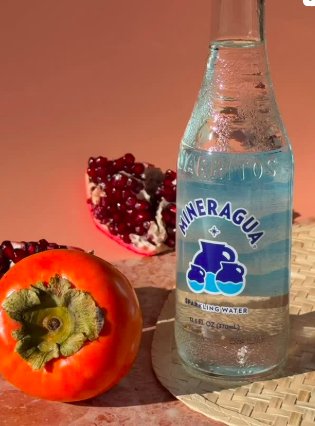
In the world of gastronomy, there are ingredients that often go unnoticed but are essential to the entire dining experience. Mineral water is one of them. And at a time when many brands are competing to dominate the table—especially in Mexican cuisine—one is beginning to stand out not only for its availability but for its character: Mineragua.
For Chef Armando Hernandez, the choice is neither a recent trend nor a response to the recent scarcity of Topo Chico. It’s something much more personal.
“Personally, I’ve always preferred Mineragua because the bubbles are more intense; for me, there’s never been any competition,” says Hernández.
The reasons for Mineragua’s growth? The water recently won a national “taste test” competition held by Serious Eats; its bubbles are fine and compact, giving it a fresh flavor that pairs perfectly with Mexican food and cocktails; and it’s widely available.
A preference that comes from home
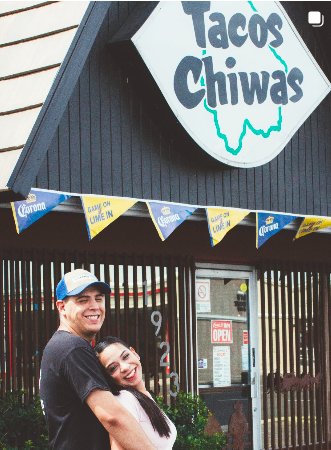
Armando and Nadia Hernández outside Tacos Chiwas
Before becoming a restaurateur, Hernández already knew Mineragua from another place: his memory.
“In Chihuahua, my grandmother had a little shop and they sold Mineragua. My grandfather really liked mineral water with lemon and salt. As a child, it seemed very strong to me, but as I grew up, I developed a taste for it.”
That image—simple, everyday—is the one that remains present in his restaurants today: Cocina Chiwas, Tacos Chiwas, and Espíritu & Aruma Café in Tempe, Arizona. Different concepts, but united by the same philosophy: honoring tradition and adapting it to the present.
The science (and pleasure) of the bubble
For Hernández, the choice of which sparkling water to serve starts with texture.
“I like the bubbles to be more intense,” he says.
That intensity isn’t just sensory. It’s functional. In drinks like the classic vodka soda or more creative variations, the bubbles define the experience: how flavors are perceived, how freshness is maintained, how the whole comes together.
“We don’t use soda dispensers; everything is done with Mineragua bottles.”
That technical detail is key. Instead of dispensing systems, using the bottle directly ensures consistency in every serving.
Mineragua is not a mineral water that is sourced from a spring; rather the product is made by adding carbon dioxide and minerals to purified water. That’s why the bubbles are small – they can be very precisely controlled in the production. And the fact that Mineragua comes from a production plant rather than a spring also means availability is never an issue.
Yes, there is a certain romanticism to naturally sourced spring water, but for a bartender making drinks, the consistency of Mineragua often outweighs the lack of an interesting backstory.
From soda to cocktails: versatility at the bar
In Hernández’s concepts, Mineragua plays an active role in mixology.
“We have a team of bartenders who create different cocktails and tweak them,” he says. “At the event we held last week, featuring Mineragua, we played music and served a cocktail made with Mineragua, mango, vodka, and lemongrass, and another with tangerine-flavored Mineragua and rum.”
That creative freedom is made possible by a specific feature: Mineragua now offers flavors, such as Mandarin, Guava and Mango, which opens up new possibilities.
Mineragua is consistent with Hernández’s restaurants’ identities. His cuisine is based on specific ingredients—chiles from the Chihuahua Valley, flour from Utah, local produce from Arizona—and on a clear narrative: connecting origin and territory.
Mineragua fits into that logic: a Mexican product with a strong presence in the United States, which bridges both worlds.