

Magda Erika Salgado Ponce
By Alfredo Espinola
Good politicians and good restaurateurs have a lot in common. They remember names and faces, they listen, they try to take care of their constituents. Yet rarely does one person live in both worlds. Magda Erika Salgado Ponce, aka Meggie Salgado, is one of those individuals: She is a diputada (equivalent to a congresswoman in the United States) and she owns Casa Manzano, a popular restaurant with locations in Cuernavaca and Mexico City.
“I am a recent diputada, although deep down I have always been an entrepreneur,” says Salgado, who was elected in 2024 and represents Cuernavaca, which is located in the state of Morelos. “Since I was a child, I observed, imagined, and sought to create. I recognize myself as a creative woman, but above all, as an activist: committed to defending the rights of women, children, youth, and caring for nature.”
First Came Hospitality
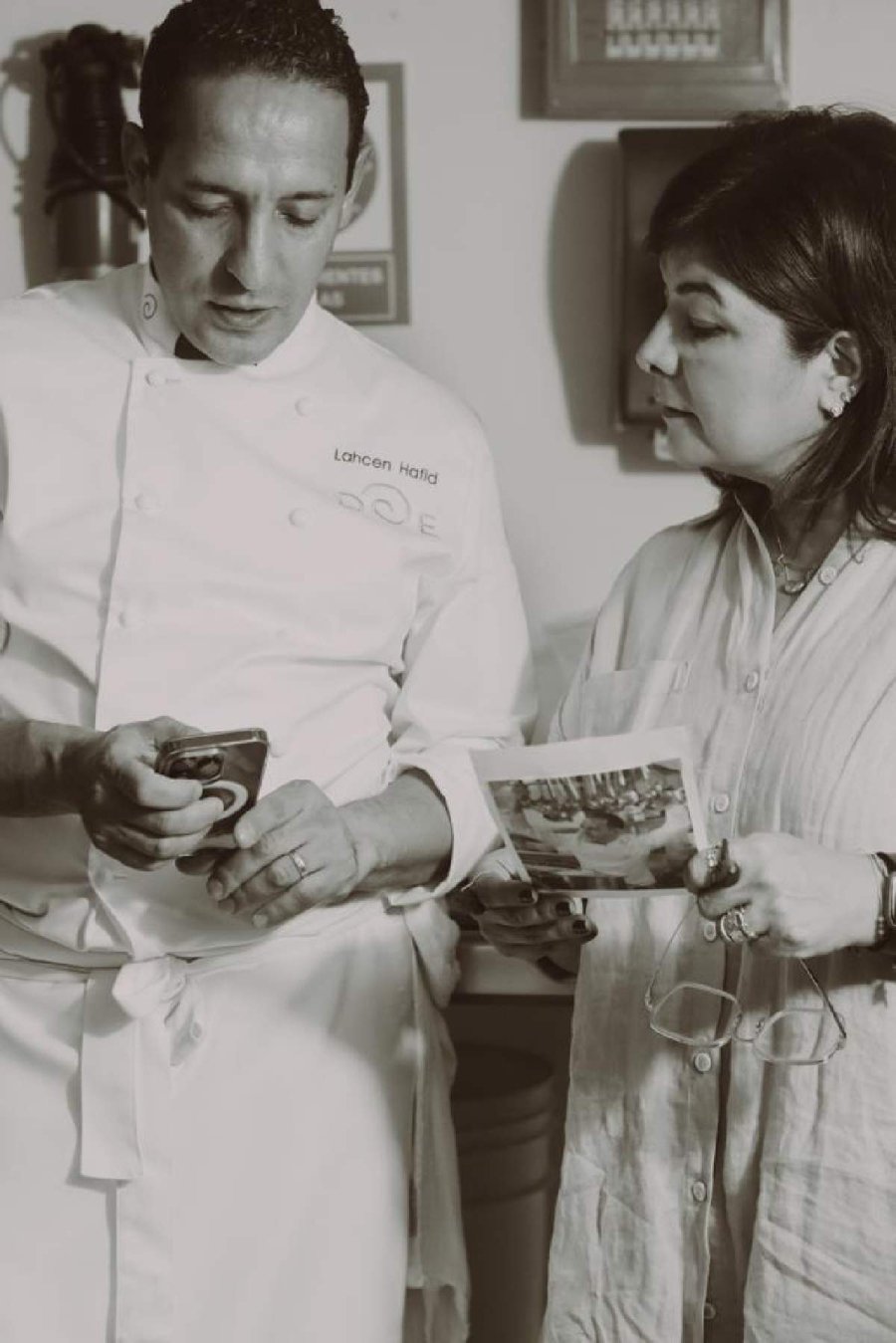
Renowned Chef Lahcen Hafid with Meggie Salgado in Casa Manzano
Salgado’s journey began with hospitality. Born in 1972, her first encounter with gastronomy occurred decades ago, when she studied at Le Cordon Bleu in Paris. She married shortly thereafter and, given the circumstances, had to go to work. She started by baking wedding cakes, then organizing small events, and later opened a café.
Casa Manzano was born in 2008 in Cuernavaca (the Mexico City location opened in 2024). A painting of an apple tree (manzano in Spanish)—a gift from her friend, the artist Elisa Cano—hung in front of her as she searched for a name for this new project. The apple tree, a symbol of abundance, roots, and food, became its identity.
From the beginning, Salgado had a clear obsession: details. Before anyone was talking about “restaurant experiences,” she already understood that eating was not just about nourishment, but about something deeper. Casa Manzano began to take shape based on intuition, sensitivity, and attention to every detail.
The business grew along with her family—her children were always involved—and with a team that, almost unintentionally, became mostly female. Cooks, managers, administrators: women who found a safe, respectful, and dignified place there. A space where they worked as a team.
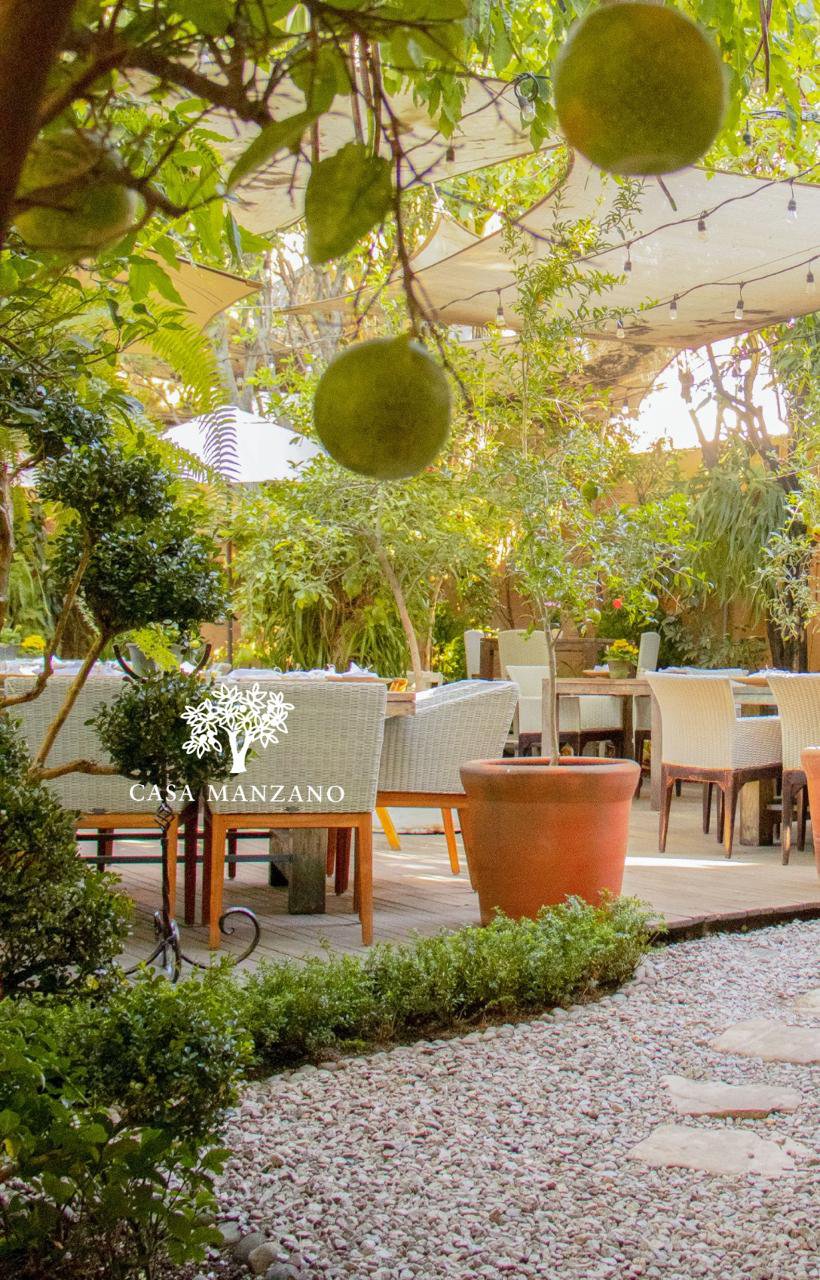
Casa Manzano features spaces filled with plants and light
Today, the restaurant is much more than a gastronomic space. It is a place where nature plays a central role: abundant vegetation, seasonal flowers, soft music. An oasis in the middle of a busy avenue in Cuernavaca, where upon crossing the threshold, the rhythm changes and the body relaxes.
The cuisine is traditional Mexican, deeply linked to the territory. Corn is at its heart. The tortillas arrive every day from Tepoztlán, made by women who grow native corn. The dishes respect the seasons: huazontles, esquites, corn tamales, mole, candied pumpkin, rice pudding. Nothing is pretentious. Everything reminds you of home, of your grandmother's table, of memories.
Cooking, Caring, and Serving: The Path to Politics
Since its inception, Casa Manzano has been a space that dignifies women's work. Many of the women who work there are mothers and heads of households. Salgado insists on something essential: it's not just about valuing their work, but about them valuing themselves. It's about their families understanding the importance of what they do. Because, as she says, women's work builds community and country.
It was this social perspective that led Salgado to become immersed in politics. She became involved in local government in 2009, first as a coordinator of digital initiatives of the Cuernavaca City Council, and later as a member of the Municipal Council for Public Safety of Cuernavaca. Over the years she has served in various other positions, including vice president of the Confederación Patronal de la República Mexicana (COPAMEX) Morelos, a non-partisan employers’ association that promotes sustainable, competitive, and socially responsible business practices.
Today, as a diputada, Salgado serves on three committees: Climate Change and Sustainability, Public Safety and Tourism. She is a member of Morena, the ruling political party founded by former president Andrés Manuel López Obrador.
Her experience as a diputada has taught her some difficult truths.
“Being in the legislative arena today has allowed me to understand that transformation is not as simple as it seems from the outside,” Salgado says. “There is a rigid, entrenched institutional apparatus that needs profound changes in order to move forward. Criticism is necessary, but the real challenge is to shake up that system and move it forward.”
Her political involvement has also made clear a disconnect between politics and the business world, she says.
“There is a lack of understanding towards those who risk their assets and dreams to create jobs, particularly small and medium-sized entrepreneurs, who are responsible for most of the work in the country.”
On the other hand, she has observed that politics and hospitality share something essential: a vocation for service.
“Just as in the kitchen we work to make others feel good, politics should exist to improve people’s lives,” she says. “The challenge is to find common ground and set aside divisions.”
Resisting Together: The Strength of a Shared Kitchen

Over the years, Casa Manzano has witnessed profound stories. During the pandemic, the project faced one of its toughest moments. Salgado sat down with her team and was honest: there were not enough resources to sustain everything, so the only option was to work as a team. No one left. Everyone adapted. They sold takeout, used social media, and supported each other. Customers responded with moving solidarity. They weren't customers: they were community.
That community also manifested itself in small and large gestures: fundraisers, social support, and bonds that have endured over time. Salgado says it without hesitation: Casa Manzano doesn't just serve food, it builds relationships.
Perhaps she hopes to have the same experience as a congresswoman: “The challenge is to break down prejudices,” she says. “To recognize that there are people of integrity in politics and entrepreneurs with a genuine desire for change. Only from there, from common ground, is it possible to build a better country.”