
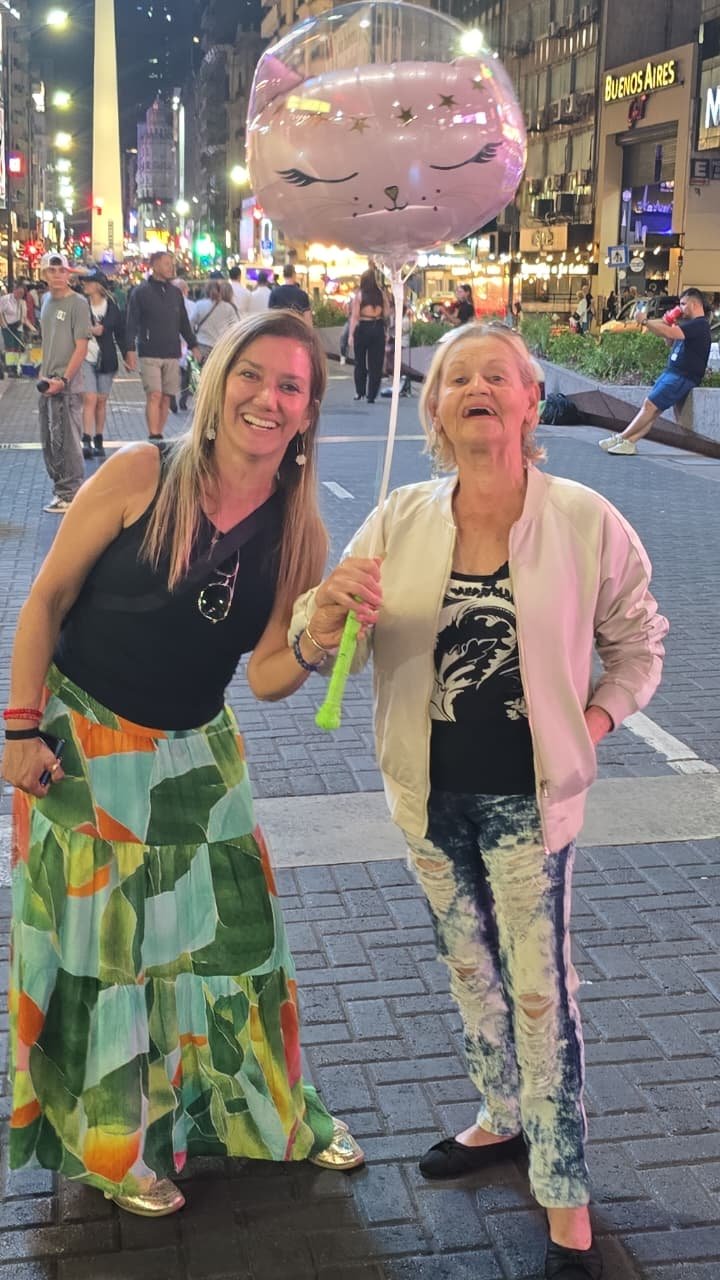
Lorena Cantarovici and her mother Maria
By Natalia Otero
For Argentine Lorena Cantarovici, the empanada was never just food. It was memory, survival, and, eventually, a way to rebuild a life. Cantarovici is living proof of women’s tenacity: her intuition, her wisdom, her ability to pause and make better decisions, and the inspiration to honor her culture, her mother, and her grandmother have led her to build a business that, as she describes it, is “a person with a life of its own” that keeps growing and growing.
Today, her brand María Empanada has five locations in Denver, a presence at the city’s airport, and a new partnership inside a soccer stadium. Since 2008, and over the years, the business has sold millions of empanadas and has become a benchmark for Argentine cuisine in the United States. But when Cantarovici arrived in the country in 2001, she had neither a business plan nor capital to invest.
“Coming from the other side of the continent, from Argentina, isn’t like in the movies,” she recalls. “My reality was very difficult.”
Her childhood and youth in Buenos Aires were marked by economic instability. In Rivadavia Park, one of the city’s most famous spots, street vending was part of daily life.
“My mom, María Castillo, and I used to sell things in the parks,” she says. “I often worked at a bank, and when I got off, I’d go sell electronics. Sometimes we’d close up and it was already nighttime.”
Those years left harsh memories.
“There were times when we had no home and nowhere to sleep. We’d borrow places to stay from friends. But my mom always made sure I got an education.”
Tired of the uncertainty, she made a radical decision.
“One day I got tired of seeing my family suffer. I grabbed my backpack; I had $300, no English, and the contact information of an acquaintance of an acquaintance. I came with the dreams from the movies.”
The Birth of María Empanada
In the United States, she started working in restaurants while trying to build a new life. That’s when something clicked.
“I started falling in love with the restaurant’s energy,” she says. “It had the hands-on work and the dynamism. I fell in love with that vibe.”
Years later, in 2008, her life changed again. She was married, had two young children, and the family’s finances demanded new decisions.
“I had to help out,” she explains. “And I started making empanadas. It was what I knew best.”
The recipe came from long ago and from a rich Argentine tradition, in which the empanada holds the same nutritional value as a plate of pasta or a pizza.
“Making empanadas and drinking hot chocolate in Argentina are traditions that never fade,” she says. “When you can’t afford to buy them, you start making them at home. Everyone knows how to make them, and we all think we make the best empanadas.”
But Cantarovici also saw something more in that traditional dish.
“I always thought the empanada was everything Americans are looking for: convenience, something you can prepare ahead of time, reheat, and take for breakfast or to the park.”
The first empanadas from María Empanada were made at home. The business started out small, selling to friends and acquaintances. But even something as simple as the dough presented unexpected challenges.
“In Denver, the dough suffers from dryness, temperature, and lack of humidity,” she explains. “I had to make it from scratch and learn to work with residential ovens.”
For over a year, the business grew, driven almost exclusively by word of mouth. She found herself cooking until two in the morning; demand was growing, and María Empanada was beginning to push her to evolve.
“The aroma in the neighborhood was too good,” she recalls. “A friend told me, ‘Lore, you have to open a shop.’”
The Difficult Years and the Turning Point
Opening her first restaurant was a huge leap into the unknown. She opened it in 2011 with two employees in a location that had little visibility.
“I had to pay employees, rent… and sales weren’t what I’d imagined.”
At that critical moment, she made a simple but powerful decision: to pause.
“As an entrepreneur, you can’t forget to stop,” she explains. “Sometimes it’s not a week; it’s an afternoon to grab a piece of paper and make two columns: the ‘yes’ and the ‘no.’”
The “yes” column was compelling: “Customers were coming back with more people. The reviews were fabulous.”
Even so, she needed money to continue. Money was the “no,” and she realized that if that was all it was, there had to be a way to fix it. As she explains, when there’s no money, that’s when you can shine the most because you have to work hard to get out of those difficulties, and she was an expert at navigating this kind of turbulence.
“I had to borrow $2,000 from a friend. The problem was the money, but everything inside me was telling me ‘yes,’” she explains.
The real turning point came later that year when she secured a space on Broadway, one of Denver’s busiest avenues.
“The owner gave me six months of free rent,” she recalls. “It was a blessing.”
She calls her friend, the owner of the Broadway location, her husband, and the customers who continued to support her “believers.” The “believers” are those who never stopped believing in her and to whom she owes her ability to keep going without giving up.
The restaurant in that location changed the business’s fate. “The location sparked curiosity in the neighborhood and across the city.”
Over time, visits from famous chefs and politicians like Kamala Harris followed, along with mentions in national media and growing brand recognition.
Piloting the Plane
For Cantarovici, entrepreneurship remains a constant exercise in resilience. She often describes the business using a very personal metaphor.
“Your life is like an airplane, and you are the pilot,” she explains. “When the sky is clear, everything is beautiful. But when the clouds roll in and you can’t see, you can’t stop the plane. You have to keep going.”
That philosophy was key during times of crisis like the pandemic.
“When severe turbulence hits, the important thing is to reach out to your supporters,” she says.
Today, María Empanada has five active locations and continues to expand.
“We’ve had to close and reopen some locations,” he explains. “But it was all for a reason. The new ones are, what I call, smarter.”
Growth hasn’t changed the core principle of the business or its flavor. Processes have been refined; when new machines arrive, she pays special attention to ensure they work properly; she innovates with recipes, and adapts, but remains true to the essence. The most important thing is always maintaining the empanada’s excellent quality—both in its crust and the flavor of its ingredients.
“We make everything from scratch,” she says. “We don’t take shortcuts.”
Explaining the María Empanada
One of the biggest challenges has been introducing the empanada to American consumers.
“You have to show it and explain it,” she says. “American consumers can’t see what’s inside because it’s closed.”
That’s why the focus of explaining it is on showing the customer its versatility. Not just what it’s made of, but how they can use it: “You have to explain that you can freeze it, take it to the park, eat it while driving.” A taco, for example, would spill in the car. The empanada serves as a snack, breakfast, lunch, or dinner. It’s portable but can also be served while seated at a table.
Explaining the empanada has also meant explaining the María Empanada brand. Although many people believe the restaurant’s name is her own, Cantarovici sees María Empanada as something distinct.
“Everyone thinks that María Empanada is me, but it’s not,” she says. “We are two different people. María comes from my mother’s and grandmother’s names. Sometimes people call and ask for María, and I have to explain that there isn’t a María—it’s the restaurant’s name.”
That symbolic distance allowed her to see her business more clearly. “Viewing it as a separate entity helped me understand how to grow it. It also helped me detach from it, to see that it can stand on its own and doesn’t need me as much since I can delegate. Sometimes it’s hard for us to let go and allow someone else to do what we used to do, just as well or even better than we did. That’s what makes her and me special.”
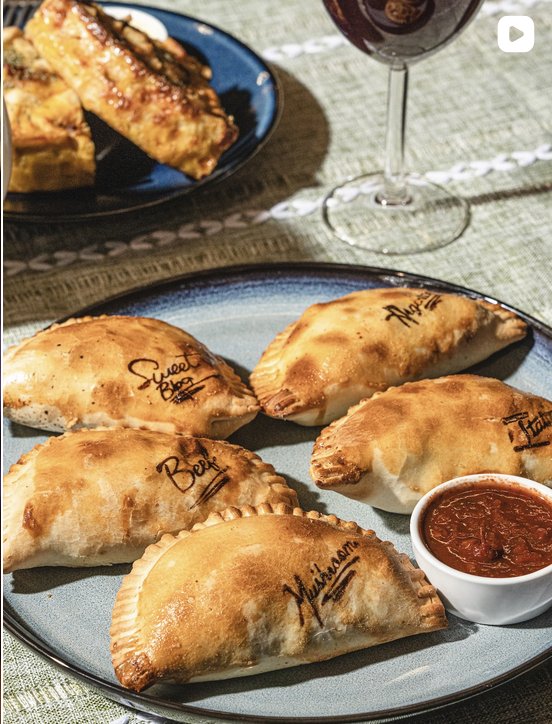
This has allowed her, as she expands, to incorporate ingredients that she—with her cultural background and Argentine tradition—might not have included. This is key to the future of María Empanada, which, she says, will involve expanding the empanada throughout the country. For example, the menu features a sweet BBQ empanada—something you wouldn’t find in Buenos Aires, but which works very well in the United States.
A tribute to María, the mother
The name honors the women in her family. In addition to being a very powerful name, alluding to the Virgin Mary, it is with María, her mother, that her story begins. Today her mother lives with Alzheimer’s, but she remains an inspiration.
“Life takes many turns,” says Cantarovici. “Today, that park where we used to go together to sell things just to get by is the park she now returns to, but under different circumstances. She lives near there,” she recalls, noting that at the beginning of her story, they often had nowhere to sleep. “In Rivadavia Park, my mother takes walks, meets new friends who are navigating old age and now rely on their canes, with their own struggles, and they keep each other company.”
That park where her mother managed to raise her is the park her mother now returns to, supported by her daughter who, thanks to her business, has been able to provide for her and pay for her medical treatments.
Today, after selling millions of empanadas and more than a decade of building her brand, her advice for other entrepreneurs is simple.
“You know the truth within yourself,” she says. “Intuition tells you when to keep going.”