
By Alfredo Espinola
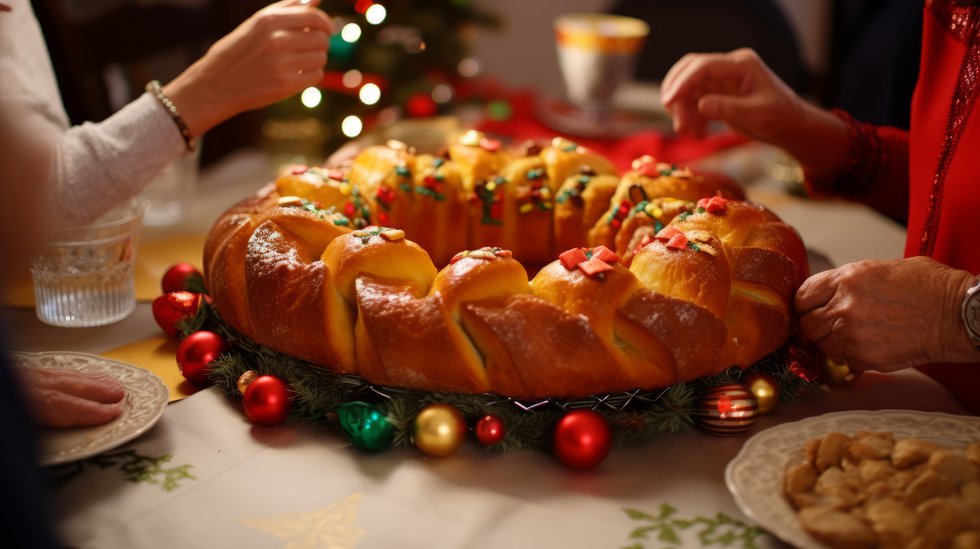
The Rosca de Reyes (Three Kings Bread) is a delicious ring-shaped cake enjoyed by Mexicans and Spanierds every January, specifically on January 6. It takes center stage on many tables and reminds people of the value of sharing.
For chef Roberto Alcocer, who leads Malva in Valle de Guadalupe, Mexico and Michlin-starred Valle in Oceanside, California, the continued popularity of the Rosca de Reyes can be explained by Mexico’s deep relationship with bread and culinary celebrations.
“Contrary to what many foreign chefs think, bread is a very strong and deep-rooted tradition in Mexico. We have practically a bread for every celebration, and that is why the rosca is still so popular. For me, cutting the rosca represents the end of the December holiday season: Christmas, New Year’s, it is the end of that festive period, even though we are already in January.”
Yucatecan chef Misael Canché defines the Rosca de Reyes as one of the most significant gastronomic events in Mexican cuisine.
“The rosca represents food as a symbol, as a gathering, and as a legacy. Although its origin is European, in Mexico it was adopted and transformed until it became deeply ours. Its relevance lies not only in its flavor, but in the collective act of breaking it and sharing it.”
Canché draws a parallel with other regional traditions.
“In Yucatan, the mucbilpollo (a giant tamale wrapped in banana leaves, filled with corn dough, lard, chicken, and pork stewed with achiote and spices, traditionally cooked underground in an oven called a ‘pib’) serves a similar function; it is not an individual dish, but a collective act. The rosca remains alive because it is not consumed alone; it is shared, discussed, and celebrated.”
Traditional Recipes Dominate
There are several variations of Three Kings Bread, but Alcocer and Canché stick to the classics. (Click here for a traditional recipe from el Restaurante.)
“I stick to the traditional recipe, just as I learned it in school,” Alcocer says. “Where I allow myself to play around is in the decoration, but the dough and the bread remain the same as always.”
Canché similarly takes the traditional recipe seriously: “To reinterpret a tradition, you first have to understand it. Contemporary cuisine should not erase tradition, but rather engage in dialogue with it.”
What is common in all recipes is something unrelated to cuisine: Each cake has a “muñequito” (figure of the Baby Jesus) hidden inside. Finding the little Jesus is a thrill, and whoever finds the Baby Jesus takes on the commitment to care for him and present him on February 2, “Candlemas Day,” when tamales once again bring the family together around the table for celebration.
From pagan ritual to Christian symbol
Many historians agree that its origins date back to ancient Rome. During the Saturnalia, festivities dedicated to Saturn, god of agriculture, round loaves of bread were made with figs, dates, and honey, inside which a coin or a fairy representing chance and fortune was hidden. and whoever found it was named “king” for a day, in a symbolic ritual where the social order was reversed and celebration prevailed over hierarchy.
With the spread of Christianity, this pagan custom took on new meaning; the sharing of bread evolved into a celebration associated with the Epiphany, the manifestation of Jesus to the Three Wise Men.
During the Middle Ages, the tradition was integrated into the Christian calendar. The circular shape of the rosca began to be interpreted as the crown of the Three Wise Men or as a symbol of God's infinite love. The candied fruits evoked royal jewels, while the hidden figure of the Baby Jesus alluded to the passage that tells how Joseph and Mary hid him to protect him from King Herod.
From Spain, the custom crossed the Atlantic during the Viceroyalty and arrived in Mexico, where it was not only adopted but transformed into one of the most beloved gastronomic rituals of the national calendar.
“The rosca is an excuse to reconnect with people you may not have seen at Christmas,” Alcocer says. “It’s a fun and endearing tradition; finding out who gets the figurine and, with it, the tamales.”