
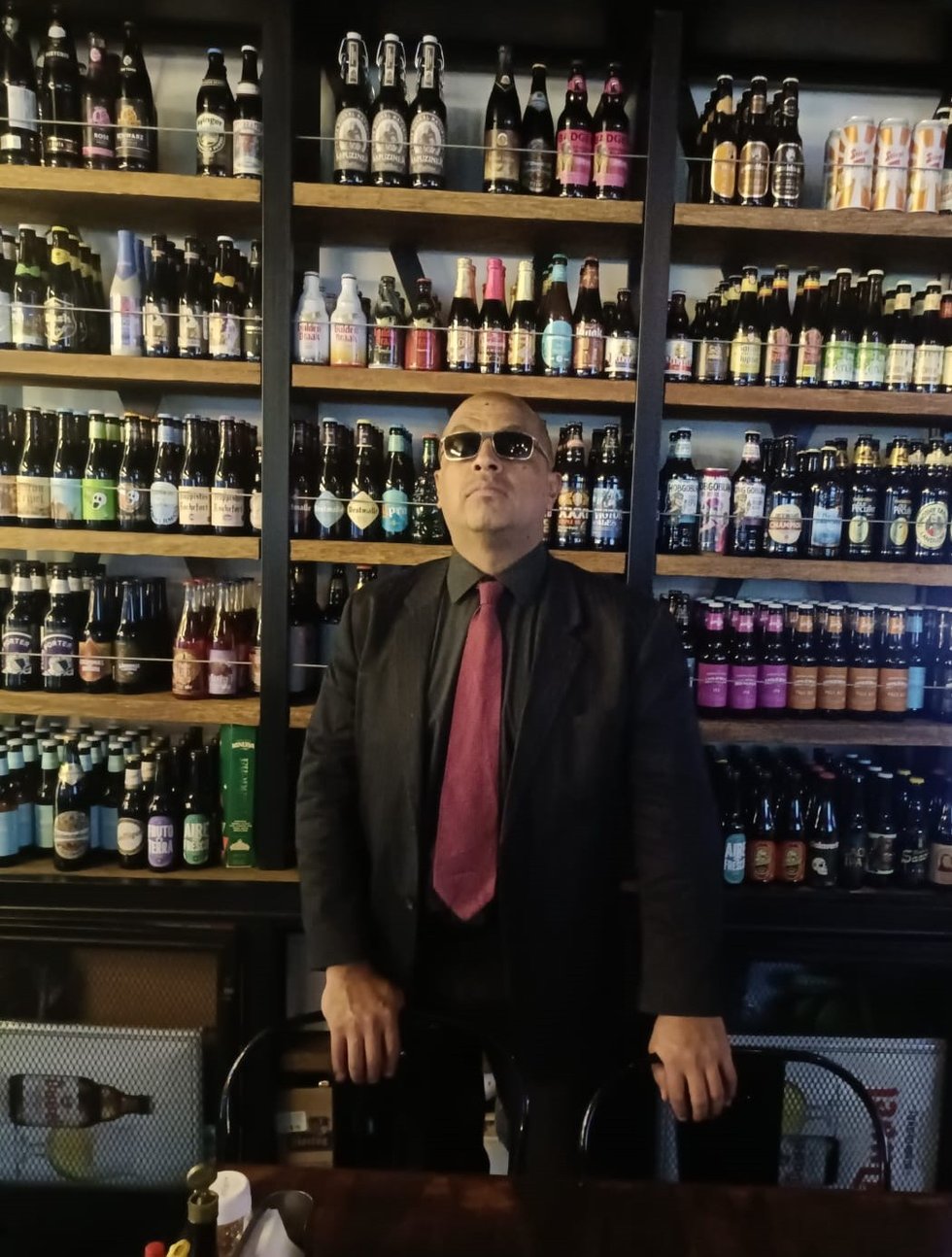
Juan Martínez, chef and sommelier
By Alfredo Espinola
A shared table, open beers, voices mingling without formality. We are inside Hoppy Cat, an artisanal beer bar in Mexico City. Outside, the city goes about its business; inside, something different begins to take shape. It’s not an interview; it’s a meandering conversation.
Juan Martínez, a chef and sommelier, tells us that, following a violent incident in 2009, darkness descended upon his life—he went blind. The next part of his life didn’t take place in a kitchen, but rather amidst Braille, rehabilitation, learning a new way of navigating the world.
“A glass isn’t just there; it’s at eleven o’clock. A plate isn’t seen; it’s located, as if it were a clock,” he explains.
Precision replaced sight, and with it, something deeper changed: the way of perceiving. Martínez didn’t abandon gastronomy; he reconfigured it. He returned to work as a waiter, bartender, and barista. The kitchen was still present, but it was no longer the only thing that mattered; there was something else: the experience.
He began with blind tastings and multisensory dinners. Completely dark spaces, not as a limitation, but as a method. “For us, the love for a dish doesn’t begin with sight. First the aroma, then the flavor, then the texture; sight, if it appears at all, is secondary,” Martínez explains.
Martínez earns his living conducting tastings and samplings for companies in this fashion. His most recent engagement was at the Hotel Barceló in Mexico City for a company called Yo También.
There’s one dish that explains it all
Bread, kiwi, Camembert cheese, and peanut sauce—it combines sour, bitter, and spicy flavors. Nothing spectacular to look at, but remarkable on the palate.
“My dish looks ugly, but it tastes good,” he admits.
He says it with a laugh, but then comes a blunt critique: “Today’s gastronomy is obsessed with the visual, and the visual is deceiving.”
The conversation shifts in tone; the discussion turns to inclusion, its absence, and four blind sommeliers—none of whom are currently practicing their profession. One sings in the subway, another gives massages, one runs, and another waits. It is not a lack of ability; it is a lack of sight.
All of this leads to a single point: “Companies continue to judge by appearance rather than by skills.”
When the palate surpasses sight
Francisco Olachea, an internationally renowned sommelier and sommelier trainer, joins our discussion in the bar. He shares his experience teaching blind students, and then an uncomfortable truth emerges:
“The disadvantage isn’t theirs; it’s those who can see, because those who can see rely too heavily on their sight; those who can’t develop sensory memory, recognizing aromas, structures, and nuances with precision. We who can see are at a disadvantage; this isn’t meant to be provocative, it’s the truth,” says Olachea.
We have the delightful experience of participating in a completely blind tasting—a service conducted in the dark—with a team composed of people with visual impairments.
Among the attendees, someone hesitates, someone gets excited, another imagines spilled beers, plates placed incorrectly; you hear inevitable laughter; but also something else: a real experience.
“Disability is not an impossibility,” says Martínez.
The right to fall
Before wrapping up, Martínez leaves us with some advice—not for those living with a disability, but for those around them: the parents.
He speaks of overprotection, of limits that become cages, of young people who cannot move on their own.
“Let them fall; it’s not harshness, it’s freedom. Because that’s the only way to learn to walk without depending on others.”
The conversation ends without ceremony.
A night filled with laughter, promises, and ideas that might just come true; someone suggests a book; another, a restaurant in complete darkness. Martínez listens, smiles, and at some imperceptible yet definitive moment, something happens:
Sight ceases to be the center; what remains is another way of understanding—slower, more precise, more honest—one where flavor isn’t anticipated, but discovered.
Alfredo Espinola is el Restaurante's representative in Mexico City.