
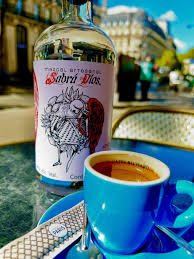
By Alfredo Espinola
As soon as she sits down in front of me, Camila Ramírez Velázquez tucks a strand of hair behind her ear. She breathes softly, like someone who knows that what she is about to say speaks not only of her work, but of her life. Her story begins long before she could even pronounce the word mezcal.
“Well... Mezcal Sabrá Dios, originally from Miahuatlán de Porfirio Díaz, Oaxaca, had already been around for a few years,” she says with a shy but confident smile. "But a year ago, I decided to take it on. I saw that the brand was going places... only it was going towards an older audience. And I wanted to bring it closer to young people.”
She says this with the same naturalness with which others talk about a school project. Camila says she decided to take responsibility for an artisanal mezcal with family history and a renewed spirit. She doesn't say it in a heroic tone; she says it like someone who has grown up among maguey plants, like someone who understands that mezcal, in her home, is not only drunk, but breathed, learned, and inherited.
A name that embraces uncertainty
The name Sabrá Dios – “only God knows” -- is not the product of a marketing strategy. It is part of everyday life, one of those phrases that Mexicans use when we don't know the answer to anything and everything.
“It's that idea of uncertainty,” she explains. "That's also why the label has that figure that you don't know if it's an angel, a devil, someone thinking or drinking... Only God knows. Like in life, you never know what's going to happen. You can only be in the present.”
She says this with the clarity of someone who has understood, from a very young age, that the world offers no guarantees and yet you still have to take a chance on it.
A producer looking at her generation
Camila knows that the mezcal industry is dominated by an older generation.
“Many young people don't drink mezcal on its own; they find it too strong,” she says. “That's why we started with cocktails, more approachable flavors, and lower alcohol content. We also revamped our social media to make the brand look more youthful.”
The idea was never to dilute the essence of mezcal, but to bring it closer. To make it a gateway, not a head-on collision. Through cocktails, more accessible aromatic profiles, and fresh communication, Camila wants young people to relate to mezcal through conscious enjoyment, understanding what they are drinking, where it comes from, and how it is honored.
Because promoting responsible consumption also means educating the palate and the decision-making process; knowing when, how, and how much. Mezcal should cease to be a test of endurance and become a cultural, social, and sensory experience, she says. A shared ritual to be enjoyed without haste, with respect for tradition and for oneself.
In this way, mezcal finds new voices, new moments, and new generations that recognize it not for its potency, but for its history, its character, and the way it is enjoyed in moderation, with identity and pride.
A young soul looking to the future of agave
At school, Camila found a way to combine her academic training with her responsibility as a producer.
“With my chemistry teacher, we made a tank to collect vinasses and purify them,” she explains. “That way we can nourish the maguey plants without chemicals. We also take care of the kosher process and smoke reduction in the oven.”
It's a surprising conversation about neutral pH, acidic soils, and agave overexploitation. But she does so with the passion of someone who knows that the future of mezcal depends as much on technique as on the ethical sense of those who produce it.
Dreams that fit in a bottle
I ask her what she dreams of, now that Sabrá Dios is officially in her hands.
“That it reaches every corner of the world,” she says without hesitation. “Even Asia, which is always more complicated. That it becomes an internationally recognized brand.”
Her eyes shine. Not with excessive ambition, but with that mixture of hope and reality that only someone young can sustain without fear.
The intimate relationship with mezcal
The last question takes her by surprise. How would she describe her personal relationship with mezcal?
Camila pauses. She breathes. She searches for words she has never had to name before.
“I think it's a very strong connection,” she says slowly, "I was almost born among maguey plants. I grew up watching this whole process, smelling mezcal, listening to the stories. And now it's a project that I decided to take on and that I'm moving forward with. It's part of me, my life, my history."
And then she smiles. A bright, authentic smile that only someone young, at the helm of an artisanal brand, can have; a smile that says that the future, although uncertain... God knows, will have its own spirit.