
By Alfredo Espinola
At times, when Cynthia Belén Robles Ramos talks about Maguey Dorado, her voice becomes a soft echo of three generations who have lived with the aroma of cooked agave. At 22 years old, with a determination that seems to defy her age, she heads an artisanal mezcal brand born in the heart of the Isthmus of Tehuantepec, with the serenity of someone who knows the deep roots of what she carries in her hands.
Maguey Dorado is not just a company, it is an extension of her family history, which is also written by her sisters Monserrat and Daniela. “They are behind me, we are a brand founded by three sisters,” says Cynthia.
An origin marked by black birds and agave
Cynthia Belén Robles Ramos and Monserrat Robles Ramos
Mezcal was born in her family before the brand, in Santo Domingo Zanatepec, the town where they grew up. Their father and grandfather had been sharing mezcal for decades as a gesture of affection, almost like a personal blessing, a recurring gift for friends and neighbors. That simple act unwittingly became an early validation of the flavor that now represents Maguey Dorado.
Their logo says it all: two winged sanates protecting a maguey drawn in the center; these birds symbolize the town, reflecting a symbol of origin, belonging, and respect. Because there, between the heat of the Isthmus and the wind that blows down from the Sierra Sur, the essence of mezcal is born, which today seeks to conquer the world.
The lineage in distillation
When Cynthia describes how her mezcal is made, her gaze and voice combine in a deep emotion. She begins by talking about cutting the agave during the full moon, “when the plant has the most sugar.” She emphasizes the horse-drawn tahona, extolling the smell of damp wood in the fermentation vats, the copper distillation, and the master mezcalero as the sole guardians of the process.
In Santa María Zoquitlán, they not only produce mezcal, they also pass down ways of feeling time. “They are the only ones who can do the final tasting,” she explains. “It's a lineage that cannot be broken, and that lineage insists that it must also be visible to the consumer. When someone tastes our mezcal, I want them to feel that continuity. That love that cannot be manufactured.”
Four mezcals, four ways of telling the story of Oaxaca
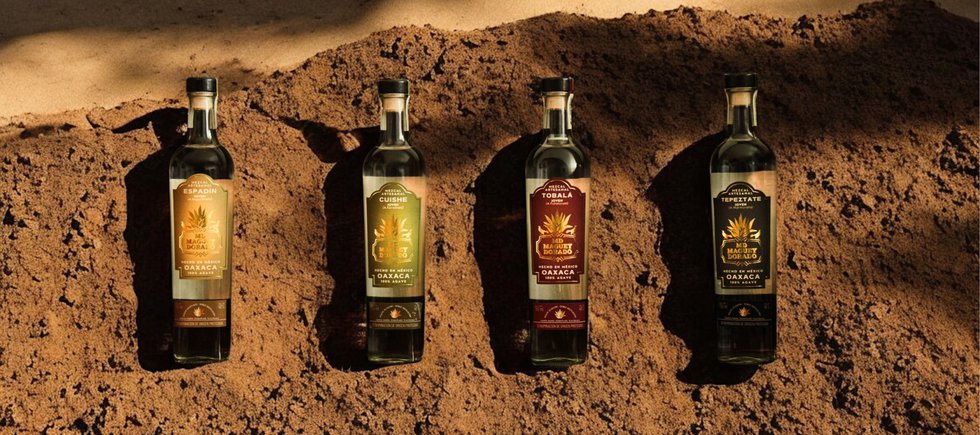
The Maguey Dorado collection consists of four labels, each with its own personality:
· Espadín: the starting point, smoky and noble; ideal for mixology.
· Cuishe: green, fresh, restless.
· Tobalá: sweet, elegant, bronze medal winner at Mundo Mezcal.
· Tepeztate: silky, subtly sweet; to be drunk calmly, without haste.
These are mezcals that do not seek to impose themselves, but to accompany.
The silent struggle of a young woman in a man's world
There was a moment when Cynthia doubted whether she was in the right place. “I encountered people who did not expect to see a woman, let alone a young woman, offering mezcal,” she said. “At first, I was intimidated.” She does not say this to make an impact, but because that is how it was.
But her strength did not come from speeches or motivational courses; it came from her own mezcal. “When they taste it, the smoothness, the quality, that has supported me more than any words,” she emphasized.
The other half of the learning process was internal: learning to speak with confidence, respecting her own knowledge, trusting the vision she was building.
Between tradition and sustainability
The other challenge, a quieter but equally urgent one, is sustainability. The rise of mezcal has brought with it risks: overexploitation of agave, loss of wild varieties, and pressure on the countryside.
Cynthia knows this, faces it, and although she acknowledges that they are still in the process of structuring their reforestation program, they are already working with teachers to ensure responsible practices, especially with varieties such as cuishe, tobalá, and tepeztate.
“We cannot lose sight of the fact that the raw material is the most valuable thing we have,” she emphasized.
A map that is beginning to expand
Today, Maguey Dorado is already in Puebla and will soon open markets in Cancun and Mexico City. "This is just the beginning. The medium-term goal is to be in Monterrey, Querétaro, and the main consumer centers of the country, and soon it will be exported to Europe and the United States," she says, proud of her Oaxacan roots.
Cynthia today and five years ago
When asked what she would say to the teenager who started this dream, Cynthia pauses slightly, as if searching her memory for maternal advice.
“I would tell her that with perseverance, effort, and a lot of love for what you do, anything is possible.”
A few minutes later, she pauses again in front of another question: A scene in the future, her, her sisters, a table in the Isthmus, a consolidated brand. What would you say to them?
The young entrepreneur takes a breath, settles in, and responds with luminous candor:
“I would tell them that I never imagined this would be possible, but that we achieved it together. That Maguey Dorado is part of our heritage and that we must continue to care for it together.”
Cynthia walks that fine line with unexpected maturity for her age. She talks about mezcal as if it were another member of her family, and perhaps it is. Because each bottle bears her signature, but also that of her sisters and predecessors.
And so, with the full moon and young hands, mezcal continues on its path. Drop by drop, Maguey Dorado reminds us that everything true is born slowly: from the earth, from lineage, and from the courage of those who dare to listen to their origins.
Because in the end, mezcal, like life, tastes better when it honors where it comes from and where it wants to go.