
By Alfredo Espinola
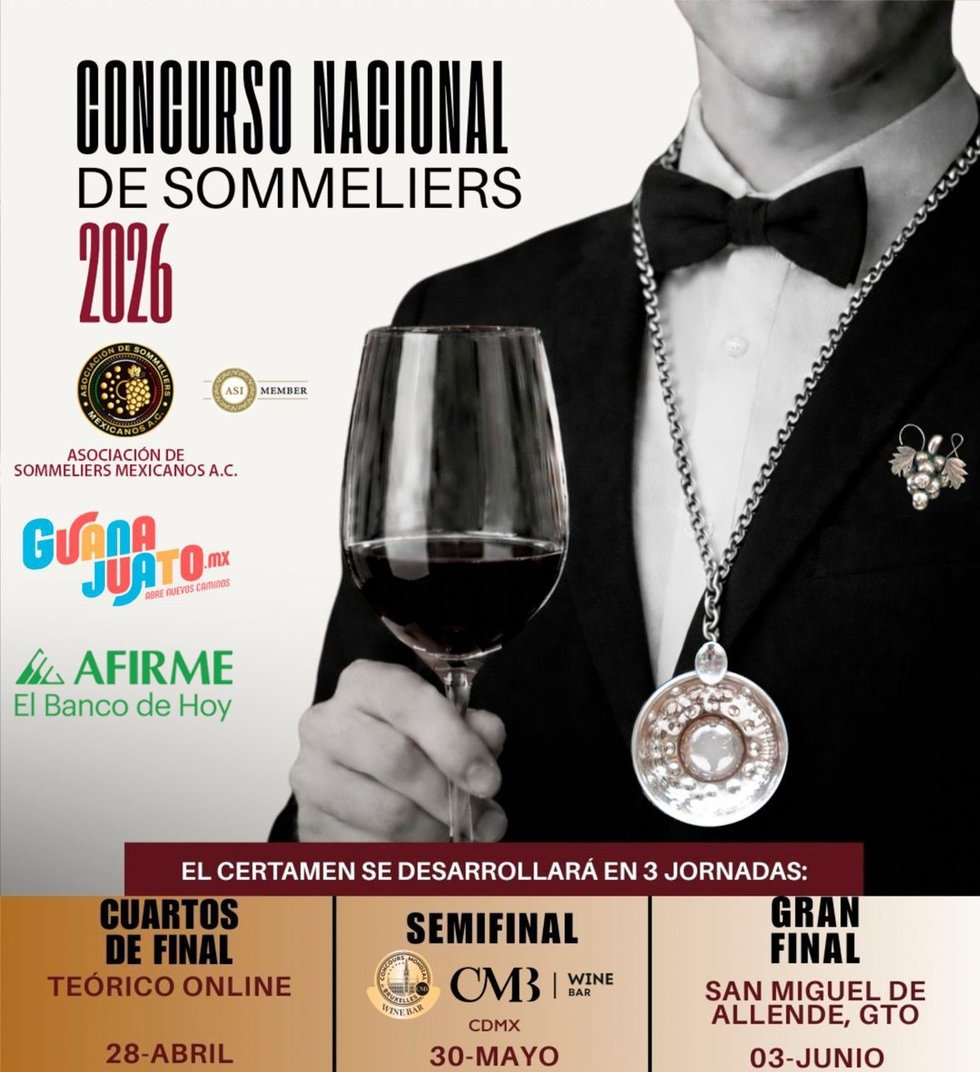
International Sommelier Day 2026, June 3, will mark a turning point for Mexico’s food and wine community. For the Asociación de Sommeliers Mexicanos A.C. (ASM), this year’s celebration not only honors the profession but will also serve as the venue for the National Sommelier Competition, a contest that will determine Mexico’s representative at the world championship to be held in Lisbon.
“We are very happy because last year we celebrated International Sommelier Day at the Camino Real Hotel, and Lupita Robles, Secretary of Tourism for the state of Guanajuato, joined us as the event’s patron. When it was over, she told us: I want to bring this event to Guanajuato. From that point on, we began working to ensure that this year’s celebration and competition take place there,” explains Georgina Estrada, president of the ASM.
The 2026 edition will have a special focus. The association has decided to strengthen its commitment to training and professional development, so the program will include academic activities, tastings, and meetings with producers.
“We want International Sommelier Day to also include educational opportunities. We’ll have masterclasses on Guanajuato wines, roundtable discussions with producers, and various activities throughout the day. In the afternoon, the grand finale of the national competition will take place—which normally happens every three years—and this is the first time we’re organizing it under my presidency,” she says.
The urgency is no accident. The winner will represent Mexico at the International Sommelier Competition, scheduled for October in Portugal, so the schedule requires selecting the champion well in advance to allow for preparation.
“The winning candidate will have to compete in Lisbon, and we want them to arrive at the highest possible level. There is a lot of talent in Mexico, but it also takes time to study, practice, and hone skills.”
The prize for first place will be particularly significant: a training trip to Bordeaux, France, led by Omar Barbosa, ASM Vice President of International Affairs and former national champion, who currently resides in that region and works at a hospitality establishment linked to one of the great names in wine.
“The winner will first go to France for training and then to the world championship. It’s a very comprehensive experience, designed so they arrive prepared to compete with the best in the world,” notes Estrada.
A demanding and increasingly professional competition
The competition will take place in three stages.
The first will be an online exam, designed to facilitate participation by sommeliers from across the country.
“Before, many told us that everything took place in Mexico City and that it was difficult to travel. Now, the quarterfinals will be held online, with all necessary safeguards in place, so that anyone in the association can participate regardless of which state they live in.”
From there, between ten and twelve semifinalists will be selected, who will compete in person in the capital during a closed-door round that will include blind tastings, beverage identification, and practical evaluations.
The grand final will take place on June 3 in San Miguel de Allende, as part of the celebration of International Sommelier Day, before an audience, the press, and a specialized jury.
The tests will put participants in real-life service situations: decanting, pairing, identifying wines and spirits, preparing cocktails, serving sparkling wines, and even recognizing images related to regions, producers, or figures from the world of wine.
“These are complex tests, because that is exactly what they will face in the international competition. Additionally, the finalists compete in shifts, without seeing what the others are doing, to ensure fairness.”
The jury will consist of recognized figures in the sector, including sommeliers, academics, and specialists with extensive experience, reinforcing the professional nature of the competition.
On that same day, in addition to announcing the champion, the association will present awards to the Sommelier of the Year, Winemaker of the Year, and Winery of the Year, chosen by the members themselves.
Who can participate?
The competition is open to all professionals who can demonstrate their training as sommeliers, though they must be members of the association.
“Any sommelier who joins the association and demonstrates their qualifications can participate, regardless of where they studied. What matters is that they have the knowledge and accreditation.”
Contestants typically include professionals from luxury hotels, haute cuisine restaurants, and highly prestigious culinary groups, which raises the level of competition.
The sommelier, a key element of the dining experience
For Georgina Estrada, the competition also aims to reinforce the role of the sommelier within contemporary gastronomy, where their function goes far beyond simply recommending wine.
“The sommelier and gastronomy are inseparable. Today, wine culture in Mexico has grown tremendously, and the sommelier is involved in the entire dining experience, from the moment the guest arrives until they leave.”
She explains that a well-trained professional must be knowledgeable about food, beverages, spirits, coffee, tea, front-of-house service, and even languages.
“I always say that the sommelier is the best investment a restaurateur can make, because they cover the entire service cycle. They can welcome the guest, recommend an appetizer, suggest pairings, explain the dishes, and select the wine, dessert, coffee, or spirit. They are a well-rounded specialist.”
These skills are also evaluated during the competition, especially in the pairing and service tests, where communication skills, confidence in the dining room, and mastery of protocol are observed.
Mexico on the World Stage
The ultimate goal of the competition is clear: to raise the level of Mexican sommeliers so they can compete internationally.
“We want Mexico to be on par with the best countries. We’ve had champions who now work in major hotels, restaurant groups, or even in Europe. That shows the talent exists, and what we’re seeking is to promote it.”
The growing interest in wine in the country, combined with the development of wine-producing regions and the professionalization of the gastronomic sector, has made the role of the sommelier increasingly significant.
For this reason, the most anticipated moment of the competition is often one of the most traditional: the decanting service.
“It’s a very demanding test. The sommelier must follow a precise protocol: light the candle, uncork the bottle correctly, prevent sediment from mixing, and do it in front of the audience and the judges. It’s a moment of intense concentration and also immense pressure.”
There, on stage, not only is the winner determined, but also the standard to which an entire generation of professionals aspires.
And for the ASM, that standard must measure up to the best in the world.