
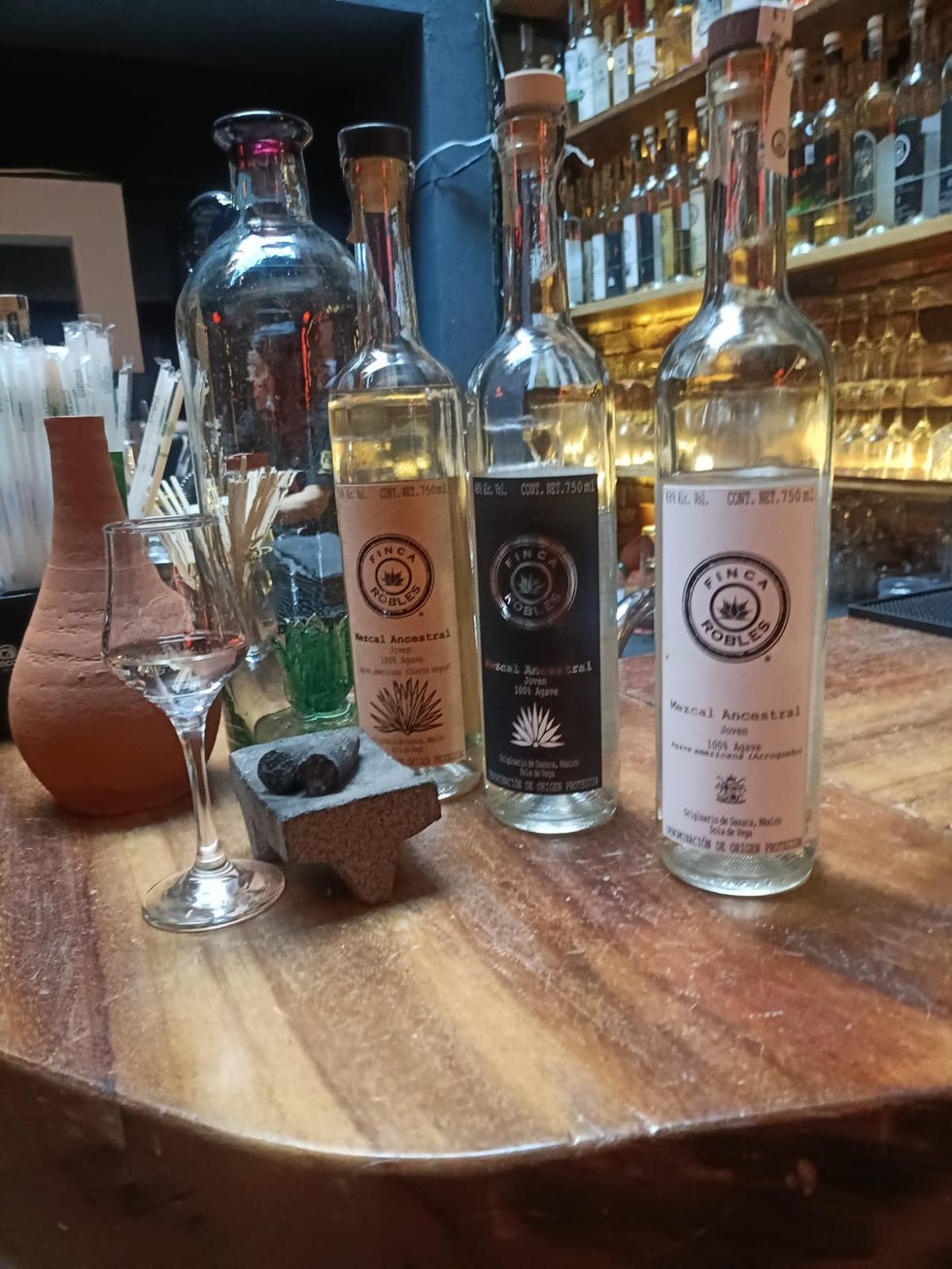
By Alfredo Espinola
In Sola de Vega, time does not pass; it matures. It seeps into the earth, is stored in the agave leaves, and eventually reveals itself in the glass. Here, mezcal is neither a recent industry nor an exportable fad. It is an ancient language. And in the case of Finca Robles, it is also a story of continuity… and of resilience.
Where heritage becomes choice
The story of Finca Robles rests on two intersecting lines: one that comes from the past and another that looks toward the future.
On one hand, a tradition of over 350 years in mezcal production in Sola de Vega, safeguarded today by Adair Robles, the fourth generation of a family that didn’t learn the craft: they inherited it as rituals are inherited.
On the other, a decision made just a decade ago that would change the course of the project: planting agave at a time when it seemed to be disappearing.
Ten years ago, the crisis was not one of knowledge or technique. It was one of raw materials. The tequila boom had led foreign buyers to purchase both mature and immature agaves prematurely. The landscape began to empty out.
So, the family did something that, in market terms, seemed irrational: they planted.
Planting agave is not an immediate solution. It is a long-term investment.
An act of agricultural faith, Adair remarks.
Because the maguey’s time is not the market’s time.
Cultivating patience
Today, that decision at Finca Robles translates into more than 20 hectares under cultivation and a diversity of agaves ranging from the precise, honest espadín to more complex varieties such as tobalá, arroqueño, jabalí, or tepeztate.
But here it is not about taming the land, but about understanding it. Each agave grows where it wants to grow.
The tobalá seeks out steep slopes. The jabalí thrives in almost hostile conditions. Instead of forcing production, Finca Robles adapts to the environment. It respects the logic of the landscape.
In a context where the mezcal boom has encouraged overexploitation, the project chooses another path: regeneration.
10% of the agaves are not harvested. They are left to bloom. The quiote emerges, pollinators arrive—bats, bees, hummingbirds—and the cycle continues. The land also rests: after each harvest, corn, beans, and squash are planted to return nutrients to the soil.
Here there are no chemical fertilizers; there is time and there is memory.
The Method as Identity
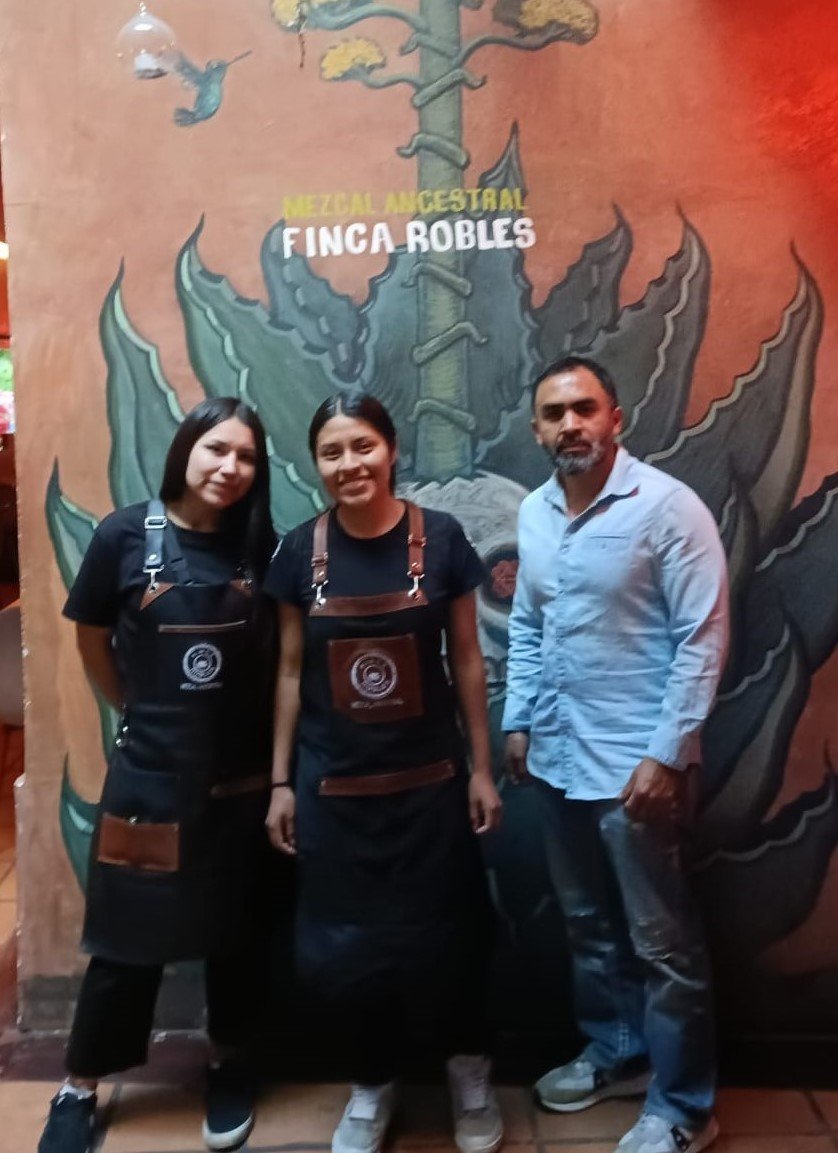
Adair Robles (right), with colleagues Belen (left) and Marisol (center)
If the land defines the character, the palenque reveals it.
At Finca Robles, production remains faithful to one of the most demanding and least common methods: distillation in clay pots. A process that involves losses of up to 35%, but one that offers something impossible to replicate in steel or copper: sensory depth.
Clay does not merely contain. It interprets, adds texture, complexity, and nuances, turning each batch into a one-of-a-kind piece.
The grinding, meanwhile, is done by hand, with a mallet, in a canoe. No shortcuts. No standardization; from the nursery to distillation, everything follows an artisanal logic where every decision impacts the result.
The mezcal that emerges from this process does not seek to be uniform; it seeks to be honest.
Subtle smoky notes, pronounced minerality, elegant body. A profile that doesn’t impose itself, but endures
From scarcity to character
Mezcal possesses a paradox that few products can sustain: its value grows with scarcity.
To produce one liter, between 10 and 15 kilos of agave are required. In varieties like tobalá, that figure can double. More raw material, lower yield.
More time, less volume.
In a market that rewards scale, Finca Robles takes the opposite approach: small batches, clear identity, absolute traceability.
Each label is a landscape, each sip an interpretation of its origin.
From the jug to the city
The transition to the market was neither immediate nor simple.
The project began in an almost intimate way: mezcal transported in jugs, shared among friends, unbranded, without a strategy. Just one constant: people liked it.
Over time, that intuition became a structure. In 2013, the project was formalized. And years later, it found its first home: a small space in Mexico City.
Today, Finca Robles has two tasting rooms and a mezcal bar that serves as a natural extension of the palenque.
A place where mezcal isn’t just drunk—it’s understood.
The model is straightforward: from producer to consumer. No middlemen, no adjustments. What reaches the glass is exactly what is produced in Oaxaca.
Uncompromising recognition
Gold, silver, and Grand Gold medals have come from various national and international competitions. They validate the quality, yes. But they do not define the project.
What sustains it is something else: consistency, batch after batch. Year after year.
Today, with 15 labels in its portfolio, Finca Robles is preparing for a new chapter: exporting to the United States, with Texas as the entry point. Growth, however, does not follow an expansive logic.
Here, growing does not mean multiplying; it means sustaining.
What Endures
Finca Robles is, in essence, a well-resolved tension between past and future.
A legacy that did not stand still, a decision that did not sacrifice its origins.
In a world that demands immediacy, there is something profoundly radical about waiting ten years to produce a single drink. About planting without guarantees. About distilling without haste.
Because in the end, mezcal is not just what you drink; it is what you wait for.
What you care for, what you choose to preserve.