
Boule Shutterstock
By Ed Avis
Nicholas DeFilippo is careful when he determines how much to charge for a new cocktail at Salazar in Cincinnati, where he is the bar manager. He adds up the cost of all the ingredients in the cocktail, from the spirits to the mixers to the garnishes, and divides that total by a predetermined percentage, typically between 18 percent and 20 percent.
“Sometimes we’ll go a little bit lower, sometimes we’ll go a little bit higher, so we can have some room to work with some more expensive ingredients but still meet our margins,” says DeFilippo, who has been the bar manager at Salazar for about four months, and previously worked at its sister restaurant, Mita’s, for seven years.

Nicholas DeFilippo
That effort pays off for Salazar by creating a consistent margin across the bar menu. Below are some tips on how to do that in your restaurant.
Determining the Pour Cost
DeFilippo’s pricing method is typical, though many bars and restaurants only consider the cost of the spirit in the cocktail, not the mixers. Either way, the cost of a cocktail’s ingredients — whether you include all the ingredients or just the spirit — is commonly called the pour cost. You can also call it your cost of goods, which is what DeFilippo does.
The pour cost is expressed as a percentage of the amount you sell your drinks for. Restaurant and bar owners typically aim for a pour cost of between 18 and 24 percent, long-time bar owner Michael Sanders says in his book Trendy Bar & Nightclub Business Startup.
Let’s start with a simple example that only counts the spirit, say tequila. A 750 ml bottle of Patron Silver will probably cost about $40 wholesale. There are 16 shots in that bottle, so each shot costs $2.50. If you want to have a 21 percent pour cost, which is right in the middle of Sanders’ range, here’s the math that will set your price for a margarita with one shot of Patron Silver: $2.50/0.21 = $11.90. Round that up to $12 to make it easy.
Notice this: The lower you set your pour cost percentage, the higher your menu prices, and hence your margin. Using the same example as above, but with a pour cost of 18 percent, the math becomes: $2.50/0.18 = $13.88 (round that up to $14 for the menu).
The math is easy to adjust for different priced spirits. If you’re using an añejo tequila that costs $45 per fifth, at an 18 percent pour cost that works out to $45/16 shots = $2.81 per shot/0.18 = $15.61.
Now let’s return to DeFilippo. He counts ALL the ingredients, not just the liquor. So, if he makes a cocktail that includes a shot of Patron Silver ($2.50), 25 cents worth of mixers, and 25 cents for garnishes, his total cost for that drink is $3. Since he uses a range of pour costs between 18 and 20 percent, he can adjust based on labor or other factors. Let’s say this drink will be easy for his bartender, so he chooses the 20 percent pour cost (remember, the higher the pour cost, the lower the price). At that percentage, the price of the cocktail would be $3/0.20 = $15.
What About Wine and Beer?
Wine and beer are easier to prepare than cocktails — just pour them in the glass. Consequently, bars and restaurants can generally afford to price wine and beer proportionately lower than cocktails.
“We definitely aim for a little bit higher profit margins when it comes to cocktails,” DeFilippo says. “Part of that is because there’s more labor involved in making a cocktail, both when it comes to prep and then when making it during service.”
DeFilippo says their cost of goods (the pour cost) for wine and beer is closer to 25 percent. What’s the price of a pint of Dos Equis on your menu if your pour cost is 25 percent? Let’s say you get a half-barrel of Dos Equis for $175. There are 124 pints in a half barrel, so each costs you $1.41. So, here’s your math: $1.41/0.25 = $5.64 menu price for a pint of Dos Equis.
Wine can be more complicated, especially when you sell it by the glass. You can only keep an opened bottle of wine for a day or two, so if someone orders a glass of wine and you only sell that single glass, you may have to throw out the other four glasses in that bottle (assuming you’re giving the standard 5 oz. pour of wine). If you’re being conservative, that means the first glass must at least cover the wholesale cost of the bottle.
Assuming five glasses of wine in a bottle, your pour cost needs to be 20 percent to ensure that you cover the cost with the first glass. So, if you pay $15 wholesale for a bottle of Bruma “Plan B” Chardonnay, a good Mexican wine, your menu price per glass should be $15/5 glasses = $3 per glass/0.20 = $15 per glass served. If you’re confident that you’ll sell more than just one glass of that wine, increase the pour price to 25 percent and your menu price drops to a more affordable $12 per glass.
The illustration with the chardonnay leads us to a key point: There’s a balancing act going on, right? You probably will sell more wine (or any beverage) if your pour cost is higher (which means the menu prices are lower) — but you’re making more money on each drink when your pour cost is lower. The trick is figuring out your sweet spot to maximize profit.
Finding Your Pricing Sweet Spot
There are several factors that go into determining the right pour cost for your restaurant.
A key factor is your market position. Salazar, where DeFilippo works, is a fine dining restaurant where people expect top-flight food, service and cocktails. That means they can charge more than if they were family-style restaurant or a sports bar.
Another factor is competition, to some extent. If you run a taqueria, you probably don’t want your cocktail prices to be much higher than other taquerias in the vicinity, because customers expect value from a taqueria. But if you operate a fine-dining restaurant, matching competitors’ prices is less important.
“I like to see what other restaurants are charging just to see how they’re approaching their program,” DeFilippo says. “But it’s not like we’re going to say, ‘Oh, our cocktails are $2 cheaper than this place across the street.’”
Accuracy and Consistency Pay Off
A final consideration when you’re setting prices is the efficiency and accuracy of your bar staff. Good bartenders can make cocktails quickly and consistently, which means customers are happy, so your prices can probably be a little higher.
Good bartenders don’t just show up that way, however. Management needs to set the bar high.
“We have very clear standards for all of our drinks, very specific recipes,” DeFilippo says. “And part of my job as the bar manager is to make sure everybody’s following the recipes and making things properly. I’ve worked places where bartenders are like, ‘Oh, I know this is how we’re supposed to be doing it, but I feel like this way is better.’ That’s not something we do here.”
In addition to enforcing the recipes, train your bartenders how to pour properly. Don’t let them use the “count” method (a shot is a six count, for example) when pouring the liquor. Instead, teach them how to use the jigger. Also make sure they don’t “trail pour,” or continue pouring from the bottle as they dump the jigger into the glass. Some customers like it when the bartender is overly generous with the liquor, but that cocktail may not taste the same the next time. And obviously, that extra liquor is costing you money.
Many restaurants help maintain consistency, and keep costs in line, by pre-batching some cocktails. For example, at Mita’s, the Latin-influenced Old Fashioned is made with New Riff Bourbon, Licor 43, chocolate mole bitters, and Angostura bitters. All of that is pre-batched and kept refrigerated so it can be poured and served quickly by staff, DeFilippo says.
The bottom line is that it pays to be deliberate in your bar pricing. Successful programs like what DeFilippo runs are based on knowledge, standards and consistency.
SIDEBAR: The Impact of Glassware, Ice Cubes & Garnishes
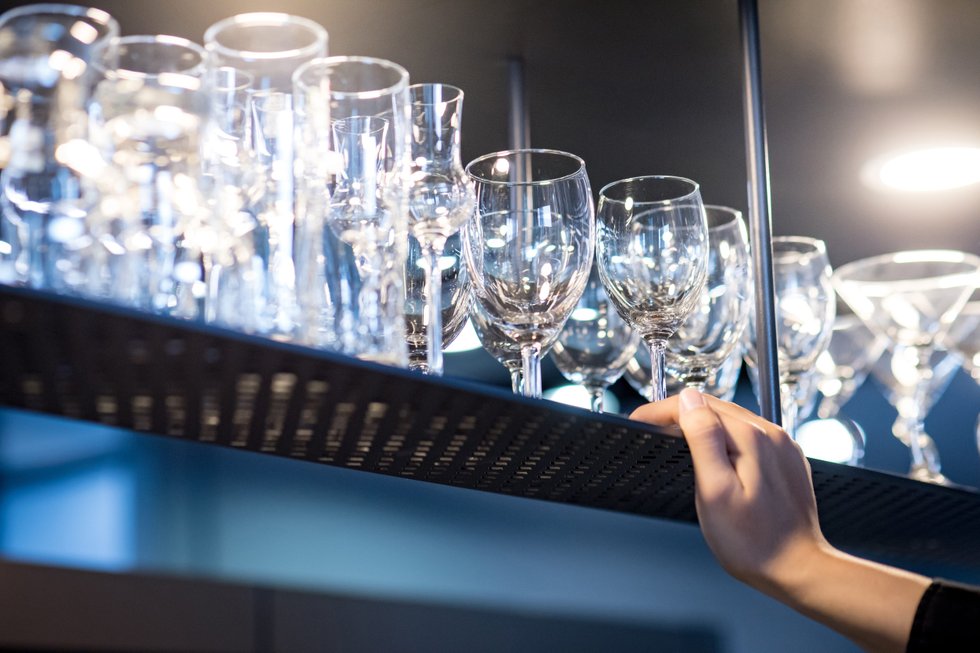
Bar prices always take the liquor cost into consideration, and sometimes the mixers. But Nicholas DeFilippo, bar manager at Salazar in Cincinnati, says there are other things that often play a role in his cocktail prices.
Quality glassware, for example, elevates a bar program. But good glassware is more expensive than cheapie stuff, and it breaks, so he considers that when setting prices.
Similarly, at Salazar they sometimes use a slice of quality local cheese, Luxardo Maraschino Cherries, or Castelvetrano olives for garnishes, all of which cost more than typical bar garnishes.
Finally, don’t forget the ice!
“We recently switched to using a company called Big Ice that makes really nice, clear cubes, and they etch them with our logo,” DeFilippo says. “It’s a nice little touch, but that is a factor in our costing, because it can cost anywhere from 50 cents apiece to $1.50 apiece.”